
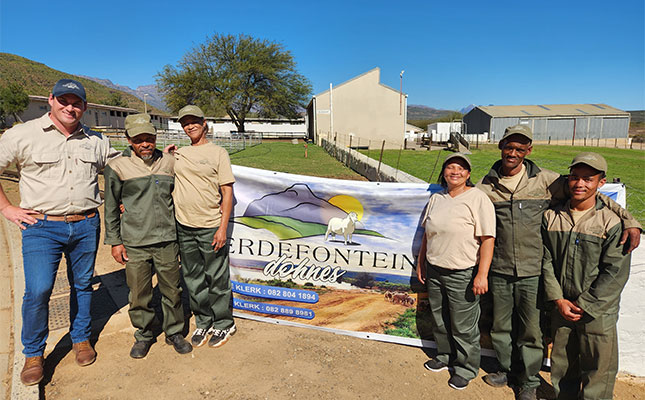
Martin de Klerk runs Perdefontein Dohne Merinos with a focus on hardy, fertile sheep that can produce under difficult conditions. His breeding programme is built around strict selection of the ewe flock, performance data, and a balance between meat and wool.
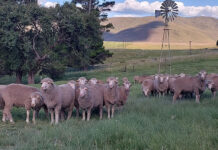
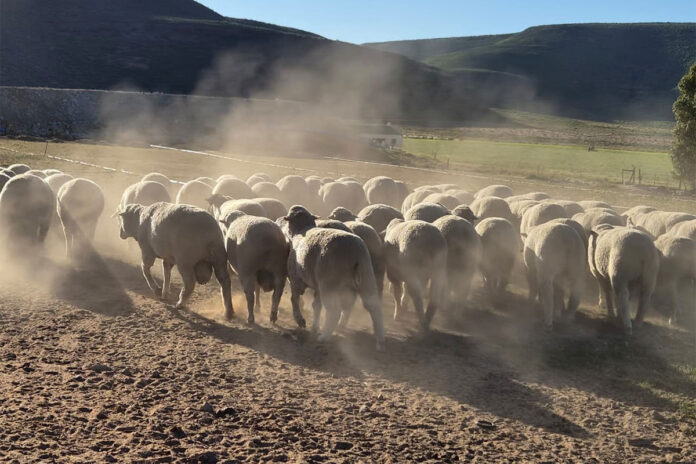
Perdefontein receives between 150mm and 180mm of rain a year, with short winters and long, exceptionally hot summers in which temperatures often exceed 40°C, according to De Klerk. The farm includes dryland lands, fynbos, and Karoo-type shrubveld, as well as irrigated pasture supplied by the Brandewyn River.
Those conditions played an important role in the decision to move towards Dohne Merinos, De Klerk explains. His father initially farmed another meat breed, but adaptation and profitability pushed the family towards a more efficient dual-purpose sheep.
There was also a family connection to wool sheep. De Klerk’s father came from the Karoo, while his grandfather bred Merinos and Angoras. While studying for a BSc in Animal Science at Stellenbosch University, De Klerk was introduced to the Dohne Merino through John Morris of Terra Vino Dohnes.

He later bought several older ewes from Morris, whose stud had already been breeding Dohnes for about 40 years.
What particularly attracted him was the breed’s use of predicted breeding values and BLUP, which offered a way to select deliberately for measurable traits linked to profitability, says De Klerk.
Perdefontein started breeding Dohnes in 2015. The flock grew slowly because the foundation ewes were older and because the De Klerks culled strictly rather than increasing numbers for the sake of growth. De Klerk says the environment reinforced that approach, as animals that could not cope tended to expose their weaknesses quickly.
In De Klerk’s experience, the Dohne has proved hardier than he initially expected, while maintaining fertility and strong maternal ability under difficult conditions.
Build the ewe first
“It is simple for me. It is the ewe and ram that make the most money,” he says.
Perdefontein has maintained about 250 stud ewes for the past two years, a figure De Klerk regards as the ceiling. At that size, the flock is large enough to produce 40 to 50 top sale rams annually without forcing the stud to retain animals simply to build numbers. Holding the flock at this level also allows stricter selection, supported by the BKB Decision Support Services (DSS) system.
For De Klerk, economic efficiency starts with functionality. An animal must be structurally sound, while its wool must suit the production environment and deliver good clean yield in sandy conditions. Functionality alone, however, is not enough: the animal must also justify its place economically.
Selection of replacement ewes starts at about 100 days, with the major selection taking place at around 16 months, once performance-test data are available and there is enough wool to assess, according to De Klerk.
Young ewes are first mated at about 20 months, while the flock is run on a 34-day joining period with about 40 ewes allocated to each ram. Fertility pressure is strict: a ewe that misses gets one chance before being removed from the stud group, says De Klerk.
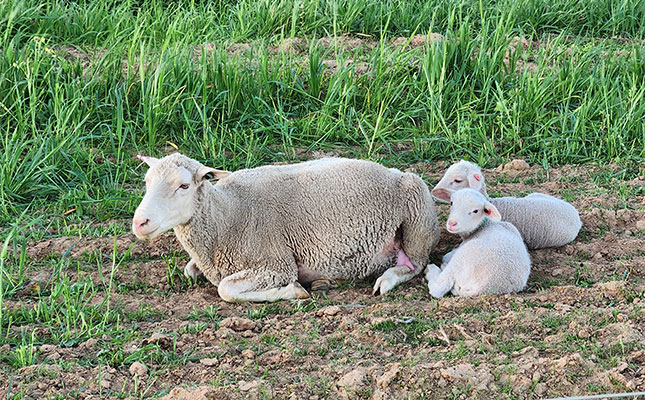
The flock’s lambing percentage ranges between 120% and 140%, according to De Klerk. Annual laparoscopic artificial insemination (AI) lowers conception in the group somewhat, but he accepts that trade-off because it accelerates genetic progress.
Fertility remains the most important profitability trait in his selection system. DSS adds another layer by helping identify ewes that do not wean enough lamb weight, shifting the focus from conception alone to productive output.
The lambing system is designed to accommodate twins and triplets in lambing pens. De Klerk credits the women working in the system with handling multiple births particularly well and does not regard prolific ewes as a disadvantage.
In his experience, ewes that successfully rear multiples are often the animals that remain fertile in a poorer season. At Perdefontein, lambs are weaned strictly at 100 days, with a target weight above 38kg.
Let the veld expose weakness
After weaning, young animals are placed on the veld until the 12-month performance test. The aim is to prevent supplementary feeding from masking genetic weaknesses and to assess sheep under conditions closer to those in which Perdefontein’s commercial clients operate, De Klerk explains.
“We take the animals from the veld for performance testing because our clients and commercial farmers run their sheep on the veld. We need sheep that can perform on the veld,” he says.
Sale rams are only finished after the performance test. The 12-month catalogue figures therefore reflect animals that have not been supplementary-fed during that post-weaning testing period.
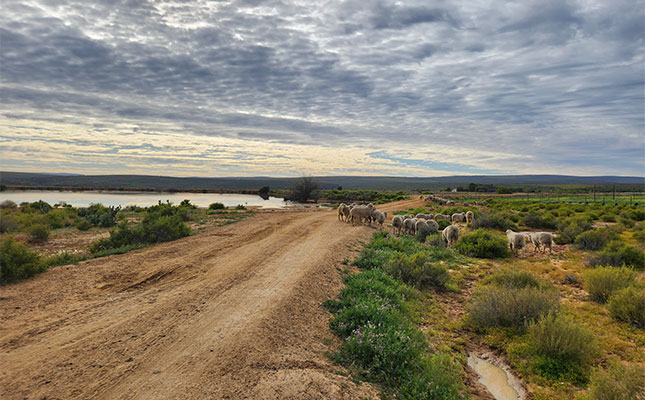
This does not mean nutrition is restricted throughout the production cycle. De Klerk stresses that Perdefontein supports ewes and lambs strongly up to weaning so that young animals can express their genetic potential, with most supplementation concentrated in late pregnancy and especially early lactation.
During late pregnancy and in the lambing pens, Perdefontein uses self-mixed rations containing organic trace minerals. In early lactation, ewes move onto planted pasture with a high-quality lick. Creep feed is also important because young lambs convert feed more efficiently than older animals.
The additional nutrition, De Klerk explains, helps ewes move more quickly from a negative to a positive energy balance after lambing, which influences the next conception cycle.
Health pressure still has to be managed. Midges make bluetongue an occasional challenge, while parasites become more important when the flock is managed more intensively on pasture in late pregnancy and early lactation, according to De Klerk.
Numbers first, then the animal
Breeding values play a central role when Perdefontein buys genetics, but De Klerk does not use them as a substitute for visual appraisal. His selection process begins with the catalogue: he first identifies rams whose figures meet his requirements and only then inspects those animals physically.
The first broad measure De Klerk considers is General Merit (GM), which he uses as a broad selection measure. From there, he moves to individual traits, with fertility carrying the greatest weight, followed by growth.
Visual appraisal remains the final functional filter. A ram may meet the numerical requirements, but it still has to be structurally and functionally acceptable before De Klerk will consider buying it. The objective, De Klerk stresses, is not to maximise one trait at the expense of another.
“We look for good balance where no trait is weak,” he says.
Ram JD21.0486 illustrates that preference. De Klerk says the ram stood out because his figures were strong across the different traits and there was little to fault in his overall balance.
Genetics that must keep proving themselves
Maintaining genetic progress in a relatively small stud requires close attention to inbreeding. Perdefontein retains only its best homebred ram each year and buys new rams annually, while the Logix inbreeding programme is used to help match ewes and sires.
To broaden access to genetics, De Klerk buys in partnership with leading Western Cape Dohne studs. This gives Perdefontein access to fresh semen from top rams for annual laparoscopic AI.
A purchased sire does not keep his place on reputation alone. Its performance is monitored as more progeny information becomes available, and if its updated figures fall below De Klerk’s requirements, it is no longer used. A ram that continues to breed well may remain in the programme for three to four years, while another may be used for only one season.
Balancing meat and wool
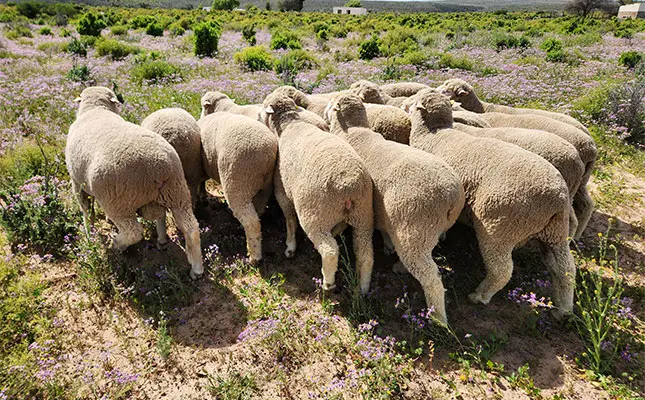
Although meat and growth remain the larger economic priority, wool is receiving particular attention in the current breeding programme. Bodyweight and weaning weight are relatively strong in the flock, De Klerk explains, so the present focus is on improving staple length and clean fleece weight without allowing other traits to deteriorate.
Wool accounts for about 20% to 25% of income in a productive dual-purpose flock, De Klerk estimates, with meat contributing the larger share. The wool therefore has to add value without compromising growth or fertility.
Perdefontein selects for a dense, compact fleece with sufficient wool oil to support clean yield in sandy conditions. De Klerk’s preferred fibre diameter is between 18,5 and 19,.5 microns. Finer wool is not automatically better, in his view, as each trait has a useful range beyond which pushing it further can begin to compromise overall balance.
Strict selection of purchased rams and young replacement ewes is used to prevent gains in growth from gradually weakening wool characteristics, according to De Klerk.
“I could not farm sheep if it was not for the wool income combined with high fertility,” he says.
Commercial value over auction records
Most Perdefontein rams are bought by commercial producers in the surrounding area. For De Klerk, that reinforces the emphasis on veld performance, fertility and functional efficiency.
Although pleased with the prices achieved in 2025, De Klerk felt they were too high. He suspects that too few rams were available for the number of buyers, pushing prices upwards.
Because Perdefontein holds the last production sale on the calendar, he would rather buyers have access to enough suitable rams at prices that still offer value for money. Ultimately, De Klerk wants the sale group to reflect the same breeding objective as the ewe flock: functional sheep with good wool and strong performance figures that can add value under commercial conditions.
The next gain is fertility
Asked which trait he expects to become more important in South African Dohne breeding over the next decade, De Klerk’s answer is immediate: “Definitely fertility,” he says. Fertility is already receiving more attention in the BLUP (a linear mixed model equation) formula, he adds.
Looking further ahead, De Klerk wants to continue breeding alongside his father and further strengthen the female base of Perdefontein. He still sees considerable scope to improve the ewe flock and wants to build a group of females that combines hardiness with consistently high fertility.
His long-term ambition is for Perdefontein Dohnes to become a reliable source of rams that farmers across South Africa can buy with confidence that the genetics will add value to their flocks. “Good rams are the by-product of a good ewe flock,” he says.
For more information, contact Martin De Klerk at: [email protected].