
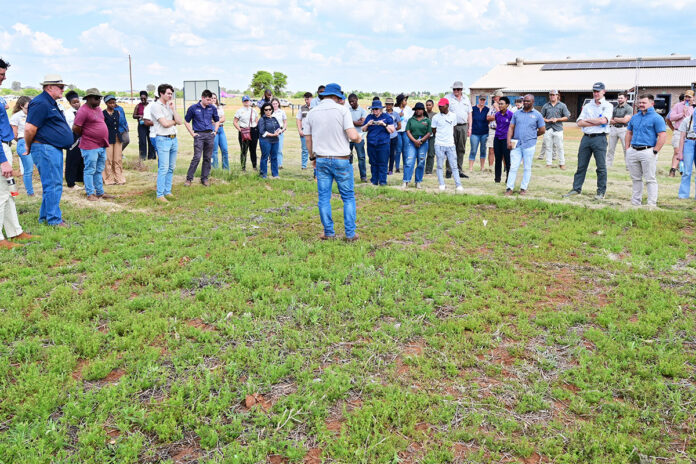
The event drew researchers, farmers, students, and academics from the region, alongside partners of the Conservation Agriculture Research Forum.
Gathering at North-West University’s (NWU) Faculty of Natural and Agricultural Sciences’s Living Laboratory for Sustainable Agriculture, located on the Pienaarskamp research farm, attendees spent two days exchanging evidence-based insights, strengthening industry partnerships, and mapping out practical steps to advance sustainable agriculture in South Africa.
Co-hosted by NWU, ASSET Research, and the Agricultural Research Council, the joint research forum serves as a platform for collaboration and networking. It drives research and development in sustainable farming systems, conservation agriculture (CA), and climate-smart regenerative agriculture (RA) through technical presentations of the latest research results, primarily funded by the Maize Trust, and field-level knowledge-sharing, placing farmers at the centre of the innovation process.
Achieving nutritional balance
The importance of balanced soil and plant nutrition was the focus of an in-depth workshop on the Diagnosis and Recommendation Integrated System (DRiS) method on the forum’s first day.
DRiS is a specialised data-driven approach to analysis that evaluates the chemical components of a plant and its soil environment under varying operational conditions.
“Combined research has revealed that the key to healthy, highly productive soils and crops lies in maintaining a strict balance of nutrients within the soil and plant itself,” Charles le Roux, commercial director of DRiS, explained.
“By successfully applying this principle of nutrient balancing across different soils and crops in diverse geographical production regions, we can empower farmers to optimise and accurately manage their marketable yields.”
Le Roux cautioned that reacting purely to visible crop deficiencies was often an expensive and reactive mistake.
“By the time a plant displays physical symptoms, it may already be too late to implement cost-effective corrective action. We must diagnose the root causes of these symptoms, and the answers are almost always found in the data. Frequently, a problem isn’t caused by a direct lack of nutrients, meaning that simply adding more inputs isn’t the solution,” he said.
Redefining soil health analysis
The DRiS approach has already proven effective in field trials. Dr Hendrik Smith, CA facilitator and programme manager at ASSET Research – a core collaborator on and co-host of the forum – explained how the methodology has reshaped their ongoing field studies.
“Since ASSET Research partnered with DRiS, soil health analysis across all of our research trials has been conducted using this method. We have found its focus on soil chemical balance, rather than isolated nutrient values, to be incredibly compelling,” Smith told Farmer’s Weekly.
During the 2025/26 season, soil samples were collected from a series of eight on-farm trials in South Africa’s eastern and western summer grain production regions, as well as from commercial grain farms across the Mpumalanga Highveld, the eastern and north-western Free State, and North West.
The data generated from these samples and analyses formed the basis of discussions at the forum.
“Discussing these results with a broad spectrum of stakeholders, ranging from producers and agribusiness leaders to academic researchers, was highly refreshing. It pushed everyone to view soil health from a completely new angle,” Smith noted.
Le Roux added that DRiS effectively removed the guesswork from crop production by providing a tool that measures a plant’s precise physiological response to changing management practices.
“Our ongoing collaboration with ASSET Research gives us access to data from an enormous range of soil types and management regimes. To date, we’ve successfully cleaned and processed data from three provinces, 15 distinct areas, and 34 localities, leaving us with a robust dataset of roughly 200 complete composite samples,” he said.
“The clear takeaway is that the industry remains overly focused on treating symptoms rather than addressing the underlying nutritional imbalances and other soil health problems.”
Balancing nutrients for better results
A central theme of Le Roux’s presentation was that optimal crop quality and marketable yields depend more on precise nutrient ratios than on high volumes of fertiliser.
He said many traditional fertilisation programmes targeted excessively high nutrient levels, inadvertently triggering “antagonistic relationships”, in which an overabundance of one nutrient blocked the plant’s ability to absorb others. This imbalance results in a significant portion of expensive chemical inputs going to waste.
According to Le Roux, the DRiS algorithm can quantify these antagonistic effects, allowing farmers to reduce input waste and improve crop quality.
He said that, to make the technology more widely accessible, DRiS had developed a cloud-based platform that allows farmers to upload standard laboratory reports and receive a simplified, broad-format diagnostic mapping out their crop’s limiting factors.
Field-testing future solutions
The first day of the forum concluded with a tour of the ongoing field trials at Pienaarskamp, giving attendees a first-hand look at the CA practices being researched in the field.
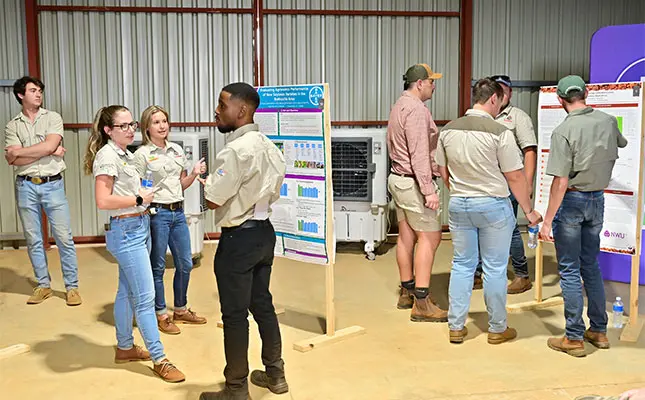
Final-year NWU BSc Agriculture students also presented posters of their research projects, which were adjudicated by senior faculty members. The projects covered agronomy, soil science, entomology, and plant nutrition.
While many of these student studies are conducted at Pienaarskamp, others involve farming operations in key agricultural areas, including Koster, Rysmierbult, and Bothaville.
Much work is being done in the field
The second day of the forum focused on progress in long-term research, including updates on the implementation and performance of the various Maize Trust-funded CA initiatives.
Cobus van Coller, a grain and livestock farmer from Viljoenskroon in the Free State and chairperson of the Conservation Agriculture Research Forum, spoke to Farmer’s Weekly about the collective effort that researchers, agronomists, extension officers, farmers, and input suppliers contribute to the research done in this field.
He said practical, region-specific research was essential to helping farmers improve soil health while keeping their businesses financially sustainable. Van Coller also collaborates with ASSET Research through trials on his farms.
The forum brings together research conducted in recent years through the Maize Trust’s CA projects. One of its key purposes is to report findings to the organisations funding the work and to demonstrate that the research is progressing and serving the interests of South African farmers.
These findings were reported to the forum on day two by various researchers participating in field trials in their own regions.
Although the focus is on CA, researchers also use conventional farming systems as comparisons in the regional on-farm trials. This helps them assess whether soil health and fertility are improving, whether soil organic carbon is increasing, and how production systems affect crop yields and profitability.
Ultimately, the aim is to help farmers keep their businesses sustainable. Van Coller said that while better yields matter, so too does the effect of a system on net farm income and return on investment.
He added that research across different regions was important because soil types and conditions varied considerably.
“The Free State, North West, and the eastern parts of South Africa have different soils, and conditions can vary even within one area such as Viljoenskroon. Practices that work on one farm may not necessarily work on another.”
The practical approach
Van Coller said the research platform was intended to help farmers transition to CA without incurring unnecessary costs or repeating mistakes made by earlier adopters. He began experimenting with these practices in 2006, when there was little support or locally relevant information available to guide him.
He emphasised that CA should not be confused with no-till, which is one possible tool within a farming system, alongside minimum tillage and other forms of soil disturbance where appropriate. CA is a broader approach to improving soil health through practices such as crop rotation, maintaining soil cover with residues or cover crops, and integrating livestock.
“The combination of practices should build soil fertility and reduce risk, while still making financial sense for the farm,” Van Coller added.
He pointed out that some South African farmers have applied elements of CA for decades. In Viljoenskroon, for example, Anthony Evans, Carel Koch, and Rhys Rolfe developed a ripper in 1974 to address compaction in sandy soils with low clay content. The implement was designed to break up compacted soil below the surface, with as little disturbance to the topsoil as possible.
In Van Coller’s view, this is also part of the CA approach. Many farmers already use practices such as loosening compacted layers while limiting soil disturbance, reducing herbicide use where possible, and carefully applying fertiliser. However, fewer farmers apply the full suite of CA practices.
Access to regional data
Internationally, interest in RA is growing, and banks and other financiers are increasingly encouraging sustainable farming practices.
“But implementation matters: a poorly adapted system can also cause problems. Fortunately, the research done across different regions gives farmers access to data relevant to their own soil types and climates, although each farmer must test and determine how best to adapt the practices to their farm,” Van Coller said.
He cautioned against treating no-till as a universal solution, as it might not be suitable for every environment. He explained that farmers need to understand their soils and choose practices that suit their local conditions.
CA is not a quick fix but a long-term process that requires farmers to continually observe, evaluate their practices, and adapt as needed. In this CA research process, researchers work directly with farmers, to develop, assist, and share knowledge, Van Coller added.
Ongoing commitment is needed
The on-farm trials conducted in various areas as part of the Maize Trust’s CA projects are an important element of this process, but they require commitment, time, and money.
Van Coller is conducting a substantial trial on his own farm at his own expense, doing the work himself and spending substantial amounts of his time at the trial site, working with other partners, like ASSET Research.
“Reliable statistics and consistent management are essential if the results are to be trusted. This work also takes time away from other fields and normal planting operations,” he said.
Nevertheless, he added that the trials benefit his own business because he can apply the practices that worked in the trial to the rest of his farm. Over multiple years, he has tested several variables, including crop varieties and cultivation methods to establish what works under his own conditions.
He believes every farmer should conduct on-farm trials, although, from what he observes, relatively few do so.
According to Van Coller, working closely with researchers is mutually beneficial: researchers carry out physical analyses and help explain why crops respond in particular ways, while farmers provide practical implementation, experience, and observations from the field.
He said more farmers need to participate in this work. He went as far as buying a dedicated tractor, planter, and sprayer for his trials so that the research does not disrupt operations in his production fields.
Trials cannot be neglected if the resulting data are to be reliable. Van Coller added that a neighbour’s results can provide a useful guide, but they are not a substitute for testing a practice on one’s own farm. Differences in soil, climate, and farming systems mean each farmer needs to establish whether a method will work in their own operation.
Van Coller said the broader message was that soil degradation had accumulated over many years and must be halted.
“Today’s farmers have a responsibility to protect this essential asset for future generations. Neglected soil is unlikely to deliver good yields or retain its value,” he concluded.