
This was according to Dr Michael Southwood, independent agricultural consultant, who was speaking during a Farmer’s Weekly-hosted panel discussion at Nampo Cape in Bredasdorp on El Niño and managing drought and heat stress.
Southwood said lessons from previous droughts in South Africa, Namibia and Zimbabwe showed the value of being proactive rather than waiting for water stress to become a problem.
“We need to partner with nature, we need to see water as a strategic asset, and when we apply it, we need to apply it slowly and deep into the soil profile,” he said.
Build a reservoir early
For irrigated crops, Southwood said some of the most important water-management decisions were made early in the season.
Good establishment and a uniform stand were important, while sufficiently deep irrigation early on could help build a reservoir of moisture in the soil profile, and create a favourable microclimate in the orchard.
“If you can fill up the soil early, nice and deep, and create that reservoir, it takes you very far into the season,” he said.
Fertiliser applications also needed to be matched to the amount of water available.
“As the soil dries out, fertiliser salts become more concentrated around the roots, making it harder for plants to take up water and increasing the risk of salt stress. So, don’t apply too much fertiliser when water is limited,” he said.
Precision irrigation could help farmers take this even further.
Southwood explained that instead of treating an entire orchard block in the same way, growers were increasingly placing soil-moisture probes according to different soil textures and irrigating these areas accordingly.
This allowed irrigation to be better matched to what the soil could hold and what the trees need.
Start from the roots
Southwood said his approach when dealing with stressed orchard and berry crops was to work “from the bottom up”.
Healthy roots were central to a plant’s ability to take up water and nutrients, which made rootstock and soil condition particularly important. In orchards, this could include choosing rootstocks with good disease resistance to help maintain a healthy and efficient root system for longer.
High-density planting was another option being used in some crops. Southwood explained that smaller trees generally had less vegetative growth to support than large trees and therefore placed less demand on water and nutrients. This allowed growers to direct more of the plant’s resources towards production.
But even the right rootstock or tree architecture could only do so much if soil conditions restricted root development or the soil could not hold water effectively.
Southwood therefore said farmers needed to pay close attention to what was happening below ground, including soil structure, compaction and water-holding capacity.
Choose cover crops for a purpose
Cover crops could help improve soil condition, but Southwood cautioned against simply planting what worked for a neighbour.
“We can’t just do what the neighbour does,” he said.
The choice of cover crop should depend on the problem the farmer was trying to address.
Where soil compaction was a concern, for example, the solution could differ from a situation where the main problem was nematodes or poor water-holding capacity.
Southwood said he was increasingly looking at annual cover crops that could produce biomass relatively quickly, as well as species with deep roots that could improve conditions deeper in the soil profile.
Cover crops did use water and nutrients themselves, particularly while becoming established, but he said their longer-term contribution to the soil also needed to be considered.
Carbon helps hold on to water
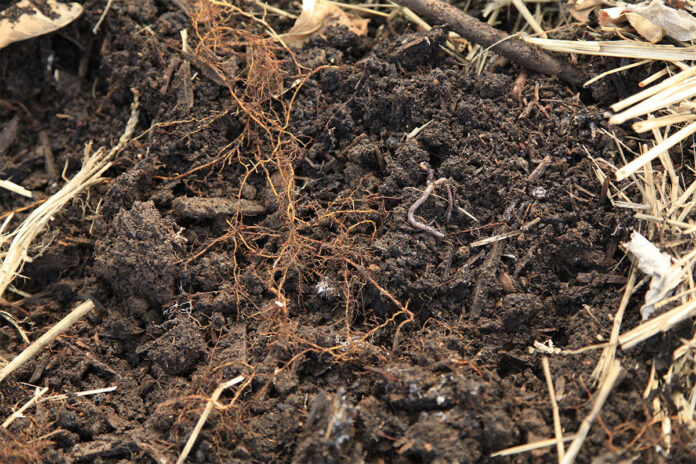
Building soil carbon was another important part of improving water-holding capacity.
Southwood said changes in soil carbon happened slowly, but even relatively small improvements could make a difference to the amount of water stored in the soil.
In the sandy soils he was referring to, he estimated that every 1% increase in soil carbon could hold roughly an additional 5mm to 7,5mm of water over a 30cm soil depth.
He added that an increase of about 0,5% in soil carbon could potentially represent enough additional stored moisture to save the equivalent of an irrigation day during a summer week under those conditions.
“Carbon is the currency,” Southwood said.
He said work conducted in the Western and Southern Cape indicated that a soil-carbon levels above roughly 1,75% could be regarded as a useful target.
However, farmers should not expect to change soil carbon quickly.
Even with regular applications of the best organic amendments, Southwood said it could take at least three years to bring about meaningful changes in the soil.
Know what is happening in your soil
Southwood encouraged farmers to get a better feel for their soils themselves, rather than relying only on laboratory results.
An auger could show where moisture was sitting in the profile, while a penetrometer could help identify compaction. Farmers could also dig soil profiles to see how roots were developing and observe how quickly water moved into the soil.
“Get your hands dirty,” was his advice.
Laboratory testing still played an important role, particularly when it came to soil chemistry and biology, but Southwood stressed that the physical condition of the soil should not be overlooked.
Pre-plant testing could also help farmers identify problems before a crop was established. He referred to the Cornell soil health test as one example that assessed physical, chemical and biological soil properties.
The results could help identify the main constraints in a soil and show which problems needed immediate attention and which could be addressed over the longer term.
Southwood suggested that a general soil-quality assessment could be done about every three years, depending on the crop and production area. Testing for soil-borne diseases or nematodes might need to be done more frequently.
Southwood provides the same soil-health test as Cornell University, and invited people to contact him.
Adapt the crop to the conditions
Farmers could also make changes to the crop or production system when water, salinity or other constraints became more serious.
Southwood gave several examples.
In strawberries, growers struggling with saline or degraded soils could move production into substrate, although this increased production costs.
For lucerne, salt-tolerant cultivars (like BAR ST) offered another option where salinity was becoming a problem, although Southwood noted that these varieties generally had a shorter productive lifespan than conventional varieties, like BAR 7.
Tomato growers could also rethink the plant habitat they grew. Some growers were moving away from tall, indeterminate plants of around 2,5m to shorter, semi-determinate plants of about 1,2m to 1,5m.
The shorter plants produced a more concentrated crop while requiring fewer inputs, particularly water. This allowed growers to remain in tomato production while adapting to reduced water availability.
The point was not that every farmer should make the same changes, but that production choices could be adjusted according to the constraint facing the farm.
For Southwood, drought resilience therefore started with understanding what was happening below the soil.
Farmers needed to know where their water was going, how much their soils could store, whether roots could reach it and what could be changed to make better use of the water available.
The less water there was to work with, the more important those decisions became.
For more information, email Dr Michael Southwood at [email protected].