
In a world where global demands for food are continuously rising and challenges facing the industry are becoming increasingly complex, the need for innovative solutions in the feed and food sectors has never been more pressing.
The Animal Feed Manufacturers’ Association Forum 2026 held at Sun City provided a platform for industry participants to examine challenges affecting feed production while exploring practical solutions for a changing agricultural environment. With animal feed directly connected to the production of meat, milk, and eggs, the discussions held over three days have implications that extend well beyond feed manufacturers.
Feed drives food security
Feed manufacturing is at the centre of South Africa’s food system. “Feed is a critical link between agricultural inputs and the production of animal protein, meaning changes in feed prices, quality, availability, and manufacturing efficiency can influence the wider food chain and specifically food security,” Liesl Breytenbach, executive director of the Animal Feed Manufacturers’ Association, pointed out.
Discussions during the forum focused on:
- Innovation, digital and technology transformation, the application of AI, digitalisation, and advanced technologies in feed manufacturing and livestock production systems.
- Antimicrobial resistance (AMR) and biosecurity: looking at science, compliance, and resilience and how antimicrobial stewardship, regulatory frameworks, and cross-sector responsibility within a One Health context can address biosecurity.
- Sustainability in feed manufacturing: exploring practical models for resource efficiency, environmental stewardship, and long-term cost resilience.
- Grain and oilseed market dynamics, analysing market volatility, procurement risk, and global trade influences affecting feed formulation and pricing.
- Livestock outlook across species, focusing on production trends, disease pressures, and demand shifts and how these are shaping feed requirements.
Fighting AMR through nutrition
Looking at the role animal nutrition can play in reducing reliance on antimicrobials, guest speaker Prof Coen Smits, global sustainability director at Trouw Nutrition, a Nutreco company, and chair of Functional Ingredients for Sustainable Animal Nutrition at Wageningen University & Research, gave a global feed industry perspective that focused specifically on resistance to antibiotics.
He pointed out that microbes are becoming increasingly resistant, and, in addition, are transferring those resistant genes. In addition, he mentioned that resistance to fungi is also an emerging problem in the horticulture industry and that this was indicative of a growing global issue of AMR.
Antimicrobials are medicines used to prevent and treat infections caused by microorganisms in humans, animals, and plants. The use of antimicrobials in agriculture and food production has significantly contributed to improved animal welfare and safer production systems. However, overuse and misuse of these critical tools can have far-reaching consequences, which not only threaten human health but also undermine the long-term viability of our agrifood systems.
Smits explained that an antimicrobial drug works only against one type of organism. Antimicrobials include antibiotics, antifungals, antivirals, and antiparasitics.
“Antimicrobial resistance occurs when the microorganism changes or mutates over time and gets to a point where it no longer responds to medicines previously used to treat it.”
AMR is also causing deaths in humans, and according to Smits, predictions show that the deaths may rise to eight million people by 2050.
“In 2021, there were about 1,14 million deaths directly attributable to bacterial AMR, while 4,71 million deaths were associated with bacterial AMR.”
He noted that AMR is a prevalent risk in farm workers and veterinarians as well as an emerging health risk for the elderly specifically. “Others at risk include young children, patients with compromised immunity and suffering from chronic diseases, and ICU patients, as well as people in low- and mid-income countries.”
The transmission routes to humans are human-to-human at 60%, human-to-food at 19%, and humans-to-companion animals at 8%.
He emphasised that reducing reliance on antibiotics will create a win-win situation. “Reducing reliance on antibiotics will create sustainable value! Investing in biosecurity, vaccines, feed, water safety, functional nutrition, and climate control instead will move the needle and create value.”
Looking at strategies and interventions, Smits stressed that the following strategies should be implemented to address AMR:
- Animal husbandry practices, including farm cleaning and sanitation, looking at stocking density as well as looking after air, feed, and water quality.
- Biosecurity measures to prevent on-farm cross-contamination focusing specifically on the purchase, transportation, and reception of animals, as well as ensuring other farm visitors comply with regulations.
- Training and awareness raising amongst farm workers, visitors, and feed mill operators.
- Farm-level microbiological and epidemiological profiling by keeping good records of incidents.
- Non-antimicrobial approaches for disease prevention and control through vaccination programmes.
- Only use the antimicrobial approach for disease treatment.
- Compliance with good practices in the use of vaccines, antimicrobial alternatives, and antimicrobials through monitoring and record-keeping.
- Tracking effectiveness.
- Regular assessment of on-farm antimicrobial approaches and trends.
Smits stated that nutrition can play an important role in managing and preventing AMR.
Industry calls for stewardship
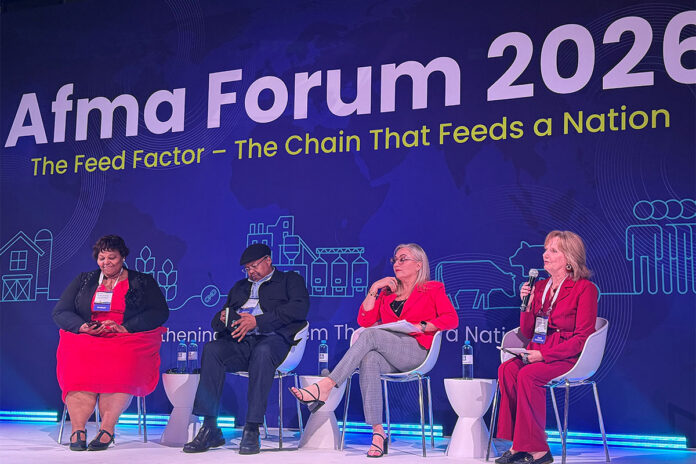
A panel discussion with Margaret Churchill from the South African Animal Health Association (SAAHA), as facilitator, also dissected antimicrobial stewardship in South Africa.
According to Churchill, the escalating threat of antimicrobial resistance (AMR) is one of the most significant challenges the industry is facing today.
“If left unaddressed, AMR could diminish decades of progress in healthcare and agriculture, endangering not only human well-being but also the sustainability of our agriculture production systems. It is an issue for everyone and should be addressed as a collaborative,” Churchill said.
Discussing AMR were Dr Ziyanda Qwalela, president of the South African Veterinary Association; Dr Alice Sigobodhla, deputy director at the South African Health Products Regulatory Authority (SAHPRA); Dr Mphane Molefe, director of veterinary public health at the Department of Agriculture; and Anina Hunter, chairperson of Animal Feed Manufacturers’ Association.
According to Sigobodhla, SAHPRA’s concerns about antimicrobial use include the large concentrations that are being used, the fact that antimicrobials are mixed into water and feed, and that there is little or no veterinary oversight in many instances.
“In addition, we are concerned about the quality of some products, the large-scale use of critically important microbials, under-dosing, and the bypassing of registrations,” Sigobodhla said.
She added that South African livestock producers heavily rely on direct-to-farm over-the-counter purchases of vaccines and other stock remedies to keep costs low. She reiterated the fact that only a veterinarian is allowed to dispense scheduled animal (veterinary) medicines to animals, though a pharmacist may fill the prescription. “We must ensure that these regulations are followed.”
According to Sigobodhla, the way forward is continued discussions amongst role players and strengthening antimicrobial controls.
Qwalela emphasised that prevention AMR should be focused on prolonging the life span of the products that are currently available. “Stewardship should be the focus.”
Molefe stressed that microbial products should not be allowed to be used indiscriminately. “It should only be used when absolutely necessary. Equally important is the way in which these products are transported, stored, dosed, and disposed of.” In addition, he pointed out that registration of products and treatment guidelines should remain priority areas within the industry.
Hunter added that the use should be reduced and controlled.
“You should not be using antimicrobial products for something that you can fix with good nutrition and management practices. We should have a targeted approach and not use these products with a shotgun mentality.”
She added that while keeping food security in mind, the approach should perhaps not focus on eliminating the use of antimicrobials and antibiotics but managing the use and ensuring that there are no traces of residues in food.
“We must make it simple. We should ensure that we drive good practices down into rural communities while we still focus on attaining food security.”
Hunter concluded by stressing a joined approach. “As we embark on our journey to the future, we must remember that the responsibility of curbing AMR does not fall on any one organisation or country alone. It is a collective duty that requires the cooperation of governments, industry stakeholders, researchers, and the public.”