
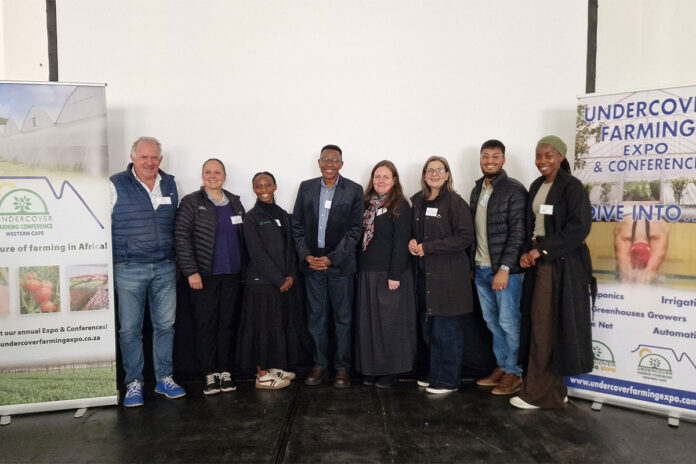
This was the message from speakers at the Western Cape Undercover Farming Conference and Expo, held in Groot Drakenstein on 21 and 22 October.
Speaking to delegates, Tshogofatso Matlala, a water and sustainable agriculture graduate trainee at GreenCape, said undercover farming infrastructure should be treated as a productive investment rather than merely protection against climate and production risks.
“Undercover farming infrastructure should be viewed not merely as a defence and risk-mitigation measure, but as a high-return, bankable capital asset,” she explained.
Matlala estimated that undercover production represented a potential R5,4 billion to R8,6 billion investment opportunity, spanning shade netting and more intensive tunnel infrastructure.
However, the conference also highlighted that infrastructure and automation need to form part of a commercially sound production system, beginning with the genetics planted.
Innovation begins with seed
In her keynote address, Dr Miekie Human, science and policy manager at the South African National Seed Organization, said: “Without seed, there is nothing.”
She argued that plant breeding continues to evolve as producers face climate variability, disease pressure, changing consumer demands, and the need to reduce food losses.
“Plant breeding isn’t something that has stopped changing. It’s always evolving.”
Human added that new tools, including high-throughput phenotyping, molecular markers, and precision breeding, could help breeders select useful traits faster and develop varieties better suited to future production conditions.
“Every meal begins with innovation. Some are centuries old, some are cutting edge,” she said.
Market must come first
While technology could increase control over production, Paul Makube, senior agricultural economist at FNB, warned growers not to invest before securing a viable outlet.
“You don’t go into this environment without knowing where you’re going to sell. You have to know exactly what your market is,” he advised.
Makube added that cash flow in capital-intensive enterprises was particularly vulnerable to fluctuations in prices, production volumes, and operating costs.
“Small price and volume changes can erase cash very quickly,” he said.
Data must guide decisions
Joël van der Schyff, co-founder and CEO of Agrilogiq, an agricultural automation service provider, said environmental control should be based on crop responses rather than temperature measurements alone.
“The most important data point we use on the climate side to steer crops in greenhouses is VPD [vapour pressure deficit],” he said.
VPD considers the relationship between temperature and relative humidity and indicates how readily a crop loses water through transpiration.
Van der Schyff said the commercial challenge was balancing the additional control offered by greenhouse technology against its operational demands.
“The biggest challenge is managing your energy costs versus your output,” he added.
Roots must function
Nerine Koch, an agricultural scientist specialising in plant nutrition and crop protection at Vireo Agri, cautioned that sophisticated fertigation systems could not compensate for damaged or poorly functioning roots.
“The roots mustn’t just be there; they must be fully functional,” she noted.
Koch explained that root-zone acidification could restrict calcium uptake and weaken fruit development, even when sufficient fertiliser had been applied.
Quality losses can start early
Dr Ida Wilson, an independent specialist agricultural consultant in crop systems, said producers should look beyond the visible symptoms when diagnosing postharvest damage.
“The visible postharvest problem could be an expression of a failure earlier in the system, but this failure isn’t always visible,” she said.
She added that planting material, water quality, calcium uptake, flower-stage infection, spray accuracy, harvest maturity, and cooling could all affect the quality of the produce eventually delivered to the market.
“The minute your produce has been harvested, it starts to decline. Don’t diagnose damage in isolation. Look at the entire system,” Wilson warned.
Delegates also visited Cultura Fresh to see how hydroponic lettuce is produced under protective structures, and Stellenbosch University’s HortiDemoCentre, where integrated greenhouse technologies are used for research, training, and commercial-scale trials. The visits demonstrated how some of the conference’s key themes translate into practical production methods.