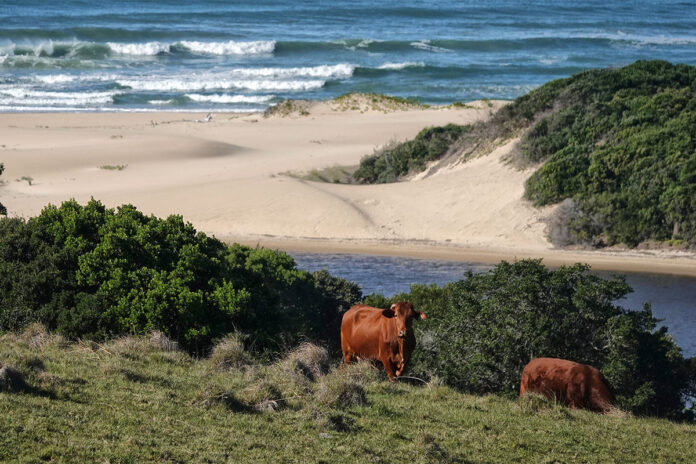
On an Eastern Cape voyage of discovery along the Sunshine Coast between Port Alfred and Kenton-on-Sea, we come across a sleepy hollow of a seaside village called Kasouga.
At an expanse of grass aptly named The Green, we find a half-moon row of beach shacks, a gathering of canoes, and glossy Beefmaster cattle all over the show.
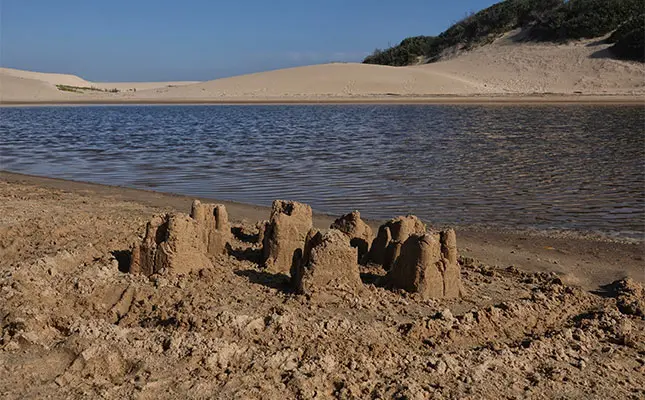
But what really catches our eye, right next to the Kasouga River outflow, is a sandcastle. This is not one of those elaborate works of beach art you find so often these days. No, this is the work of a child wielding a dinkum bucket and spade.
No virtual reality here. No digital screens in sight. This is a skoroskoro of a sandcastle, rough edges to seven turrets arranged in a circle, surrounded by two moats.
And it gives us great pleasure, because it speaks of olden times, Tom Sawyer days, fishing for totties (bream) on the river, teenage bonfires on the beach, someone playing a guitar instead of streaming from Spotify, dune-boarding, and simply strolling on sand.
In Kasouga Sands, a book written by Doris Stirk, Michael Cooke of Shack 32 has this to say: “My family have been holidaying in Kasouga since 1944. Electricity was introduced to the shacks in 1984. For years, some of the traditionalists of the family resisted this innovation – we liked the hiss of Tilley lamps and those temperamental old Colemans.
“We liked the smell of paraffin and meths and all the paraphernalia and the do’s and don’ts of the lighting-up process. And we liked fumbling around in the dark looking for matches when coming back to the shack after an evening’s walk on the beach.”
In this remarkable book of warm memories, we read of how, one New Year’s Eve, “a lone bagpiper stood on a dune at Kasouga Beach and bade a farewell to the old year with the haunting strains of Amazing Grace.”
Across the river from The Green is New Year’s Hill where, on that special night, teenage boys and girls on holiday with their parents at Kasouga would race up to the top. The boy who won got to kiss all the girls who took part. Old school to the max.
Then there are all the names in and around the village: Old Abraham’s Hut, Honeymoon Bush, The Barracks, Mickey Mouse Beach, Spring Cottage, Jordan’s Hole, The Gap, and Old Woman’s Rock. Each has its very own story to tell.
Fishing and Walking
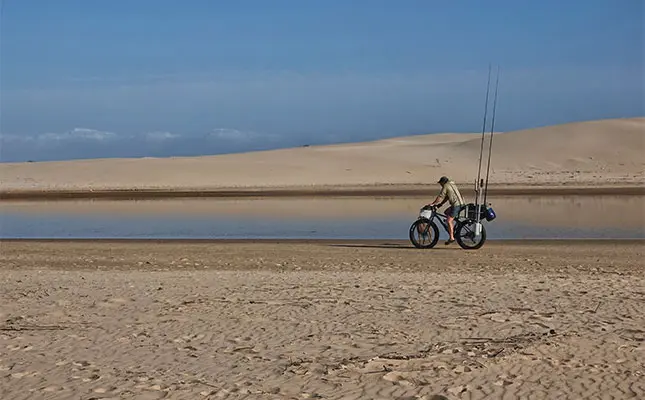
At the beach, we see a lean chap with his rod and tackle cart, returning from a morning of surf fishing.
“One small cob only today,” he says with a wry smile and walks back to the car park. Fishing has always been tops around here, down at the seaside or up along the river.
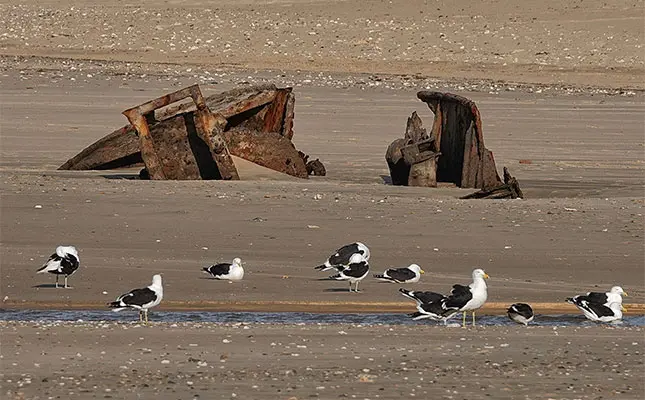
In front of us, between the river mouth and the shore, stands a rusting wreck. This is a section of the Cape St Blaize, a trawler that ran aground near here on 22 June 1965.
The crew of 13 were saved by the efforts of a Port Alfred man, Ronnie Samuels, and a local policeman known as Constable Du Preez. Samuels swam a rope out to the trawler’s dinghy and attached it. Du Preez then hauled the dinghy to shore with his Land Rover.
An attempt was made to salvage the ship by cutting it into two sections and moving them to somewhere they could be worked on. But only the first section was dragged up to its present spot, because the rest of the ship was just too heavy.
Nowadays, depending on the tides, the Kasouga part of the wreck shows its face occasionally.
The Magical Ship Rock
Then three walkers come striding up, and if their stance and pace are anything to judge by, they’re off on a serious hike along the water’s edge.
We follow at a distance for about a kilometre or so, on a slow stroll punctuated by photo stops for clutches of seagulls.
The whitecaps are out today, and the east wind is rising. The tide is coming in, and we see, through an increasingly angry seascape, something that looks very much like a foundering vessel on the rocks, tilting in the direction of the coastline. This is the famous icon of the district, Ship Rock.
We’ve seen side-on land-based images of Ship Rock before, and to us it resembles a jagged boulder, and is not at all ship-shape, so to speak.
But look at it across the boiling seas at high tide, and you totally get the reference.
The Farm
Kasouga was the very first Eastern Cape beach resort, and it has slowly morphed into a settlement of beach houses, big and small. Houses and erfs here are passed down through families, mostly descended from those who came on beach holidays in the mid-1870s, first in oxwagons and horse-drawn spiders, then in early internal-combustion-engine vehicles.
The resort used to be part of Kasouga Farm, then owned by William Dell.
He cut off a section, sold or gave away erfs, and members of Eastern Cape families have been coming here ever since – the Jollys, the Bowkers, the Guests, the Dells, the Longs, the Bagleys, the Wiblins, the Fords, and more.
Kasouga Farm belongs to Walter and Jenny Currie. It’s a 5km-long strip of coastal grassland and dune forest. Grazing on these soft green swathes, interspersed with thickets of milkwood and thorn trees, are Beefmaster cattle and some very rare antelope, like oribi, blue duiker, and bontebok. You could also expect to see impala, bushbuck, and grey duiker.
Their agritourism cottages are called Oribi Haven (Dairy Cottage and Guineafowl Cottage), and they neatly combine the carefree joys of the beach, only minutes away, with a farmstay. You can hear the distant roar of the surf and see the blue of the ocean on the other side of rounded hills.
Walter’s cattle may come and gaze at you solemnly while you braai on your stoep. A shy pair of bushbuck may also pay you a quick visit.
Apart from random appearances in the lanes, bushes, and on the beach of Kasouga Village, you’ll also see cattle posing on the horizons of those rounded hills.
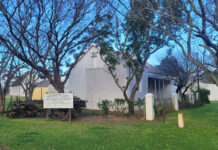
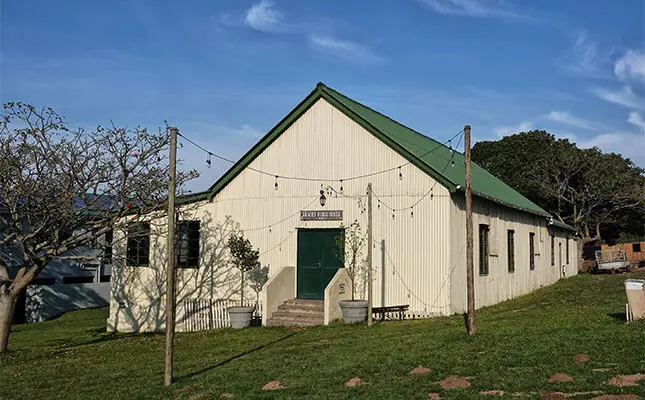
Walter is a descendant of James Ford on his grandmother’s side. Like everyone here, he has vivid and happy memories of carefree childhood holidays at Kasouga Beach. His ancestor Ford donated a plot for a hall, built specially for gatherings, dances, and parties, but stipulated that alcohol should not be served there.
“Of course, that doesn’t stop us youngsters from nipping out to our vehicles and sipping drinks from the car boot,” says Walter.
Life on the Farm
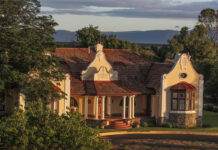
In 1890, James Ford built the farmhouse the Curries now live in. Later on, a dairy was built near the farmhouse. The cream was turned into butter, which was sold in Port Alfred, Bathurst, and Grahamstown.
Jenny still has some of the old butter churns and moulds. The building was turned into the first of the guest cottages, simply called Dairy Cottage.
The other, Guineafowl Cottage, is a little further away, and sleeps five. It was built using blocks from a dismantled crocodile shed.
One of the real attractions is the birdlife, and Jenny has created an interesting water feature at Guineafowl Cottage that attracts plenty of birds, and, occasionally, the very elusive blue duiker.
In the trees around the cottage, we see hornbills, orioles, ravens, flycatchers, and drongos, with a pair of blue cranes flying overhead. At night we hear the fiery-necked nightjar singing “Good Lord deliver us” over the distant roar of the sea.
On the beach we spot black oystercatchers, white-fronted plovers, and one particular cattle egret that seems to be auditioning for the position of seagull, hanging out on driftwood and then darting around the river mouth with the more thuggish gulls.
Why Oribi Haven?
Kasouga Farm is no ordinary cattle and game farm. The Curries and their neighbours have established a conservancy to protect the oribi and other rare antelope like the blue duiker and bontebok.
Oribi occur throughout the grasslands of Africa, but Ourebia ourebi is a South African subspecies and has its stronghold in certain parts of KwaZulu-Natal and the Eastern Cape.
As the late biologist Richard Estes notes in his book The Behavior Guide to African Mammals: “The oribi avoids habitats dominated by woodland or bush.
“It likes open grassland that is not too tall or dense, affording good visibility, but needs some hiding places, therefore it often favours mosaic grassland and ecotones where bush grades into open plains.”
In South Africa, they number somewhere around 2 000, and their numbers are dwindling because of poaching with dogs, agricultural expansion into their habitat, and grassland fragmentation. As a result, they are classified as endangered on the Red Data List.
Estes observes that oribi do well in areas where there are bulk grazers like hippo, buffalo, and zebra, (or in this case, the Beefmaster cattle) that mow down the long grass.
Small Antelope
Out on a drive with Walter and Jenny, we see several small family groups of oribi, distinctive with their rufous coats, white bellies, oval ears, and black tails.
They have quite long, elegant necks, and are more than a little gazelle-like. The males sport shortish, straight black horns.
They are lying in the medium-long grass, apparently enjoying the early summer sun.
One lets out a whistling snort, and they spring to their feet and zig-zag away with black tails raised like flags. Then, inexplicably, they slow to a rocking-horse gait, and turn around to look at us.
This run-and-look habit is the reason why their numbers have dropped so dramatically over the past decades. They are no match for hunting dogs.
The numbers are sobering – 97% of oribi are found on private land, with only 3% in formal nature reserves.
Part of the farm business is game capture and translocation of the oribi and other antelope. There are 140 on the farm, and 166 oribi have been translocated to other suitable habitats.
But Kasouga Farm is also part of the 35 000ha Kowie Kasouga Conservancy, which protects 800 oribi, a very important segment of the nation’s herd.
The blue duiker thrives here, in the thick coastal forests, diving into the bushes at the least disturbance.
Jenny administers the antelope numbers for the conservancy, sending blood samples to Pretoria to ensure the bontebok have not been crossed with blesbok, for example.
Kasouga offers very carefully controlled trophy hunting.
Jenny and Walter take us to the Deck, a delightful place on their farm for sundowners and picnics overlooking Ship Rock.
For more information, email [email protected], call or WhatsApp Jenny on 084 477 1166, or visit oribihaven.co.za.