
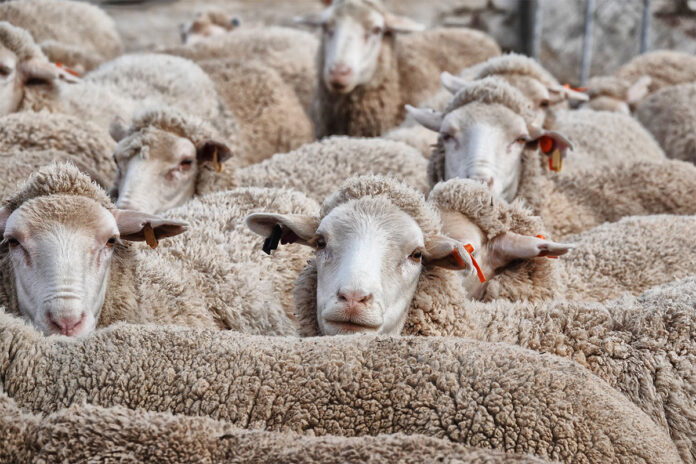
As we arrive at Karoo Secret Guest Farm, there’s a tremor of excitement in the air.
We’re just in time for the shearing, a climax moment in the Karoo. There, in the clip, lies the proof in the length, fineness, and crimp of the wool.
Farmer Chris Hayward is quietly confident about this year. There were good rains, the sheep have done well, and there are lambs all over the place.
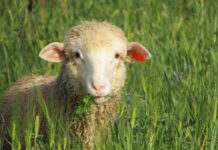
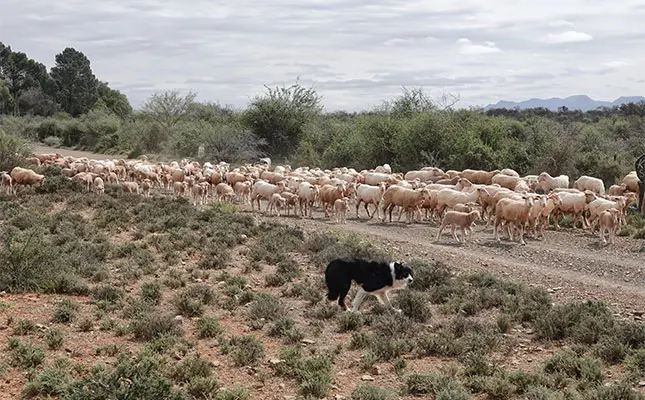
Under Chris’s whistled commands, Lulu the Border Collie is busy herding sheep (Dohne Merinos) into holding pens.
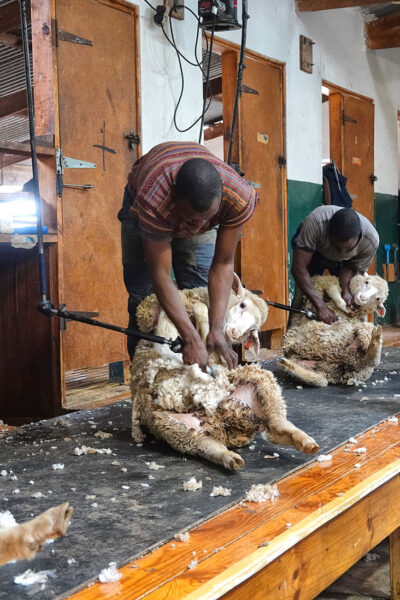
Inside the shed, there is that atmosphere of calm, interspersed with the indignant bawl of a sheep. The shearers, from Middelburg in the Eastern Cape Karoo, work methodically on a kind of platform – almost a stage.
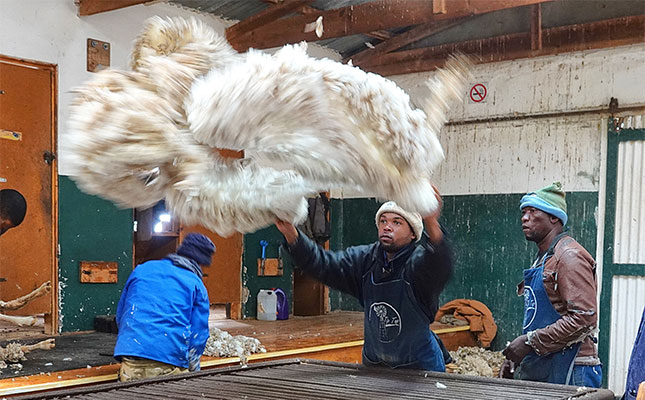
This shed was designed in the late 1980s by a New Zealander called Alan Reid. It minimises repeated bending by having the fleece at waist level.
Inside, clear shafts of light from the intermittent clear roofing illuminate the ‘stage’ like spotlights. It really is a show.
The shears buzz up and down the sheep’s bodies. Apart from the odd grunt and question from the shearers, there is mostly silence and an air of concentration, as they each work through about 300 sheep a day.
Lulu stalks up and down, giving the sheep sharp looks, then wandering through the shed, sniffing at wool scraps.
As each sheep is released and led to another chute that leads down, a man collects the fleece and spreads it dramatically, like a cape, on the slatted classing table, dark with years of accumulated lanolin.
Chris walks up and down, checking the quality of the wool and how the shearers are handling the sheep.
A group of other workers, mostly women, process the fleece, breaking off the various sections and putting them in the relevant areas in the shed.
The wool feels voluptuously soft and silky. Every now and then, one man heads off to sharpen the shear blades on an angle grinder until they glow red and sparks fly.
Shearing happens over several days of concentrated effort. It’s the ultimate farm spectator sport.
Early in the morning, the staff are out rounding up sheep and bringing them through to the shed. This year, the rains have been good, and the veld is looking healthy. It’s basically rush hour on the farm, and the dogs (Lulu, Bond and Nala) are wild with excitement.
The vervet monkeys take advantage of all the distraction to drop down from the pepper trees, purloining handfuls of mealie pips from the goats’ buckets.
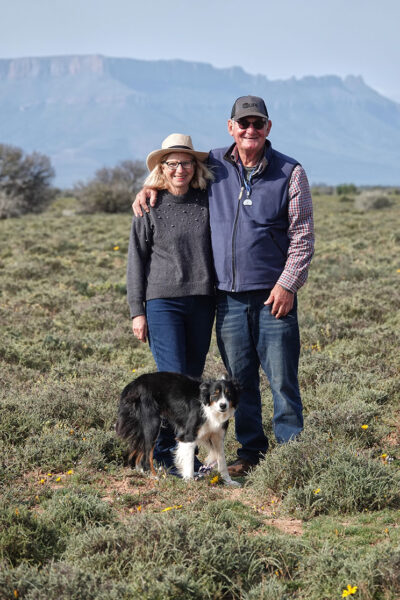
Chris looks after the sheep, and his wife Margot farms the goats and a herd of Bonsmara cattle. They are grazing at the foot of a mountain, far in the distance. The goats live closer to home.
The farm set-up
The original name for Karoo Secret is Rooidraai Farm. It lies within the bounds of a true Karoo triangle between Graaff-Reinet, Beaufort West and the little village of Rietbron. The closest town is Aberdeen (Xamdeboo).
Farming in this area south of the famed Camdeboo and Onder Sneeuberg Mountains has never been an easy matter.
During the vicious drought of 2014 to 2020, Karoo Secret Farm struggled along with every other farm in the district.
But Margot and Chris come from tough Eastern Cape farming stock. When Margot saw the workers’ shoulders droop from drought depression, she gathered them together with their families and announced: “Every day, I want you to go out and find something special.
Then you come back and tell us about it. It can be anything: a stone, a plant, a kudu, a steenbokkie sighting, a new calf, or even a funny story you heard.”
The Haywards reserved their savings to keep staff and livestock going. There were no luxuries on the shopping list. So, when a gift box (Boks vir ’n Boervrou) arrived from somebody living on the other side of South Africa, it touched them deeply.
“A perfect stranger had packed a box full of little snacks and cosmetics, a magazine and a hand-written Bible verse,” says Margot. “It was truly comforting to know we were not forgotten.”
Karoo secret house
At the height of the drought and desperation, Margot decided to restore an old manager’s dwelling for possible travellers who might want to stay on a Karoo farm. Built in the 1950s, this roomy house had stood empty for decades.
“We found out that a neighbour had a visiting team of builders on their farm, and that they would be busy for two weeks,” says Margot.
“So we just booked them. Chris and I had two weeks to plan the restoration. They arrived, got cracking and we would spend every lunchtime there, measuring and working on ideas.”
Chris found it therapeutic.
“From day one, there was something about this house. I found real peace here. We decided to call our agri-tourism business Karoo Secret, and this is Secret House. It was perfect. Everyone knows Rooidraai as Karoo Secret now.”
The house is decorated with real love and care. Trunks and suitcases are part of the decor, a nod to years of boarding schools for Chris, Margot and their children. Two old yokes from Margot’s family farm near Grahamstown have been turned into light fittings.
Margot and Chris have ensconced us in Secret House, and while Julienne is admiring the book selection, the boxes of old-fashioned but family-beloved puzzles, the mohair blankets on the beds, the gas stove, and the solar set-up, I grab a cold beer, settle on the stoep, and gaze admiringly at the coral aloes in front of the house.
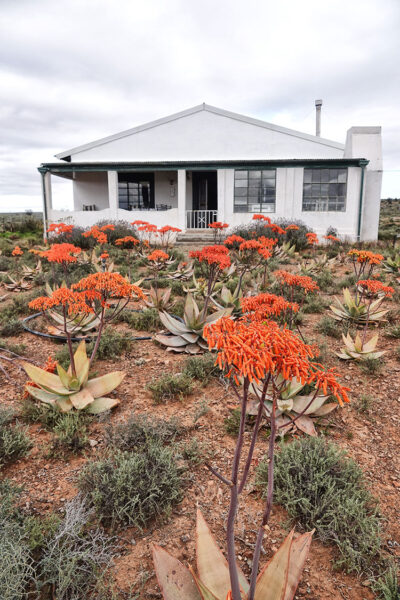
I see there’s a built-in braai on the semi-enclosed stoep, so any sudden windstorm would not disturb the four Karoo lamb chops and their boerewors necklace that will soon be sizzling away.
I think I’ll have another beer. No, wait, here come the stockmen with a large flock of shorn sheep, guided down the road by the ever-vigilant Lulu. Get a shot of them passing.
Margot tells us later that, although her husband Chris fully supported her plans, there were other family members who initially thought she was crazy for trying to restore Secret House during such tough times.
But her instincts were correct. A tourist doesn’t come to the Karoo for a verdant veld experience. Sunrises and sunsets on a Karoo farm are just as beautiful in times of plenty as in times of hardship.
And, most important of all, running a guest farm means opening another essential source of revenue. It fattens the fiscus, as they say.
A little birdie told me
Good fortune sometimes sneaks up on a person. Margot’s stroke of marketing luck appeared shortly after the restoration, in the form of a Beaufort West guide by the name of Japie Claassen.
“Japie told me he had spotted a Sclater’s lark on our farm, and when that information got out, the bird enthusiasts arrived in a steady stream from all around the world.”
A Sclater’s lark is a card-carrying member of a bird group known as LBJs (little brown jobs). There are 29 species of larks in South Africa, each one more cryptic and more difficult to identify than the last.
This one prefers a small patch of Karoo on “stony quartzite plains and ridges in arid shrublands”, according to our bird book, Sasol’s Birds of Southern Africa.
Although elusive and limited in range, it seems the Sclater’s lark is a little easier to distinguish from the others, since it has a dark brown, teardrop-shaped mark below the eye.
“Since Sclater’s lark was sighted at Karoo Secret, it has been such a blessing to share this rare bird with so many passionate birders. If this stoep could only talk of all the sightings,” says Margot.
Karoo Secret has been designated a BirdLife SA ‘Recommended Accommodation’.
Thanks to birders, Margot was able to renovate another building – the old farm school.
It is now Lark Cottage, with two separate (but adjoining) self-catering cottages, each sleeping two guests.
Then came COVID
Farming in the Karoo is also affected by world events.
In 2020, when the COVID-19 virus spread around the globe and into South Africa, the local hospitality industry went into deep freeze mode.
“I used that time to set up routes on the farm,” says Margot.
“Those routes were initially meant for biking, but they were soon adapted for birding and hiking in the veld.”
Guests looking for an escape from civilisation for a week or two began to book with Karoo Secret.
As I’m sipping away on a fresh beer, I scan the cottage visitors’ book, especially the 2020 entries.
- 9 January: “We will definitely be back for the stars, the quiet, the sunset and the tortoises! Thank you for the hospitality and the delicious rusks.”
- 22 December: “The Karoo has refreshed and revived us in a deep way. Most of all, coming to Karoo Secret has been a highlight and a total soul-cleanser for us.”
- 27 December: “This is a phenomenal spot – thank you for sharing it. Peace and quiet can be found here. The lamb chops and roosterkoek on the stoep were by far our favourite.”
Additional good news for the Haywards came late in 2020, when the long drought broke and the veld soon began to respond.
The mighty nananthus
Part of the history of Rooidraai (Karoo Secret) Farm lies in an unlikely true story about uranium and a plant.
Back in 2017, an Australian company was poised to move into the central Karoo and start creating open-cast uranium mines.
They seemed to have everything on their side. Jacob Zuma was still in power, and the Russians looked set to create a chain of nuclear reactors right across South Africa and the rest of the continent.
The uranium price was also looking encouraging.
A team was sent to do and present an environmental impact assessment. In the report, plant life was dealt with in a cursory fashion – a big mistake for an arid area as biodiverse as the Karoo.
Only a few farmers grasped the true horror of what this might mean – radioactive dust flying far and wide in the scouring winds, coating everything. What business can survive radioactive dust?
Three things then happened: First, respected German geohydrologist Dr Stefan Cramer began an unrelenting awareness campaign among Karoo communities, on farms and in the towns.
Second, Margot contributed to the anti-uranium movement by starting a WhatsApp group that eventually grew to 160 interested individuals: farmers, scientists, Karoo lovers and even people who had never been to the Karoo but were appalled by the news of possible uranium mining there.
Third, their neighbouring farmer, Philip McNaughton, found a tiny succulent belonging to the Nananthus family.
It has very specific conditions in which it thrives: soils with a very high clay content that crack when dry, and small reddish stones dotted here and there. If the rains dry up, the plant disappears.
It sinks underground entirely. Then, when rains come again, it pops up, flowers, gets pollinated, and then has a look at the prospects.
It may stay on the surface or just sink away into invisibility again. It is an ephemeral plant living on a plain with ephemeral water.
The mining company and the evironmental impact assessment team conceded they had no knowledge of this plant. Its discovery and the media attention that followed, combined with threatened court challenges and the need for further specialist botanical study, contributed to prolonged delays in the proposed mining operation.
Karoo Secret and all its neighbours were therefore spared a radioactive future.
For more information, phone Margot Hayward on 082 819 4232, or visit karoosecret.co.za.