
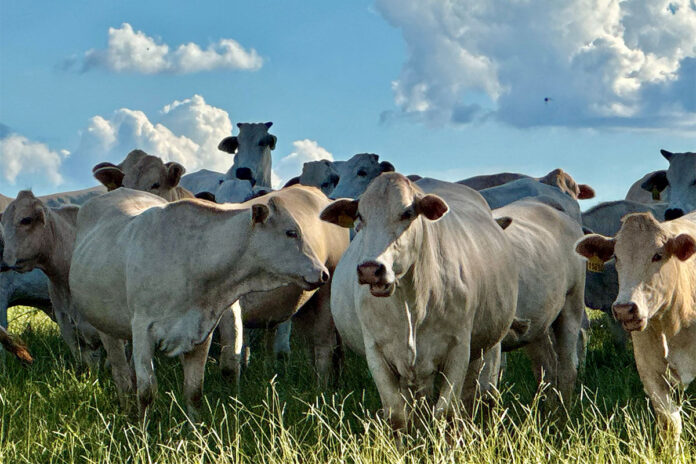
It is estimated that 40 million hectares of 110 million hectares of cultivated pastureland in Brazil are in some other state of degradation. This means that about 35% of the area that was used to keep cattle and other livestock can no longer carry these animals, mainly due to overgrazing. Looking at the total area, 20% of the country’s 180 million hectares dedicated to natural and planted pasture suffers severe degradation, and another 40% suffers moderate degradation.
There are two options to address the issue. Either new areas must be cleared to feed the growing population of cattle and cater to the production of grain, or those degraded areas should be reclaimed, improved, and put back into production.
The Brazilian government chose the latter. Over the past couple of years, some 1,2 million hectares have been reclaimed through the dedicated efforts of the government and farmers.
During the mid-term executive meeting of the International Federation of Agricultural Journalists, journalists visited research plots of the State Research Institute of the Brazilian Agricultural Research Corporation (Embrapa), where some of the proposed and current methods used to improve fields for the purpose of reclaiming their use are tested.
According to Gustavo Spadotti, head of Embrapa Territorial, the government wants to increase productivity with measures such as soil improvement in order to plant crops such as soya beans, maize, or wheat on some of the areas previously used for pastures.
They are also looking at intercropping and agroforestry where cattle graze in the shade of eucalyptus or other trees planted for forestry. This will eliminate the need to clear additional natural vegetation for crop production or grazing.

Embrapa Southeast Livestock
Embrapa Southeast Livestock is one of the units of the research corporation. This institute has 24 laboratories and incorporates concepts of precision livestock farming and animal welfare with a focus on the sustainability of the livestock industry in the country.
Recently, the research centre assumed leadership of the Space Farming Network, working with spatial plotting of productive as well as unproductive pastures. In the studies, Embrapa Southeast Livestock looks at mitigating greenhouse gas emissions in agricultural and livestock production, sustainable water use, and adaptation of production systems to extreme climate conditions, as well as promoting low-carbon systems such as crop-livestock-forestry integration.
According to Emerson Borghi, researcher in agricultural systems at Embrapa Southeastern Livestock, they are following these steps to reclaim the land.
- Identify the degraded areas;
- Start with the reclaiming of the area by planting forage crops;
- Include legume plants such as pigeon pea that can be utilised by the cattle, but which can also fixate nitrogen in the soil;
- Continuous monitoring.
One of the challenges in the entire process, according to Borghi, is that they have to deal with different levels of farmers such as communal farmers, smallholder farmers and large commercial cattle farmers.
Dr Alberto C de Campos Bernardi, a researcher at Embrapa says this integrated grazing system with an automated gate helps with the management of pastures.
“We have a diverse range of plants, some with deep root systems and others such as legumes that fix nitrogen in the soil. This combination depends on the area, climate, and type of soil. We found that we are able to increase carbon sequestration as well as the organic material in the top layers of the soil. This is good news because, if we can increase areas where we follow this concept, we might be able to reclaim more of the degraded pastures,” he explains.
He adds that planting a more diverse group of plants also helps with the dispersion of rainwater.
“Stable soils means that we can have a more stable count of organism in the soil – all contributing to a more sustainable agricultural system.”
A study developed in partnership between Embrapa Southeast Livestock, the School of Veterinary Medicine and Animal Science of the University of São Paulo and the Center of Nuclear Energy in Agriculture of the University of São Paulo in Piracicaba, São Paulo, assessed the performance and emission of enteric methane resulting from the digestive process of Nellore steers in three different production systems, including intercropping with BRS Mandarim pigeon peas.
The experiment was carried out from July 2020 to July 2021 at Canchim Farm, the headquarters of Embrapa Southeast Livestock’s research centre. The 27 animals that were used, aged 15 to 16 months, were weighed monthly, and the methane was measured through the sulphur hexafluoride (SF6) tracer gas technique for five consecutive days in the rain and drought seasons.
They found that productivity was higher in the intercropped treatment with pigeon peas. The animals gained 478g/day, while in the control comprising degraded pasture areas, the average weight gain was of 302g/day.
“Any technology that reduces methane, at low cost, and that contributes to the efficiency of the production system and to sustainability is desirable and should be implemented,” Bernardi points out.
“In the past, cattle ranching was seen as one of the major destroyers of the Amazon rainforest, but the work we do means that cattle could become a national carbon sink, reabsorbing CO2 from the air. Currently, most pastures lose carbon as soils degrade, but a well-managed pasture can accumulate carbon. In fact, our research shows it can accumulate so much that it more than cancels out the warming effect of methane and other emissions from cattle production,” says Bernardi.
Role of cattle in Brazil’s agriculture
Speaking at an information session in Sao Paulo, Luís Rua from the Brazilian Ministry of Agriculture said that European society had become “too protective.” He added that the EU is a very important market for Brazil. From the US $170 billion (about R2,8 trillion) income derived from meat exports from Brazil, some US $25 billion (R40 billion) were exported to the EU. Just China buys more products than the EU, so although the EU is a key partner for Brazil, it is not the most important.”
He added that for the past 40 years, Brazil has been supplying products to the EU, fulfilling all requirements and meeting all of the demands, sometimes even with higher standards.
“So when I see some people complaining, I think they are being protective.”
Ricardo Santin, the president of the Brazilian Association of Animal Protein said Brazilian agricultural producers are capable of increasing production to meet demand despite the fact that they are already dominating markets.
“We still have room for growth, because there is a demand in the world.”
Market pressures have led beef cattle farming in recent decades to adopt technologies to improve and intensify land use, with good results.
“The Zebu breed, Nelore, forms the base of the cattle industry in Brazil, but there is extensive crossbreeding with artificial insemination and in vitro fertilisation within the national herd of 238 million head, which is the world’s largest supplier of this type of meat,” Santin pointed out.