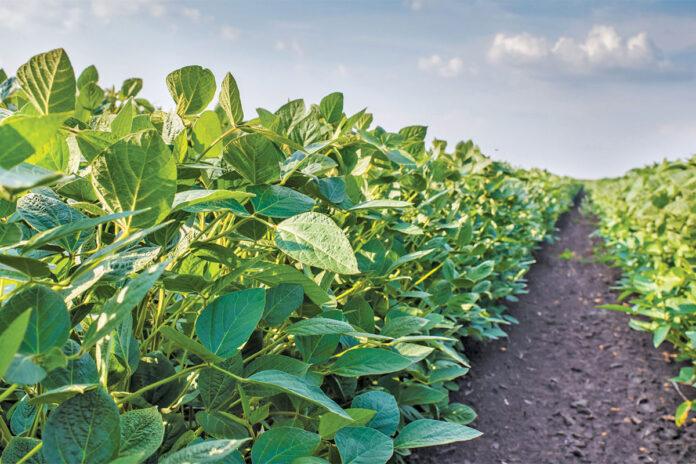
Sclerotinia white mold has a wide range of host crops: canola, soya beans, sunflowers, beans, cabbage, lettuces, chicory, carrots, and so on.
Each attack is an opportunity for the disease to rebuild a stock of sclerotia in infected crop residues and to replenish the soil with inoculum.
Understanding the Sclerotinia Life Cycle
Sclerotinia originates from the soil, where its survival structures (sclerotia)can remain viable for more than 10 years. When conditions become favourable (mean average temperature of 20°C and cumulative wetness period of 48 hours), these sclerotia will start their germination cycle:
- Sclerotia germination: produce mycelium, attacking roots at the collar;
- Apothecia formation: airborne ascospores are released and settle on petals;
- Plant infection: the ascospores germinate under ideal conditions (cool and wet). The fungus will penetrate leaves and stems if petals remain in contact long enough with saturated humidity or wetness.
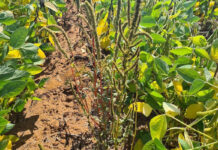
Mycelia then spread along leaves and form a white collar on stems, causing water and nutrient disruption. - Fresh sclerotia formation: Sclerotinia appears as a white rot that starts at a flowering node. It spreads along the stem, and the upper part of the plant eventually dries out. At the end of the cycle, black masses (sclerotia) form inside and on the stems and pods.
Sclerotinia stem rot can cause major yield losses in soya bean, depending on infection severity and environmental conditions.
A single contaminated soya bean plant with seven sclerotia per square metre (2% infection) can generate 70 000 sclerotia per hectare. This is more than enough to generate new infections, given that a single sclerotia can remain viable for up to 10 years and produce numerous trumpet-shaped mushrooms (apothecia) every year, each of which can release up to 200 million ascospores.
As the natural mortality rate of sclerotia is very low, the potential for contamination of subsequent crops in the rotation is particularly high.

Preventative method of control
The control measures to be implemented against sclerotinia are based on two pillars: genetic control combined with good agronomic practices (sowing date, plant density, adjusted nitrogen fertilisation, limiting irrigation at flowering).
These practices, combined with the use of foliar fungicides, reduce the risk of contamination, but in no way eradicate the origin of the infection: the resting forms of the disease in the soil (sclerotia).
Destroying sclerotia in the soil
LALSTOP Contans WG is a biofungicide based on a parasitic fungus (Coniothyrium minitans) strain CON/M/91-08, which is the only effective solution for destroying Sclerotinia sclerotia within six to 12 weeks and limiting attacks on future susceptible crops.
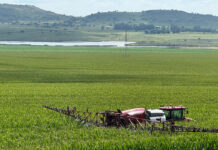
The crushing of stubble breaks up the stems (where the sclerotia form) and releases many sclerotia onto the soil surface. The application of LALSTOP Contans WG as a spray to crop residues prior to harvest residue crushing brings the beneficial fungus into direct contact with the newly produced sclerotia on the crop residues.
The recommended dose on crop residues is 2kg/ha (1×1 012 spores/ ha) with a minimum water volume of 200 litres. In case of dry conditions, a deeper incorporation at 4kg/ ha is recommended.
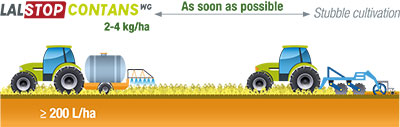
Application just before stubble discing enables Coniothyrium minitans to be incorporated quickly into the top 5cm and protect it from external conditions (radiation and heat).
Incorporation with irrigation or rainfall is also possible (15mm of water is ideal).
More about LALSTOP Contans
LALSTOP Contans WG, previously known under the brand name Contans WG, is a biofungicide made by the company LALLEMAND, and it can be used in organic farming. It provides effective control of resting forms (sclerotia) of the fungi Sclerotinia sclerotiorum and Sclerotinia minor on susceptible crops.
Who is Lallemand?
Experts in the production of yeasts and bacteria since the early 20th century, the Lallemand group decided in 2006 to put its knowledge and technological strengths in microbiology and fermentation at the service of the agricultural world.
This was the birth of the Lallemand Plant Care business unit, which has since grown steadily through the acquisition of companies specialising in plant bioprotection and biofertilisation. Today, Lallemand Plant Care is one of the market leaders, developing and marketing the best strains of microorganisms.
For more information, email Lallemand at [email protected].