
There was once a pesky, but beloved, ostrich called Kok Hen, who lived and roamed on Wheatlands Farm south of Graaff- Reinet, in the Karoo Heartland.
She would steal the mealies meant for the geese, trample the farmstead flower beds, and occasionally disappear into the veld for weeks at a time on a romantic assignation.
Kok Hen would then reappear with a bedraggled boyfriend and a bunch of chicks, which she would soon abandon in favour of various outrageous farmyard antics.
However, she was most infamous for her inappropriate behaviour on the Wheatlands tennis courts.
Back in the old days, one would leave tennis balls to warm up in the Aga stove, so they bounced better. Worn ones were even painstakingly stitched up. This was something we had never heard of.

During one specific tournament, someone over-enthusiastically klapped (hit) a ball out of the courts and into the veld, where Kok Hen pounced and performed the inevitable: she swallowed it in one greedy gulp.
One of the players caught Kok Hen by her neck, while another pulled her down to the ground and began to massage the ball from her gullet.
The slimy tennis ball was finally retrieved, and the game continued.
Farmers have always taken their tennis very seriously out here in the Karoo.
And new tennis balls don’t grow on trees, as they say. We first read about the Kok Hen legend back in 2015, on our maiden visit to Wheatlands.
That was where we were ensconced in the Big House and poring through Wheatlands: The Story of a Family and a Farm, by Margery Parkes.
High Style in the Veld
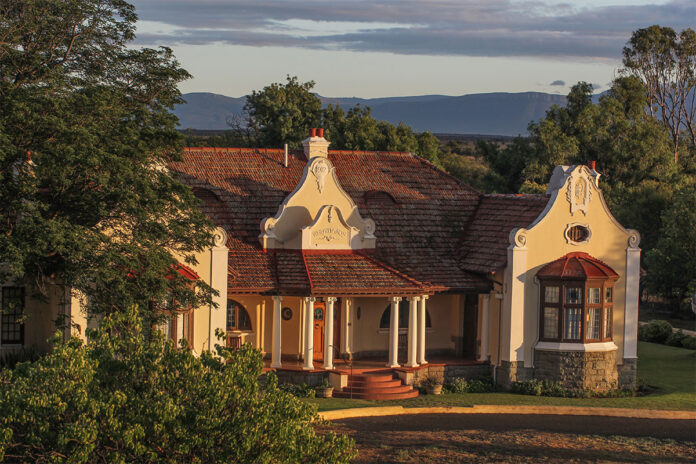
The Big House, with its six bedrooms, nooks, and stoeps, is a large mansion, like something noble and British that has been dropped from the sky onto a patch of Karoo. With wide-angle horizons and well-watered veld all around, it is one of three multi-generational dwellings on the Wheatlands homestead.
With its various sheds and family homes, the estate has the look of a small village. Down the road is the Wheatlands Sports Club (the home of the 134-year-old Harefield Cricket Club), which comes complete with a cricket pitch, tennis courts, and a large pool in the familiar shape of a farm dam.
The nearby Manor House, with its famous Widow’s Walk, is where retired owners, Arthur and Diana Short, used to live permanently before they moved to Graaff-Reinet. Next door to the Manor House is the original Wheatlands home, Garden House. That’s where current owners, their son David and his wife Kirsten, live.
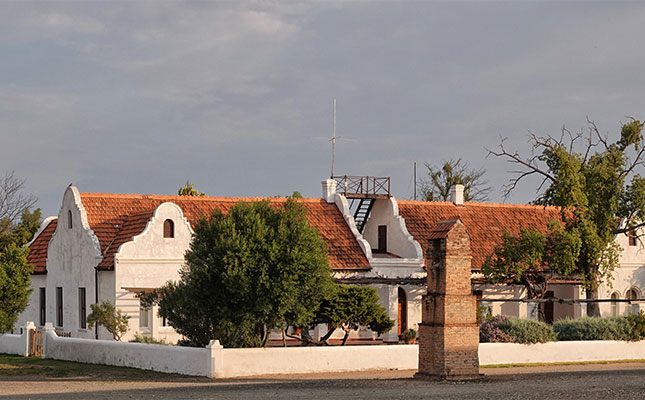
The Big House is perfect for family get-togethers, and here one specifically thinks of clans that are spread out across South Africa and beyond. A week in such sumptuous surroundings, with the added benefit of pure Karoo outside, is good for the body and the soul.
Plus, it keeps the offspring busy doing typical outdoor farm things like watching the stockmen working with the Angora goat flocks, walking in the veld, playing old-time board games on a stoep, and riding their mountain bikes all over the place. A wondrous digital detox, because life is analogue out at Wheatlands.
The Back Story
The Karoo has some swanky old farms, and Wheatlands is one of them. It has a long and fascinating history, has been owned by one family since 1849, and the buildings on it are architectural masterpieces. Wheatlands farmers were known for their skill and generosity; so too were their wives.
Not many people associate wheat with the Karoo, but when Dutch-descendant farmers arrived in the Karoo, some of them tried out wheat, and during the good years, their crops did well.
The Fouche family was one of them. They are thought to have settled here in the late 1700s. Thomas Parkes, freshly arrived from Argentina in 1843, hunted high and low for a good Karoo farm. When he went off searching, he left his wife Emma, his four sons, and his daughter at a hotel he rented or bought in Uitenhage.
This was apparently an absolute nightmare for Emma. She was a Quaker and was now plunged into making money by selling liquor. Nevertheless, her husband Thomas succeeded in finding good land – Wheatlands.
A Brandy Farm
The farm holds a few vital trump cards: there is limestone in the soil and a permanent spring on the property. It segued from being a wheat farm to being a brandy farm, because hanepoot grapes flourished here.
The Parkes family set about wool sheep farming and then began making champion brandy. One shudders to think what Emma
must have thought of this lot.
Back to the books, and this time Joan Southey of Footprints in the Karoo fame, tells us: “By the 1880s Parkes Brandy was being exported all over the Cape Colony, and in 1885 a trademark was registered with a distinctive label which included John Parkes’ signature. The superior quality of the brandy was such that even the Colonial Secretary considered it one of the foremost brandies in the Cape.”
If you farmed on the Plains of Camdeboo during the Anglo-Boer War, you were often expected to feed passing combatants.
Arthur Tucker Parkes, laird of Wheatlands Farm about 50km south of Graaff-Reinet, was a British sympathiser.
So, when a Boer kommando pitched up in a cloud of dust one day, Parkes thought he’d immobilise them with lots of booze. And then he would possibly alert the British Coldstreamers over in Graaff-Reinet to haul them away.
Arthur opened the doors of his vast brandy cellar and invited the Boers in for a free tasting.
By now, however, the Boers had learnt a thing or two about the dangers of mixing war and alcohol. Up north near Val Station, they had derailed a British train loaded with fine whisky for the officers and had ended up in a sorry, shameful state.
So, at Wheatlands, their commandant made sure each man only had a tot of brandy before hustling them away.
Another time, the Boers made off with all of Lily Parkes’ freshly bottled jam, but returned the empties the next day, as is the time-honoured custom in the Karoo.
A Farmer Who Built a Fine House
It would also be Arthur, grandson of the original Thomas Parkes, who would wind down the brandy business. According to Southey, Arthur said it “was so difficult to keep the fires going for the brandy stills, the labourer responsible either falling asleep or knocking back a few tots when it was cold.”
He introduced ostriches to Wheatlands, and they did very well. The Parkes family had always been innovators in farm fencing, but Arthur took it to a whole new level with the introduction of jackal-proof fencing, imported from the US in 1896.
Arthur loved new things, and in 1911, he bought one of the first motor cars in the district – a red Talbot with brass fittings. He never learnt to drive, but hired a local man, Piet van Deventer, for the job.
Arthur also decided to build a lovely mansion for his wife Lily in 1912. It was to be a graceful gabled building in a squarish U-shape, with plenty of fireplaces and chimneys, pillars, soaring ceilings, and sash windows.
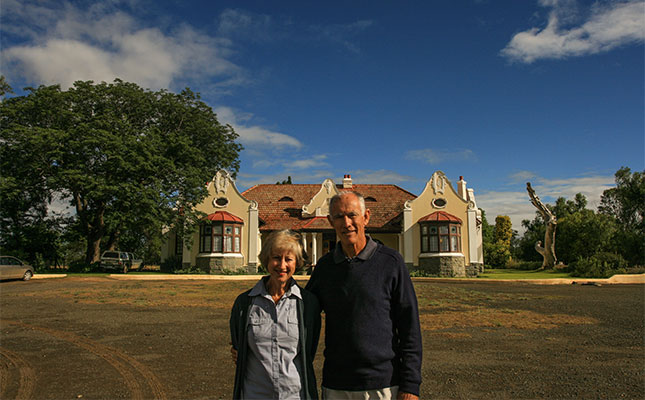
The house had electric lighting and even indoor sanitation (very unusual for its time). It was designed by Charles Bridgman of Simpson & Bridgman architects in Oudtshoorn.
Back in the Feather Boom days of the 1880s to 1914, Oudtshoorn was the place to be. Everyone was erecting lovely buildings, each one more elaborate than the last.
The flamboyant styles of Johannes Egbertus Vixseboxse and Charles Bullock are well known, but there were others.
Bridgman realised that people in the Eastern Cape were also doing well trading in feathers, and his company was involved in the design of many notable buildings in the Karoo. The Arthur Short we met in 2015 is the grandson of Arthur Tucker Parkes, and he also took up the mantle of farming Wheatlands.
The Cricketer
There was a time when this Arthur (Short) was more of a star on the sports field than in the veld.
He was named in the cricket touring squad for the abandoned 1970 Springbok tour to England. The following year, he made the team once again, this time for a scheduled tour of Australia.
This was the famous team that included cricketing heroes like Graeme and Peter Pollock, Barry Richards, Eddie Barlow, and Trevor Goddard.
It was also the team, captained by Ali Bacher, that had whitewashed Bill Lawry’s Australians 4-0 when they toured South Africa in 1970.
But these were the years of the anti-apartheid sports boycotts, and the tours to England and Australia were cancelled. Arthur Short, star right- handed batsman, never faced a ball in national colours.
“To get that close,” he told us ruefully. “It’s every boy’s dream to open the batting for his country.”
There’s new blood on Wheatlands. David and Kirsten Short are now farming there, the seventh generation. Kirsten runs the accommodation along with housekeeper Charlotte van Rooyen. David handles the farming of the Angora goats, following in a long ancestral tradition of Wheatlands lairds.
We visit once more, on a weekend when a group of their friends have come to hunt warthog on the farm.
You’ll often see warthogs in the Eastern Cape veld, tails up, always looking busy. The irritation for farmers is that they burrow through fences, making goat-sized holes, which the Angora goats cannot resist.
The House and the Walkabout
We settle in like we’ve inherited the place. Gear goes in the main bedroom, grub goes in the pantry, and, in the kitchen, we take advantage of the thoughtfully laid-out sprig of mint and lemon on a cutting board and mix a couple of gin and tonics for a lengthy stoep-sit.
We wake up and it’s Saturday morning, time for a photo shoot and a long ramble around Wheatlands.
First, the Big House in lovely light. Then the various clusters of Angora goats, their silky fleeces glowing in the dawn.
Most of the time they are in their various paddocks. But every now and then, you might find them in the garden nibbling on a bush in the driveway because, as any Angora farmer will tell you, goats are almost always where they shouldn’t be.
As the wine label says, they do roam.
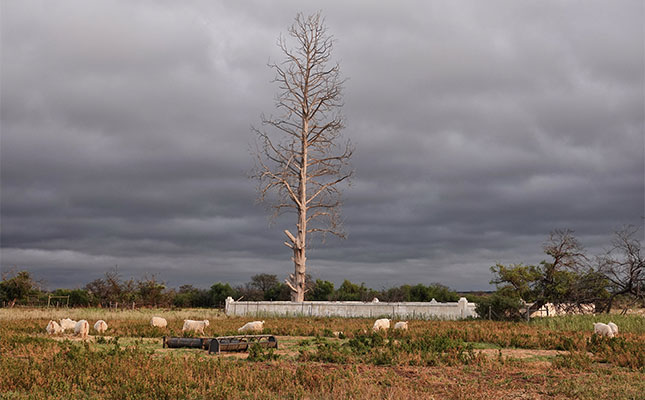
After breakfast, we walk out to the family graveyard, where a huge dead pine stands guard over the ancestors.
We find the gravestones of Arthur and Lily Parkes, among a selection of sadder stories of family cut down before their prime.
Lunch is followed by a classical Karoo nap, after which we wake up to find ourselves briefly ensconced in a grand old mansion.
We take another stroll, this time to the Melk River nearby, which is fed by a famous fountain that has made Wheatlands so special for many generations.
The translucent water is still flowing over the brown riverbed. On the sides, you can see that floodwaters have torn trees and reeds away from the banks and deposited them further down.
On our way back, we stop off at Garden House to see how the hunt went.
Their wives tell us the boys are still out in the veld.
We are asked whether we would like to stay and watch the second rugby Test between the All Blacks and the Bokke happening in Cape Town on TV with them. “No thanks”, we reply.
We have discovered the TV room at the Big House and will be cheering our guys on in baronial style.
And following the favourable result, there is general jubilation all over the farmstead of Wheatlands and beyond.
It’s certainly a fitting end to a fabulous weekend at this ‘Downton Abbey in the Karoo’.
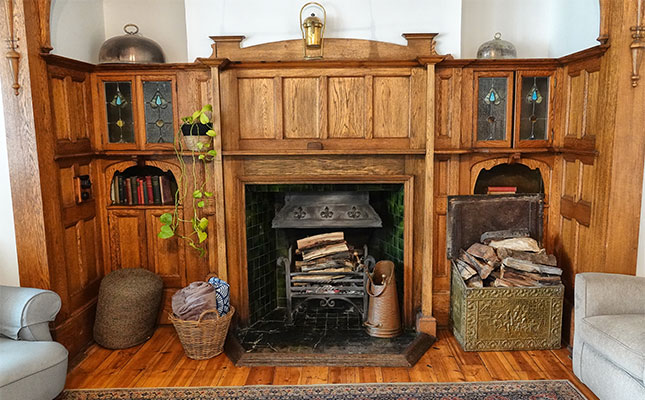
The ‘Big House’ has six bedrooms, two of them en suite, with another two bathrooms available – one with a shower, and the other with a bath. There is a lovely large lounge with a wood-panelled fireplace, a more intimate TV lounge, a study/reading room, and even a grand piano in the entrance hall. A long bookshelf full of interesting books lines one of the passages.
The house is beautifully furnished throughout. There is a large kitchen and pantry with three fridges.
Where is it?
Wheatlands is off of the R75 between Graaff- Reinet and Jansenville.
Rates
The base rate is R3 000 per night for six people. Extra adults are charged R400 a night, and children R200.
For more information, WhatsApp Kirsten Short on 072 251 9022, email her at e[email protected], or visit wheatlands.co.za.