
At Le Arc, situated between Paarl and Franschhoek in the Western Cape, Six33 Produce has been growing blueberries since 2017. The company also produces blueberries, table grapes and kiwifruit at several other farms in the Boland.
The farm receives an average of 800mm of rain annually, but totals are highly variable. Rainfall dropped to 565mm in 2022 and 653mm in 2025, but exceeded 1 000mm in 2023 and 2024. For Corné Oosthuizen, general manager at Le Arc, this unpredictability makes water management critical.
“Climate change is expected to increase the occurrence of extreme weather events in the Western Cape. A challenge for us is that we do not have the capacity to store large volumes of water, and most of our rainfall occurs in winter,” he explains.
“We are therefore highly dependent on irrigation water from the Wemmershoek water scheme during the picking season from August to January, when berries need lots of water.”
Water recycling
Le Arc has historically not used its full water allocation, but restrictions of 30% and more during the 2020/21 drought prompted a rethink of its water management strategy.
“We were forced to re-evaluate our water use and identify ways to improve efficiency in case allocations were reduced. We also considered that our young orchards would require more water as they matured, and that we planned to expand production,” says Oosthuizen.
Before planting, the farm installed subsurface drainage pipes 800mm to 1m below the soil surface to manage excess water. Previously, this water collected in sumps and flowed back into the Berg River system. During the drought, however, the farm decided to capture this run-off.
A dam with a capacity of 9 899m³ was constructed.

“We received approval to build a dam of of up to 43 000m³, but the land required and additional costs of a larger, more complex system did not justify it,” Oosthuizen explains.
The stored water is now reused on the farm, reducing reliance on external supply.
“The electrical conductivity, salt levels and overall water quality are tested regularly. The quality is excellent, often even cleaner than our drinking water. This is because it is naturally filtered through sand, and our fertigation practices prevent over-application of nutrients,” he says.
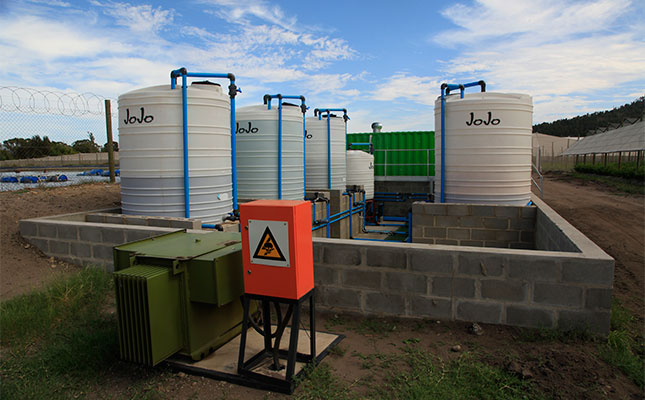
From the dam, two submersible pumps transfer water to the main pumphouse that distributes the water to the farm via booster pumps and the NetaJet system.
Irrigation system
Alongside improved water storage, the farm invested in a precision fertigation system, the NetaJet 4G from Netafim and the latest NetaJet 5G Growsphere, when they planted another 10ha in 2025.
“The NetaJet is essentially the brain of our fertigation system,” says Oosthuizen. “It uses highly accurate dosing valves to control the electrical conductivity and pH of the water, which is critical for delivering nutrients to the plants.”
The system is fully automated and manages fertigation across different irrigation blocks, each according to its specific requirements.
“It allows us to optimise every drop of water and every unit of fertiliser used. That’s not only good for production and the bottom line, but also reduces our environmental impact,” says Oosthuizen.
The system also records the exact volume of water and fertiliser applied to each block, improving traceability and generating data that can be used to compare usage between seasons. In addition, it continuously monitors the system to detect irregularities such as pressure fluctuations, leaks or dripper blockages.
“It can be programmed to shut off immediately and alert us, or to attempt a reset first. At Le Arc, we allow it to try and correct itself for about 30 minutes before sending an alert,” Oosthuizen explains.
Uniform fertigation
Netafim’s pressure-compensating non-leak drippers are used to ensure uniform application. These drippers close immediately when a fertigation pulse stops, preventing the lines from draining. This allows all drippers to start simultaneously when the next pulse begins, improving uniformity and reducing water and fertiliser losses.
Oosthuizen says the farm typically uses short fertigation pulses of eight to 12 minutes.
“If we didn’t have pressure-compensating drippers, we would have had to wait several minutes for the lines to fill before irrigation even starts. We would also need to run the system longer to ensure the entire block receives enough water and nutrients,” he says.
The system is complemented by variable speed drive (VSD) pumps, which maintain constant pressure throughout the irrigation network.
Pressure plays a big role in how accurately water and fertiliser are applied. The VSD pumps adjust automatically to keep pressure stable, improving uniformity and reducing energy use.”
Targeted irrigation
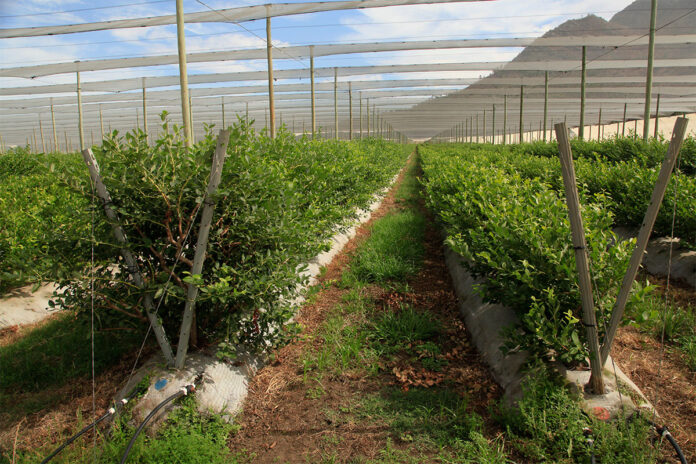
Irrigation at Le Arc is designed to match the specific needs of blueberries, which have shallow and sensitive root systems. The effective roots are concentrated within about 400mm of the soil surface, compared with deeper-rooting crops such as apples and table grapes, where the active roots are 600mm to 800mm deep.
“You’re working in a fairly narrow band of soils. If you fertigate too deep, you lose both water and nutrients. But if you apply too little, you risk under-irrigating and under-fertilising. The key is to keep moisture levels consistent in the root zone,” says Oosthuizen.
Water is applied in short, frequent pulses to maintain stable soil moisture without causing waterlogging or nutrient leaching.
“We use a fertigation programme developed based on the age and stage of production. This is adapted based on data from our iLeaf weather station on the farm, which measures precipitation, temperature, humidity, wind and evapotranspiration, and soil moisture levels based on soil probe readings. These probes measure water levels throughout the root zone up to 600mm deep,” he says.
During hot periods, applications increase to about eight pulses per day, each lasting eight to 12 minutes. Because fertiliser is applied through the system, irrigation cannot be stopped completely during rainy periods, but volumes are reduced accordingly.
“During rainy days, we cut back significantly and allow the rain to help move nutrients through the soil profile,” he explains.
Two dripper lines are installed per row, positioned 30cm to 35cm from the plants. Plants are spaced 0,75m apart inside the rows and 2m to 2,25m between rows. Drippers are spaced 0,3m apart, giving each plant access to four or five emitters.
Heavy-duty weed mats from Vegtech and Glencairns are laid over the irrigation lines before planting, with holes burnt into the material where the plants are established.
“The mats suppress weeds, reduce evaporation, and buffer the soil against extreme temperatures. We chose white mats because they reflect sunlight, which benefits both the plants and soil organisms,” says Oosthuizen.
Additionally, peat from Glencairns is added to the soil during planting to help retain moisture in the soil.
Monitoring
The high level of automation improves labour efficiency, reducing the time and effort required to manage irrigation and fertigation.
However, Oosthuizen emphasises that hands-on observation remains essential.
“We randomly collect water from drippers to compare actual output with what the system indicates. Variation of less than 10% is acceptable, but in practice we see much smaller differences,” he says.
Soil moisture is also checked physically by digging inspection holes, despite the use of probes and tensiometers.
“The human eye is still needed. With a crop like blueberries, intervention might come too late if something goes wrong with the system,” he says.
Looking ahead, Oosthuizen expects artificial intelligence to play a greater role in irrigation.
“The industry is already moving in that direction, using algorithms to develop fertigation programmes tailored to specific production conditions. I know Netafim is already testing this in other countries,” he says.
For Oosthuizen, however, the focus remains on combining technology with practical experience to ensure consistent production under increasingly unpredictable conditions.
“At the end of the day, it’s about using every tool available to make better decisions. Water is becoming more limited, so we have to use it as efficiently as possible,” he says.
For more information, email Corné Oosthuizen at [email protected].