
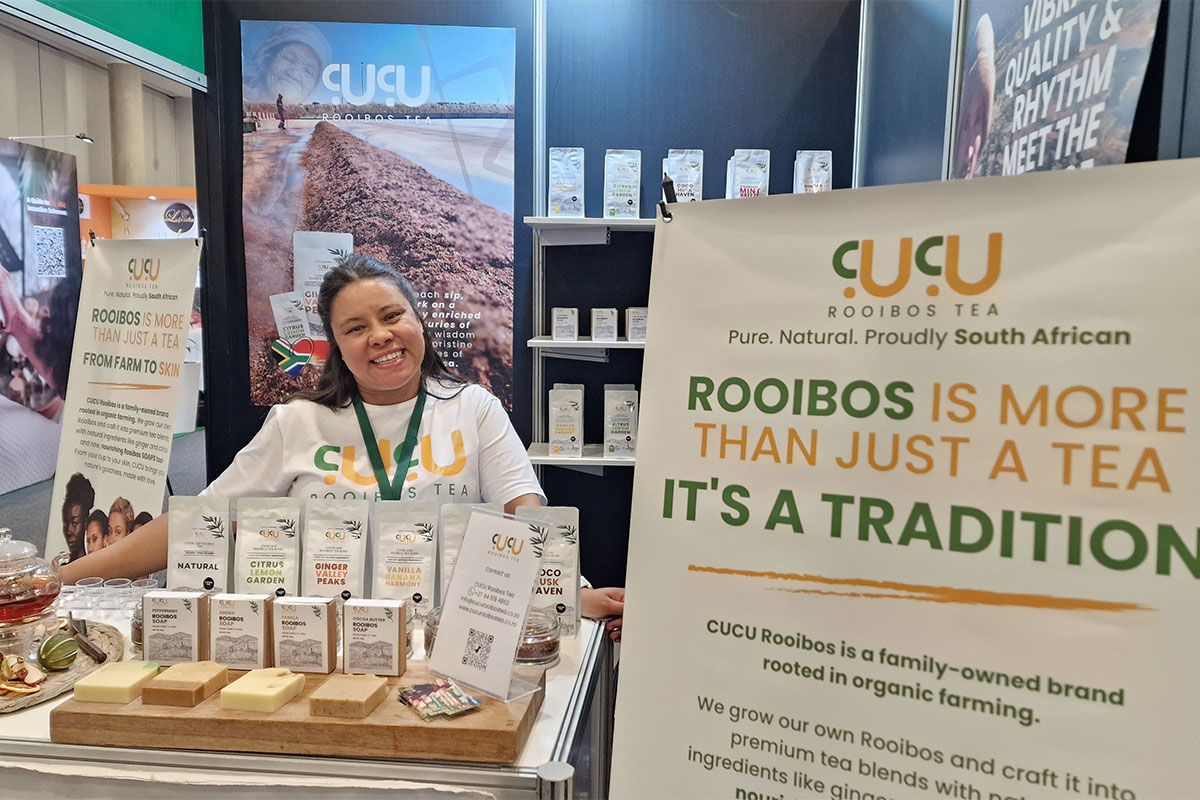
This year marked CUCU Rooibos’s first appearance as an exhibitor at the expo, supported by funding from the Small Enterprise Development and Finance Agency. The expo took place at the Cape Town International Convention Centre from 17 to 19 April.
“What sets Justin and me apart is that we farm the rooibos ourselves, harvest and process it, and make the value-added products, too. It goes from the farm right to the body and the skin,” Kelly said.
However, getting to the point where they could showcase a range of premium rooibos blends at the expo took hard work and many late nights, she added.
With help from his father, Justin bought a rooibos farm in the Cederberg–Suid Bokkeveld area during the COVID-19 pandemic period in 2020/21. The area’s unique soil and climate create ideal conditions for rooibos production, making it the only region in the world where rooibos is grown.
“When we purchased the farm, it was still a small family business, and there wasn’t much in place. We had to build everything up ourselves. The land was very dry and almost barren, and we had to work the soil hard. We also had many problems with the tractor. It broke down often and got stuck in the dry sand,” Kelly said.
The couple and their small team planted rooibos, but there was little initial success.
“When we started, we spent up to R30 000 on rooibos plants, but the yield was very small, just a few grams. It was nowhere near a ton.
“Over time, production grew from about 300g to one ton after the first full year. The next year, it was about 750g. We learnt that if you don’t look after the fields properly, they won’t produce.”
Kelly said that throughout this period of trial and error, Justin’s father continued to provide financial support. They now harvest almost five tons of rooibos from nine plots on the 134ha farm. They now have four permanent workers, as well as up to 20 local seasonal workers during the peak harvest period.
“The harvesting season runs from the second week of March to early April. This past season went very well, and we harvested about two tons. The rooibos is now being processed, dried, and taken through the full process,” she explained.
“After that, it will be purified and tested, including organic certification checks. Great care is taken to ensure no pesticides are used.
“Rooibos is expensive to produce. If your focus changes and you stop investing in it, you won’t get results. Justin compares growing rooibos to raising a child: the more you care for it, the healthier it grows.”
Building the CUCU brand
While growing and developing the farm, Justin also worked on developing the CUCU brand.
“Cucu means rhythm in the Khoi language. When you drink the tea, it takes you through a journey of emotion and taste,” Kelly said.
She added that Justin learnt a lot about the markets by travelling to more than 13 countries, including Thailand, Korea, the UK and the US, where he attended expos. These trips were funded by the Department of Trade, Industry and Competition and Wesgro.
“Our first idea for a brand name was Lifestyle Nutrition Rooibos Tea. Before going into flavours, we decided we wanted to be different and not copy what everyone else was doing. The focus was on creating a signature product,” she explained.
Kelly said it took them more than a year to develop their final brand. Justin also had a mentor from the Netherlands who advised on its development.
“We didn’t go with the first design. The final one came after about a year and three months, with tastings and about five different name options. The current blends are aimed at the premium market because CUCU is positioned as a premium brand,” she added.
CUCU’s flavoured tea is exported to Ghana through a private company and to Taiwan, and is also sold in bulk to a company in the Western Cape.
“It’s rare to find rooibos farmers who grow, process, and sell their own product,” Kelly concluded.
“Our long-term dream is to expand into products like shampoo and conditioner.”
For more information visit cucurooibostea.co.za.