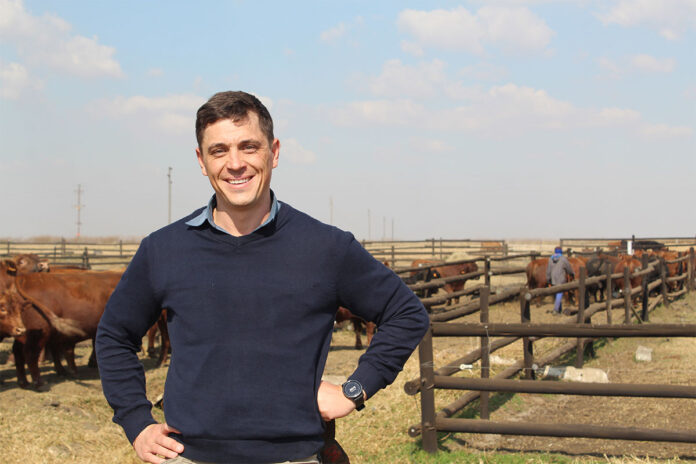
As grain farmers grapple with shrinking margins and stubbornly low commodity prices, every input must justify its place, and every hectare must earn its keep. For Anton Pelser, Agri Mpumalanga’s Young Farmer of the Year for 2026, that means questioning assumptions, testing every new idea, and accepting that building a resilient farming business is measured in decades rather than seasons.
Pelser studied agricultural economics and animal science at Stellenbosch University, joining the family business in Hendrina, Mpumalanga, in 2018. Today, he oversees Astro Boerdery’s cropping enterprise and Angus stud, while his sister Alda oversees the commercial beef herd.
His focus extends beyond producing high yields. Every management decision is weighed against its long-term impact on the business, with careful planning, continuous testing, and disciplined investment forming the backbone of his approach.
While the current economic climate can be viewed as particularly challenging for farmers, Pelser is quick to point out that it is not unlike what previous generations had to contend with.
“Everything that happens in agriculture is cyclical in nature. Both good times and bad repeat themselves through the ages. So while the challenges farmers face today are substantial, I am hopeful and optimistic that we will overcome them and keep moving forward, just like previous generations.”
Rather than dwelling on circumstances beyond his control, Pelser believes the focus should remain on continuous improvement.
“As young farmers we need to ride out the storms, making sure we are doing everything we can to innovate and farm more efficiently. South African farmers are known to do well in this regard. We adapt quickly.”
But South Africa’s success is also to a large extent its trouble. With continued gains in yields, the grain market is well supplied, and prices have started declining. Pelser believes continued gains in productivity will need to be matched by greater market demand if grain farming is to remain economically viable.
“Ideally, we would get more markets for the grain to keep farmers in business. If the government made an allowance for biodiesel production, it would make a big difference in keeping farmers on the land. Yes, people need to have enough to eat, but if farmers can’t make ends meet because the grain prices are too low, then they will stop farming, and there will not be enough food in any way. Farmers need to be given an incentive to keep producing grain.”
Building the business from the soil up
The Pelser family’s cropping programme centres on maize and soya beans, with the two crops rotated annually between fields to support both productivity and soil health. Every field follows a carefully planned production programme, but Pelser says the foundation of the system lies beneath the crop itself.
“I try to put more back into the soil than I take out so we don’t mine our soils. We start the season with liming and rectifying the soil’s pH balance. Then we look at adding the macro and micro elements. If the pH is not right, then there are nutrients that will be present in the soil, but not bioavailable.”
That philosophy has become particularly important on a farm where acidic soils remain one of the biggest production challenges. Average soil pH sits at about 4,5, with considerable variation across the farm.
Correcting that imbalance is a long-term commitment rather than a quick fix. Last season, lime was applied at 3t/ha across every maize field, with the same programme planned again this year.

The annual cropping cycle begins soon after the harvest. For fields that will be planted to maize, lime is spread, and fields are ploughed just after the soya beans have been harvested. By the end of September, maize planting begins if weather conditions allow. Fertiliser is applied at planting, followed by carefully timed applications of herbicides, insecticides, nitrogen, and fungicides throughout the season.
When fields rotate back into soya beans, cattle first graze the maize stover before the remaining residue is incorporated into the soil and compaction is addressed with a chisel plough. The establishment programme largely mirrors that of maize, except that lime is omitted before soya beans are planted.
A range of non-GMO maize cultivars are matched to different soil types across the farm, since Pelser can obtain a premium for the non-GMO maize. Roundup Ready soya beans are planted, which makes volunteer maize easier to control in the following season.
Although conservation agriculture continues to attract growing interest, Pelser says it has not yet delivered the results needed under his conditions.
“We tried no-till, but our yields dipped and we couldn’t continue taking that knock. We have a lot of soil compaction because of the soil type and structure, so we need to loosen the soil.”
On productive cropping lands, preserving soil moisture and ensuring sufficient time for cultivation before planting take precedence. Cover crops are therefore not planted between seasons. Instead, cover crops are established on marginal sandy fields that are unsuitable for profitable grain production, providing valuable grazing for the cattle. These crop residues are ploughed into the soil to build carbon.
These fields have become part of a long-term experiment in soil rehabilitation. Pelser has started alternating cover crops with soya beans on these fields, working crop residues into the soil in an attempt to build soil organic matter.
“We have only been doing this for four years, so we are not yet sure if it will be effective. I’ve heard from others who have done trials that it takes incredibly long to build even half a percentage point of carbon in the soil, so I’m not sure I will see it in my lifetime.”
Letting the data lead
Pelser acknowledges that the single biggest influence on yield remains the one factor farmers cannot control: rainfall. Everything else, however, is managed as precisely as possible.
The region receives around 700mm of rain annually, but like many farmers have experienced over the last few seasons, the spread over the season has become erratic.
In the past, Pelser has sown ryegrass into maize when it reaches the tasselling stage. This worked well in seasons when follow-up rains arrived but failed when rains stayed away. The risk of not producing a double crop is therefore substantial.
Planting date, fertiliser timing, and weed control all receive careful attention, particularly on the farm’s sandy soils where nutrients are easily lost through leaching. Fertiliser applications are therefore split between granular pre-plant and liquid top-dressing applications to improve nutrient availability throughout the season.
Weed management has become increasingly difficult as herbicide resistance spreads across the region. Pelser laments that morning glory has become a significant issue in the area. The late rain this last season also meant that the maize did not canopy properly, providing an opportunity for pigweed to flourish.
Technology has become an essential decision-making tool rather than simply another piece of equipment. Using Bayer’s FieldView platform, Pelser combines soil analyses, yield maps, and topographical data to rank land according to its production potential. Variable-rate prescriptions are then developed so that plant populations and inputs match each area’s capability.
“When the yield results come in, we go back to see if the stand and inputs were justified and tweak the prescription for the next season if necessary.”
Even the best technology must prove its worth. Every season, Pelser conducts on-farm trials, whether comparing cultivars, fertiliser strategies, or plant populations.
Trials are conducted on about 10ha before gradually expanding over three seasons if the results consistently justify the investment. Pelser notes that it is important to consider the potential of the land the trial is conducted on so a true representation of the potential of the tested product can be measured.
With fertiliser prices on the increase, current trials are focused on identifying the fertiliser strategy that delivers the greatest return on investment rather than the highest possible yield. Pelser notes that harvesting a 4t/ha crop while fertilising for a 6t/ha crop is less viable than fertilising for 7t/ha and harvesting 5,5t/ha, for example.
“The cost-price squeeze is getting tighter and the farming margins smaller, so we really can’t afford to waste. Everything we put into the soil must be as effective as possible.”
The same thinking underpins trials comparing different lime products to determine whether higher-priced options generate sufficient additional returns to justify their cost.
Years of testing have also refined the farm’s crop nutrition programme. Fungicide applications at the R1 stage, have consistently improved soya bean yields, particularly where sclerotinia pressure is high.
Calcium applied in-furrow at planting, boron at the R1 stage and molybdenum at V4 have also delivered measurable improvements in soya beans.
For maize, however, Pelser believes money is generally better spent below ground than above it.
“It’s better to spend the money on getting the soil right than foliar applications. Maize gets its nutrition from its roots, so the soil environment needs to be optimal.”
With margins under relentless pressure, the economic performance of every field is scrutinised. Areas that consistently fail to produce profitable yields are evaluated carefully before being replanted. Pelser explains that there are soils on the farm that would not produce a bumper crop, regardless of how much fertiliser was applied. The challenge is therefore to lift the yield as much as possible on those soils without wasting inputs.
Every hectare has a job
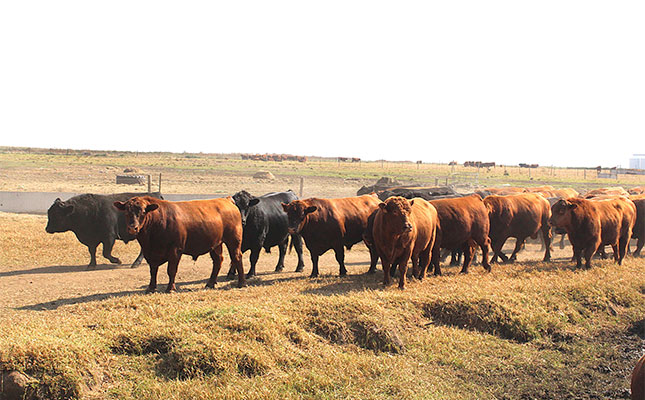
With many of the fields at Astro Boerdery being marginal croplands, grazing is instead cultivated so an income can be obtained from cattle. By making use of maize stover, the cattle are able to thrive in winter.
The farm also mixes its own rations, using maize produced on the farm together with purchased raw ingredients.
With grain prices currently under pressure, Pelser says expanding the farm’s feedlot would make sound economic sense by adding value to the maize crop. However, limited water curtails any expansion.
Pelser attributes the shortage to changes in underground water availability following increased mining activity in the area, leaving the business unable to increase cattle numbers despite favourable feed costs.
Like many livestock producers, the farm has also had to contend with foot-and-mouth disease. One infected herd had to be isolated, with replacement heifers needing to be culled. This is set to reduce herd numbers and affect breeding plans well beyond the initial outbreak.
“We usually select replacement heifers very strictly, but now we’ll have to be a bit more lenient to build the herd up again. But you can’t put a weak heifer in just to make up the numbers. It’s better to have fewer animals of better quality than a larger herd of poorer quality.”
That emphasis on quality runs throughout the breeding programme. Calves are assessed at weaning, with only the best animals retained. Stud bulls undergo Phase D testing, while commercial animals that fail to meet the required standard are marketed through auctions or the farm’s feedlot.
The breeding herd is managed with longevity in mind. Cows generally remain in production until about 12 years of age, provided they continue to conceive. Calving takes place from late June to early September, which is when feed availability is high and disease pressure low.
Although Pelser notes that beef production in the region is more expensive than in the western parts of the summer rainfall regions because of poorer grazing and higher disease pressure, he believes the cattle enterprise remains essential. “We need to utilise the fields where it’s not feasible to plant a crop. It’s better to convert those fields to grazing and get a return from them through the cattle.”
Precision pays
Whether it is choosing fertiliser rates, selecting breeding animals, or operating machinery, Pelser believes the greatest gains lie in precision. “Looking back over the past eight years, the biggest difference has been managing more precisely. You can’t manage the whole farm as one entity anymore. You have to manage every hectare individually to get the best return on investment.”
That philosophy extends beyond agronomy to the machines working the land.
Auto-steer technology has long helped eliminate overlaps and missed strips during field operations. With diesel prices soaring this year, the focus is now on reducing diesel consumption.
“Simply lowering engine revolutions during field work can generate significant savings. If you can reduce diesel consumption by even 10%, it amounts to a big saving over the whole season.”
Each machine has a dedicated operator and is carefully configured before entering the field, with engine speeds and harvesting settings standardised to maximise efficiency. Using Case IH’s AFS Connect platform, Pelser can also monitor machines remotely to ensure they are being operated correctly.
Technology, however, is only as effective as the people using it. This means staff need to be managed correctly to keep them motivated to work efficiently. Pelser believes in positive reinforcement.
“I’d rather say thank you and well done when things go right than only reprimand people when they do something wrong. Everyone wants to feel valued.”
He adds that no single management style works for every employee, making it important to understand each individual and adapt accordingly.
The farm operates Case IH Axial-Flow 8250 and 8260 combines, which were selected to increase harvesting capacity as the soya bean area expanded. Timely harvesting is critical, Pelser says, as delays increase pod shatter and grain losses.
He adds that the overall quality of the technology in the axial flow, like the draper header that allows for grain to be collected closer to the ground, maximises what ends up in the grain tank.
Equalizer planters fitted with precision planting technology provide the variable-rate capability required for the farm’s site-specific management approach, while their robust design makes them well suited to a business where several operators use the equipment.
Pelser is quick to point out that precision technology is not necessarily about reducing inputs. “Variable rate application doesn’t necessarily mean we use less. It means we get more from what we use.”
Looking beyond the next season
For all the advances in technology and precision farming, being a new generation on the land does come with challenges, as negative news and uncertainty are constant features of agriculture. Pelser has, however, consciously chosen to focus his attention where it can make a difference.
This means forgoing social media, as he believes it too often encourages people to compare themselves with others rather than concentrate on what really matters. Instead, he stays informed through industry WhatsApp groups that share practical information relevant to farming.
It s an outlook that reflects the measured approach evident throughout his farming operation. While many of agriculture’s biggest challenges remain beyond his control, he chooses to concentrate on the decisions that are within it, continually refining the business so that it is better prepared for whatever comes next.
That confidence is one of the reasons his father, Anton Pelser (senior), has been able to hand over much of the day-to-day running of the business with complete peace of mind.
“Anton has taken on immense responsibility, shouldering the majority of the day-to-day running of the farm. I have peace of mind knowing that he is in charge and can handle the running of the farm.”
Perhaps there is no greater measure of success for a young farmer than earning the trust of the generation that built the business before him. For Pelser, the Agri Mpumalanga Young Farmer of the Year title recognises not only what he has achieved but also the steady, disciplined approach that will help carry the farm into the future.