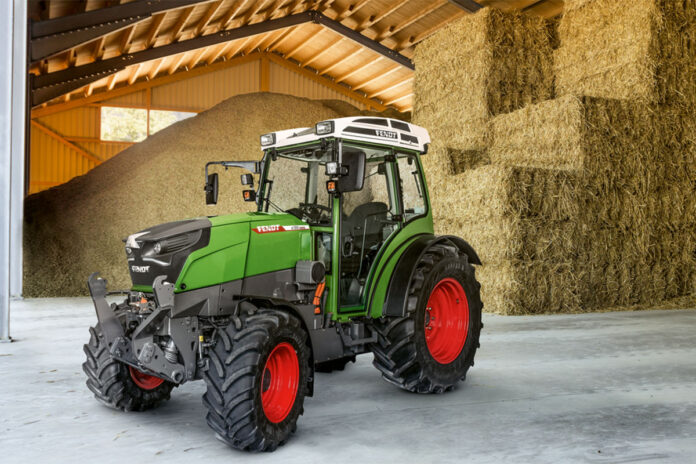
Electric tractors are steadily making their way onto farms in the EU and US, where tighter emissions regulations are encouraging manufacturers to invest heavily in battery-powered machinery.
In South Africa, however, the question is less about whether the technology works than whether it makes economic sense. For now, manufacturers and industry representatives agree the answer is no.
Although AGCO has already launched the Fendt e100 V Vario electric tractor (e-tractor) in Europe, the company has no plans to introduce it in South Africa.
According to Robert Keir, brand marketing manager for AGCO in Africa, cost remains the single biggest obstacle to introducing e-tractors to the local market.
“The e-tractor could cost up to three times the price of a diesel version,” he explains.
Such a premium is difficult to justify on farms where tractors are expected to work long hours under harsh conditions.
Keir says tractors on dairy farms, for example, often accumulate about 3 500 operating hours within three years before being replaced.
“Farming is hard on equipment; it gets beaten up. An e-tractor isn’t feasible for a dairy because you’ll need to replace it too often. Long-term cost of ownership is therefore encouraging farmers to stick with diesel.”
He adds that South African farmers also benefit from a tax rebate on diesel, further strengthening the financial case for conventional tractors.
Hein Snyman, regional production system specialist for products and precision agriculture at John Deere, says the company is still assessing where e-tractors are commercially viable.
He adds that most development is currently focused on markets such as California in the US and Europe, where emissions legislation is driving demand.
Running costs are about far more than electricity
While many farmers may assume that generating their own solar power would make e-tractors cheaper to operate over time, the experts say the calculation is far more complicated.
Snyman says farmers who want to reduce their carbon footprint would first need sufficient renewable-energy capacity to charge their machinery.
Building enough solar generation, battery storage, and charging infrastructure to keep a fleet of tractors operating would require a substantial capital investment, while charging via the national grid would do little to reduce emissions.
Operational practicality presents another challenge. Unlike diesel tractors, which can be refuelled within minutes, e-tractors can take hours to charge, interrupting work during busy periods. Current batteries are also fixed to the machine rather than designed for rapid replacement.
Support infrastructure is equally important. Keir says farmers need to feel confident that trained technicians and replacement parts are readily available before investing in new technology. That support network has yet to develop in South Africa.
Better returns lie elsewhere
Jim Rankin, secretary of the South African Agricultural Machinery Association, says battery technology hasn’t yet reached the point where it can comfortably power the large tractors used by South African commercial farmers throughout the working day.
“Looking at electric cars, the idea is that you drive to work and back home again, covering a short distance, and then charge it overnight so it’s ready again tomorrow. This is not the same scenario for a tractor that works for an entire day.”
He says the challenge increases dramatically as tractors become larger. “Large-scale farmers are using big tractors, and 400kW tractors need to be powered. Some farmers operate with fleets of up to 10 such machines. How on earth would they keep them charged?”
Hybrid machines offer one possible stepping stone because they continue operating on their internal combustion engine when the battery is depleted. However, Rankin says they are mechanically more complex and better suited to smaller equipment or specialised applications, such as cane haulage in the sugar industry.
Instead of focusing solely on electrification, manufacturers are currently investing in technologies that deliver immediate savings. Rankin adds that improvements in engine design over the past two years have reduced fuel consumption by between 10% and 15%.
John Deere is also developing engines capable of operating on biodiesel. Snyman believes this is likely to be the more realistic next step for South African agriculture.
“We are investing in electrification, but there are other regions that are better suited to this kind of technology. For South Africa, a biodiesel option is more favourable and will likely be the next phase,” he says.