
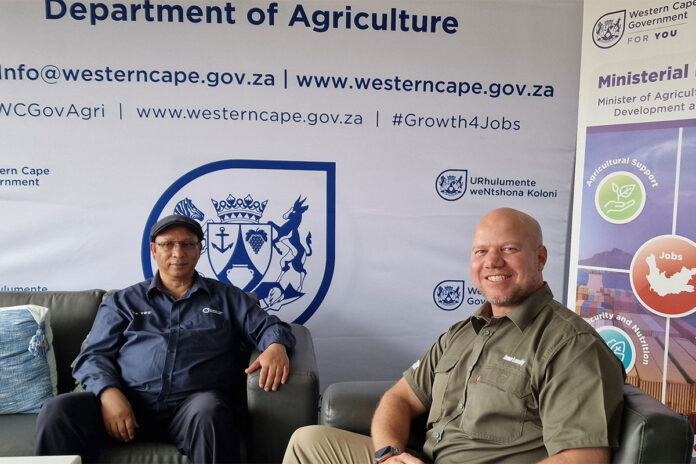
Speaking to Gary Wium, general manager of Farmer’s Weekly, at Nampo Cape 2026, Meyer said efficient logistics are critical to protecting agricultural exports, farm profitability, and jobs.
Meyer called for significantly greater private-sector involvement in the Port of Cape Town, going beyond the reforms currently under way.
“I actively called for the full privatisation of the Cape Town port terminal because, as minister of agriculture, I have clear targets,” he said.
Transnet is seeking a private operator to design, finance, refurbish, and operate the port’s multipurpose terminal under a 25-year concession. The process is independent of the Cape Town Container Terminal and does not constitute the privatisation of the entire port.
Meyer, nevertheless, regards the concession as an important step towards introducing greater private investment, expertise, and accountability into port operations.
He said international ports had demonstrated how private-sector participation could improve performance, but acknowledged that broader reform would take time.
“I see this as an incremental phase. I don’t see this happening immediately, but if you are not at the table, you are on the menu, and we are at that table,” Meyer noted.
He added that farmers have already felt the consequences of poor port performance. An estimated 55 000t of table grapes had to be rerouted through Eastern Cape ports last season, adding extra transport and logistics costs for producers.
According to Meyer, from 2024 to 2025, South Africa’s agricultural exports increased by about 10%, from US$13,7 billion (about R251,1 billion) to a record US$15,1 billion (R269,6 billion), reinforcing the importance of reliable and competitive export infrastructure.
Flood recovery continues
Turning to the subject of the severe flooding earlier this year, Meyer said the disaster had damaged agricultural land, roads, bridges, orchards, and vineyards across the province.
He said provincial assessments had placed the overall damage at approximately R9 billion, while damage to agricultural infrastructure exceeded R3,9 billion, and more than 230 roads were affected.
Meyer added that the provincial government’s immediate priority had been restoring access to farms, rural communities, and agricultural businesses.
“On [the morning of 7 May], contractors were already at the McGregor Bridge. For me, that was a signal from this government [that they responded with] urgency, [in] time, and [with the required] action,” he said.
The minister explained that more than 80% of the affected roads and bridges had subsequently been attended to or reopened, although major permanent repairs would take longer.
He added that damaged infrastructure should not merely be restored to its previous condition but instead rebuilt to withstand more frequent floods and other extreme weather events.
Farm-specific climate planning
Meyer said the floods had reinforced the need to help farmers prepare for growing climate risks.
He explained that the province was planning a climate technology symposium aimed at moving beyond broad climate warnings and offering guidance relevant to individual farms, production systems, and local risk profiles.
“We must prepare ourselves for climate change,” he said, adding that because the Western Cape has a Mediterranean climate, it requires climate change mitigation and adaptation measures suited to Mediterranean climates.
He said farmers need practical information to help them prepare for droughts, floods, extreme temperatures, and changing rainfall patterns.
Speed vital in FMD response
Meyer believes the Western Cape’s response to foot-and-mouth disease (FMD) demonstrates what can be achieved when government, farmers, private veterinarians, and industry organisations act swiftly.
By mid-August, 382 209 primary livestock vaccinations had been completed in the Western Cape, representing 82% of the provincial herd. A further 97 560 booster vaccinations had been administered.
Despite climate shocks, animal disease, and logistics constraints, Meyer said local farmers continue to demonstrate their competitiveness.
“Our farmers compete without those subsidies. Their resilience, hard work, and passion show that there’s no reason why we cannot compete with anyone else.”
Meyer recalled joining veterinary officials to collect vaccines late on a Sunday so that vaccination could begin the following morning.
“Speed is very important in a crisis. We don’t wait for things to happen. This is not the department of waiting; this is the department of getting the work done,” he added.