
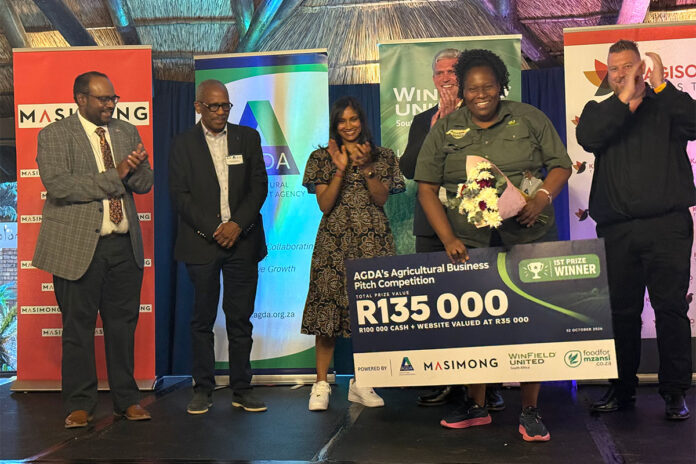
Musabeni, founder and managing director of Vhegies (Pty) Ltd, received the award during AGDA’s Annual Stakeholder and Member Engagement Conference in Boksburg on 22 October.
The former nurse, who has built a vegetable farming business supplying major South African retailers, received R100 000 in cash and website development support valued at R35 000.
The competition, supported by AGDA, Masimong and WinField United SA, brought together seven agricultural entrepreneurs who presented their businesses and growth plans to a panel of judges.
The judging panel included Boikanyo Teke, general manager of Masimong; Kgabo Rammutla, transactional advisor at AGDA; Fhumulani Ratshitanga, CEO of Fruit SA; and Jan Vermaak, CEO of WinField United SA.
Speaking after her win, Musabeni said the prize would help her establish production on additional farmland.
“Winning first prize in the AGDA pitch competition is an incredible honour and a major boost for my business. The R100 000 will help me purchase essential inputs, including seeds, fertiliser, and irrigation equipment, to get production under way on our new farm.
“I am deeply grateful to AGDA for creating opportunities that give emerging agricultural entrepreneurs the support they need to grow. My dream has always been to build Vhegies into a successful, sustainable vegetable-producing business that creates jobs and supplies quality produce to markets across South Africa and beyond. This award brings me one step closer to making that dream a reality,” Musabeni said.
During her presentation, Musabeni reported annual revenue of approximately R5 million, with a target of R10 million as the business expands. She said Vhegies employed 30 permanent workers and approximately 100 seasonal workers.
Retail expansion drives growth
Addressing the AGDA judges, Musabeni said Vhegies had progressed from supplying local fresh produce markets to servicing major retail distribution networks.
The business supplies Shoprite and Checkers distribution centres, with its produce reaching approximately 235 stores, she said.
Vhegies also supplies export markets in southern Africa, including Angola, Namibia, Malawi, and Mozambique.
Maintaining year-round supply has required production across different climatic regions. Musabeni explained that winter frost in Gauteng had prompted her to expand onto family land in Limpopo, where warmer conditions allow cultivation during the Highveld winter.
The business has also invested in vegetable processing and packing to meet customers’ requirements.
German market presents a new opportunity
Musabeni told the judges that Vhegies was pursuing opportunities in Germany, particularly for baby marrows, following a visit to the country in June.
She said the company was working towards GLOBALG.A.P. and BRC certification to meet international production, quality, and food safety requirements. GLOBALG.A.P. is the world’s leading private sector certification platform for food safety and sustainability in agriculture. BRC certification is a globally recognised food safety and quality management standard benchmarked by the Global Food Safety Initiative.
To increase capacity, Vhegies is developing approximately 50ha of additional land in Midvaal, where Musabeni plans to establish vegetable production and packing facilities.
She estimated that R5 million would be needed to develop the property, install infrastructure, and purchase a refrigerated truck.
Hiring refrigerated vehicles to deliver produce to distribution centres had become increasingly expensive as volumes grew, she explained.
During the question-and-answer session, a judge asked what she considered the business’s next major challenge beyond transport costs.
Musabeni identified production inputs and infrastructure, particularly shade-net structures and tunnels, as priorities for maintaining consistent quality.
She emphasised that produce destined for Europe would have to meet strict specifications to avoid rejection.
The new property has two boreholes, and Musabeni said she had begun the process of obtaining the necessary water-use authorisation.
She also expects the development of the new farm and packing facilities to create additional employment opportunities.
Competition supports established agribusinesses
AGDA’s Agricultural Business Pitch Competition was aimed at established farming and agro-processing enterprises with demonstrated commercial potential and credible expansion plans.
Applicants were required to have operated for at least 12 months and generated a minimum of R500 000 in revenue during the preceding year.
They also had to demonstrate how additional capital would increase production, revenue, employment, or market access.
The seven finalists represented businesses involved in vegetable seedling production, prickly pear farming and processing, potato production, mixed grain and livestock farming, and fresh produce marketing.
Their presentations highlighted challenges, including inadequate processing equipment, high production costs, limited infrastructure, and difficulties meeting the volumes required by large buyers.
Although Musabeni’s R100 000 cash prize represents only a portion of the capital needed for her next development phase, she said it would help purchase the inputs required to bring the new farmland into production.