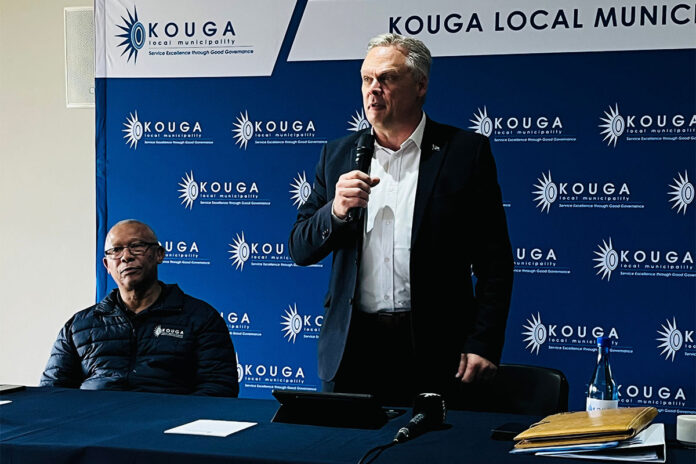
Aucamp visited the area last week to assess the impact of the severe floods in May and meet with farmers about damage to the local agriculture sector and infrastructure, as well as the support required ahead of the new production season.
The Gamtoos River burst its banks during the flooding, causing extensive damage across the valley and affecting more than 10% of the region’s citrus crop.
Disaster classification is first step towards unlocking funding
Aucamp said the first step would be to have the area classified as a disaster, which would improve coordination between the different spheres of government and pave the way for a formal disaster declaration.
“Before you can have an area declared as a disaster, it must be classified as a disaster. But for us to get funding, we need to have it declared as a disaster,” he said.
The minister said the scale of the damage in the Gamtoos Valley warranted the process.
“If you look at the Gamtoos area, the flood damage that we had in May this year is going into the hundreds of millions, if not more. We need to get it declared as a disaster, because it clearly is,” he said.
Farmers call for action
While farmers welcomed the opportunity to raise their concerns directly with Aucamp, they also called for action after months of dealing with the consequences of the floods.
Oyster Bay dairy farmer Conrad Dreyer said he wanted the commitments translated into action.
“The words [politicians] have are positive, but now we want to see implementation,” he said.
Dreyer said the floods had not caused the same level of damage to his farm as in the Hankey and Patensie areas, but road infrastructure remained a major concern.
“Our main concern is our roads, which are basically non-existent. There has been absolutely no help from government, so we’re fixing the roads ourselves. We’re already paying taxes, and we have to do government’s job as well,” he said.
FMD puts more pressure on farmers
Farmers also raised the issue of the ongoing foot-and-mouth disease (FMD) outbreak at the meeting, saying it was placing additional financial pressure on agricultural businesses.
Dreyer estimated that FMD had cost farmers in the area more than R400 million, with producers carrying much of the cost of the outbreak.
He also spoke about South Africa’s animal-health regulatory framework, saying the Animal Diseases Act (No. 35 of 1984) was outdated and needed to be reconsidered.
According to Dreyer, farmers had previously called for vaccination in the area and believed that earlier intervention could have reduced the impact of the outbreak.
Aucamp said FMD was placing significant pressure on the national agriculture budget.
“I think, firstly, that foot-and-mouth disease is a disaster. We’ve got to vaccinate [livestock across] the whole country, and that is going to take a lot of money,” he said.
The minister said the national Department of Agriculture had requested R1,3 billion in the adjusted 2026 budget to support national vaccination efforts.
Agriculture a key economic driver
Kouga Executive Mayor Hattingh Bornman said Aucamp’s engagement was important because farmers are central to the local economy.
“It’s really wonderful to have a minister here, because farmers play such a key role as stakeholders in terms of economic growth, job creation, and what they bring to other sectors as well,” he said.
Bornman said agriculture is one of the municipality’s biggest economic drivers, adding that direct engagement allows government to hear about farmers’ challenges and communicate the work already under way.
He said he supports Aucamp’s approach to addressing challenges in the sector and believes closer cooperation between government and the private sector is necessary.
“We need to work together to make sure that we get this working. It’s not the [agriculture] department alone or the farmers alone; it’s a whole-of-society approach,” Bornman said.