

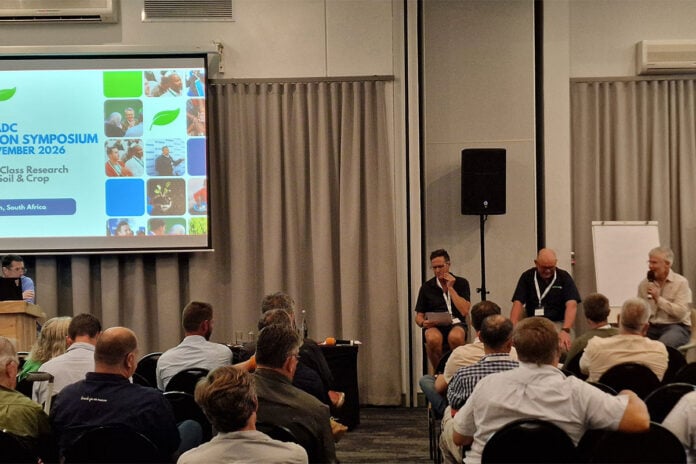
The panel discussion, held in Stellenbosch on 19 November, the first day of the symposium, was facilitated by Dr Michael Southwood, independent agricultural consultant and owner of Southern Cross Trust, who also organised the two-day symposium.
The panel comprised Andries Dreyer, agribusiness specialist at Absa AgriBusiness; Willem Engelbrecht, a South African rooibos farmer and New Zealand-based co-founder of ReviveAg; and James Dick, agronomist and plant physiologist at Crop Walker Consultancy.
They discussed what makes farming enterprises successful and how producers can adopt regenerative practices, improve nutrient efficiency, and use new technology without losing sight of profitability.
Build soil and protect margins
Dreyer said Absa AgriBusiness’s most successful farming clients shared several characteristics.
“They start with being curious. They are knowledgeable, and they’ve got the ability to exhibit critical thinking,” he said.
The way these farmers measure financial performance is equally important.
“The successful farmers are those who farm for margin, and they do that by looking at the health of their soils,” Dreyer said.
He referred to regenerative small-grain systems in the Western Cape where farmers using well-developed crop rotations and building healthier soils were applying up to 50% less nitrogen fertiliser. Depending on the production system, this could represent a significant saving relative to turnover.
Dreyer said turnover alone does not indicate whether a farming enterprise is healthy. Producers need to consider the margin earned on every unit produced, as stronger margins also reduce business risk.
He described the most successful farmers as those who are “curious, build their soils, and are conservative with their finances”.
Rather than continually expanding, some farming businesses now need to strengthen what they already have, he added.
“We should start building a moat around our castle, and stop building the castle,” Dreyer said, which he explained means improving profitability on existing hectares, boosting resilience to climate and market risks, and strengthening the farm’s position in the value chain.
Principles, not recipes
Engelbrecht, a rooibos farmer from the Clanwilliam area, has lived in New Zealand for seven years and returns to South Africa for about two months each year to attend to his farming interests here. He also co-founded agritech company ReviveAg in New Zealand.
“We wanted to farm according to recipes. We need to go back and farm according to principles, because nature doesn’t respect recipes,” Engelbrecht said.
Seasonal conditions change constantly, which means a programme that works one year might not produce the same result in the next. Farmers therefore need to understand the reasoning behind recommendations and take ownership of their broader production strategies.
“Farming is like building a puzzle,” Engelbrecht said.
He added that advisers usually focus on their own specialist areas, such as crop nutrition, irrigation, or crop protection, but farmers need to understand how the different recommendations interact.
Stop losing nutrients below the roots
Dick brought the discussion back to the practical management of water and nutrients. He warned that soluble fertiliser could move below the crop’s effective root zone if irrigation and fertigation were poorly managed.
“It just washes through the profile, and it’s gone,” he said.
Farmers need to understand soil profiles, water-percolation rates, and effective rooting depths to keep irrigation water and dissolved nutrients within the roots’ reach.
Dick said applying water and fertiliser beyond the active root zone results in wasted inputs and potentially lower farm margins.
Turn data into decisions
Engelbrecht said geographic information systems could divide farms into management zones, helping producers match crops and inputs to variations in soil, slope, aspect, and climate.
“You don’t have to be a specialist. Just make sure you at least have enough knowledge that you can guide and determine the strategy that your business is going towards,” he advised.