

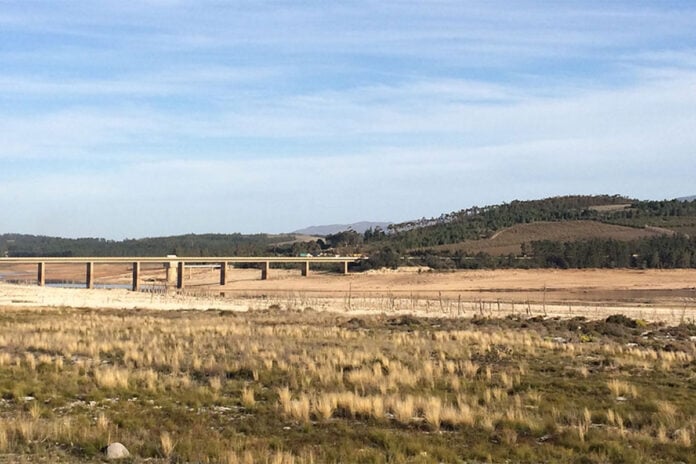
Farmers who receive water for irrigation from the Western Cape Water Supply System (WCWSS) are set to have their allocations reduced by 15%, following precautionary measures announced by Water and Sanitation Minister Pemmy Majodina on 16 November.
The WCWSS supplies water to agricultural users, Cape Town and several other municipalities, including those serving Stellenbosch, Paarl, Franschhoek and Wellington.
The planned 15% reduction applies to agricultural irrigation allocations within the WCWSS and not to all farmers across the Western Cape.
Reduction of irrigation allocations
The Department of Water and Sanitation (DWS) plans to reduce irrigation water allocations by 29,6 million cubic metres annually. Domestic and industrial water allocations will be reduced by 7%, or 27,2 million cubic metres, bringing the total reduction to approximately 56,8 million cubic metres, equivalent to 11% of the WCWSS’s total allocations.
Majodina thanked water users for not drawing their full allocations and urged them to maintain their current consumption levels.
Agri Western Cape expressed concern that agriculture would bear the largest share of the allocation reductions, both proportionally and by volume, particularly as the measures come at a critical stage of the production season for table and wine grapes, stone fruit, berries, vegetables and citrus.
The organisation warned that reduced water availability could affect agricultural production, exports and employment in rural communities.
“The agriculture sector supports responsible water management and wants to prevent a repeat of a potential Day Zero. But 58% of all primary agricultural products exported come from the Western Cape, and the sector provides 250 000 permanent jobs (25% of South Africa’s agriculture employment),” said Jannie Strydom, CEO of Agri Western Cape.
“This is even though the Western Cape has only 10% of the country’s productive agricultural land. This must be considered when deciding who carries the heaviest burden,” he added.
Dam levels and the risk ahead
According to the DWS, dam levels in the WCWSS stood at 72,5% on 2 November, compared with 84,4% during the corresponding period in 2025. This was below the department’s preferred operational threshold of 80%, but remained higher than levels recorded during the 2016/17 drought.
Majodina attributed the decline mainly to below-average winter rainfall. Rainfall for the 2024/25 and 2025/26 periods was recorded at 722,7mm and 752,8mm respectively, compared with a long-term average of 964mm.
The department also warned that forecasts of strong to extreme El Niño conditions could result in higher temperatures, increased evaporation and reduced runoff into dams.
Although the WCWSS can currently meet water demand, departmental modelling indicates that the risk of water shortages and mandatory restrictions could increase substantially from 2027 if users continue drawing their full allocations without intervention.
Concerns about declining water availability had already been raised earlier in the year. In February, Western Cape Local Government Minister Anton Bredell recommended that Stellenbosch consider introducing precautionary water restrictions in response to concerns about local water supplies.
Municipal water restrictions
The City of Cape Town has separately announced that Level 1 municipal water restrictions will take effect on 1 December 2026. Residents, visitors and businesses have been asked to reduce water consumption by at least 10%.
Under the restrictions, watering gardens with municipal drinking water will be limited to a maximum of one hour on Tuesdays and Saturdays, before 09:00 or after 18:00. The same time restrictions apply to the use of buckets and watering cans.
These municipal measures are separate from the planned reductions in agricultural irrigation allocations under the WCWSS.
Cape Town’s approved 2026/27 tariff schedules list drinking-water rates for commercial and industrial municipal connections at R45,50/kL under unrestricted conditions and R48,03/kL under Level 1.
Commercial and industrial users pay a fixed rate per kilolitre rather than the stepped tariffs applicable to domestic users. The city may adjust consumption limits for individual consumers on a case-by-case basis.
Exemptions, quotas and enforcement
Under the City of Cape Town’s tariff policy, if a customer exceeds a formal consumption limit, enforcement begins only after a warning letter has been issued and the customer has been given time to reduce consumption or submit a motivated application for a higher quota.
The city’s exemption procedure allows users to apply for exemptions in special circumstances. Applications must include a detailed motivation, certified identification and supporting evidence.
These may be emailed to [email protected] or submitted at a municipal walk-in centre, after which an inspector will assess the site, according to the city.
These procedures apply to municipal water users and should not be confused with the planned reductions in agricultural irrigation allocations under the WCWSS.
Concerns over water infrastructure and losses
Strydom also expressed concern that below-normal winter rainfall was being presented as the main reason for the current dam levels. He said concerns about the maintenance of critical infrastructure affecting dam levels had been raised at several meetings with the DWS.
His concerns also relate to those raised by Majodina about non-revenue water in municipalities, including rates of 33,3% in Stellenbosch, 41% in Theewaterskloof and 38,6% in Matzikama.
Majodina urged municipalities to enforce water-use by-laws and called on agricultural users, industry and households to conserve water while the department continues to monitor conditions throughout the year.
Agri Western Cape also called for decisive action to address water losses.
“We cannot hamstring a productive sector amid such waste of this scarce resource,” Strydom said.
He added that the organisation would continue engaging with the department and other stakeholders to promote responsible water management while ensuring that the interests of farmers, agricultural workers and rural communities were taken into account.