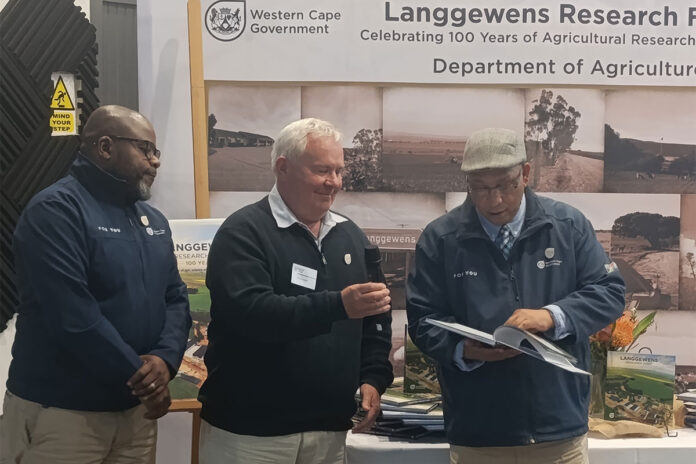
Researchers, farmers, and industry leaders gathered at Langgewens last week to mark the research farm’s centenary and reflect on how research conducted there since 1926 has translated into practical solutions for producers over successive generations.
Speaking at the event, Prof Johann Strauss, senior scientist at the Western Cape Department of Agriculture, said the value of Langgewens’s history was particularly evident in the evolution of farming systems.
In the research farm’s early decades, much of the focus was on identifying cultivars suited to local conditions. Crop rotation was already being investigated in the 1930s, although the concept had not yet developed into the systems farmers know today.
At the same time, intensive cultivation was common, with soils repeatedly ploughed and disturbed.
Strauss said these practices contributed to serious soil degradation and erosion, while wheat monoculture exacerbated some of these issues.
The 1970s and 1980s were an important turning point as researchers increasingly looked for alternatives to intensive agriculture. Minimum tillage, crop rotation, wheat breeding, and the integration of other crops and livestock into production systems received greater attention.
The introduction and development of canola as a viable break crop later strengthened crop rotation systems and helped pave the way for the expansion of research into conservation agriculture during the 1990s.
According to Strauss, this work had helped farmers build greater resilience into their production systems, particularly during difficult climatic conditions, thanks to improved soil carbon, better soil structure and water use, and increased biodiversity.
He estimated that about 60% of Western Cape producers were currently fully applying the three core principles of conservation agriculture – minimum soil disturbance, stubble retention, and crop rotation – while almost all producers had adopted at least some conservation agriculture practices.
Research that has reached farmers
For producers, Langgewens’s value has ultimately been measured by whether its research could be translated into practical solutions on commercial farms.
In a video message played during the centenary celebration, Koringberg farmer Andries Theron said research conducted at Langgewens had made a major contribution to the sustainability of his farming operation.
Reflecting on the contribution of past and present researchers, Theron said he wondered how many farmers would still be farming today without the work conducted at Langgewens.
A testing ground for wheat
Dr Litha Magingxa, president and CEO of the Agricultural Research Council (ARC), said Langgewens had also become an important part of South Africa’s wheat research effort, providing a testing environment shaped by the Western Cape’s Mediterranean climate, unique soils, winds, and winters.
“The cultivar that performs here has truly earned its place,” he said.
The research farm has, for decades, formed part of the ARC’s National Wheat Cultivar Evaluation Programme, generating independent field data that feed into the council’s annual wheat production guidelines and help producers decide which cultivars to plant, where, and when.
Magingxa said research at Langgewens had also helped answer practical questions around row spacing, seeding rates, and fertiliser placement, while long-term rotation trials had provided insight into how crop rotation, tillage, and cropping systems influence disease, soil health, and wheat performance.
Livestock research
Langgewens’s contribution to the sector is not confined to crop production.
Prof Schalk Cloete, professor extraordinaire in animal breeding and genetics at Stellenbosch University (SU), said the farm had supported decades of sheep research, ranging from nutrition and reproduction to genetic selection, genomic evaluation, and crossbreeding.
Earlier work investigated how sheep could make better use of crop residues during the Swartland’s long, dry summers. This included research into the nutritional value of wheat stubble and supplementation strategies for in-lamb and lactating ewes.
Research on long-term selection also showed that genetic improvement could increase reproductive performance, including conception, twinning, and lamb survival.
Cloete said researchers had managed to improve lamb survival even as twinning rates increased.
The questions are changing
While the celebration provided an opportunity to look back at Langgewens’s research, three young researchers also demonstrated how the questions being investigated at the farm are evolving.
Velicia Mabitsela, a PhD student in SU’s Department of Agronomy, is investigating how long-term minimum- and zero-till farming affect the distribution of nutrients through the soil profile.
She explained that nutrients tend to accumulate in the upper soil layers under reduced tillage, but this could become a disadvantage during prolonged dry periods when the topsoil dries out and crop roots move deeper in search of moisture.
Her research is examining whether occasional strategic tillage could redistribute nutrients deeper into the soil without compromising soil sustainability.
Rebecca Ellerbeck, a PhD student in the same department at SU, researched how best to integrate sheep into conservation agriculture systems.
Comparing different grazing strategies, her study found that sheep could be incorporated without negatively affecting soil health or livestock production over the study period, provided that stocking rates were appropriately managed.
Lower-rotation and continuous grazing systems were profitable from the first year, while all the systems incorporating sheep were profitable from the second year.
Fadzai Zonke, a master’s student in SU’s Department of Animal Sciences, is investigating how different South African sheep breeds cope with summer heat.
Early results have shown clear differences between breeds, with sheep carrying indigenous genetics generally maintaining more stable body temperatures under hot conditions.
The research could help inform breed choice and heat-stress management as farmers face hotter and drier production conditions.
Investment needed for the next 100 years
Strauss cautioned, however, that maintaining this type of long-term research would require continued investment in both facilities and people.
He added that research increasingly had to draw together disciplines such as agronomy, soil science, animal science, and agricultural economics rather than operate in silos, while emerging technologies would also need to be tested under practical farming conditions.
He expressed particular concern about succession planning and the need to develop younger scientists who could continue long-term research programmes as experienced researchers retired.
Strauss also said that the growing number of biological products being marketed to farmers illustrated why independent research remained essential.
“Claims that products can increase yields need to be tested properly over time before recommendations are made to farmers. One year of data is not enough,” he added.
The ARC similarly identified climate change, rising input costs, soil degradation, and market volatility as challenges already confronting producers rather than distant future threats.
Magingxa said future work would therefore increasingly need to focus on climate-smart farming systems that were more resilient to heat, drought, pests, and diseases, while continuing research into conservation agriculture, crop improvement, soil, and plant health.
Western Cape Minister of Agriculture, Economic Development and Tourism Dr Ivan Meyer said Langgewens demonstrated why long-term public agricultural research remained important, particularly as farmers faced increasingly complex production, climate, and sustainability challenges.
He said the value of such research extended beyond the solutions it provided to farmers. The data and evidence generated through long-term trials also helped government make better-informed decisions on agricultural interventions and priorities.
Meyer added that Langgewens was more than a research farm: “It is a living laboratory where science meets practice and where innovation is translated into opportunity for farmers.”
For Strauss, the lesson from the farm’s first century was that the foundation built by successive generations of researchers had allowed agriculture to adapt as farming conditions changed.
He added that the challenge now was to ensure this foundation remained strong enough to answer the questions farmers will face over the next 100 years.