

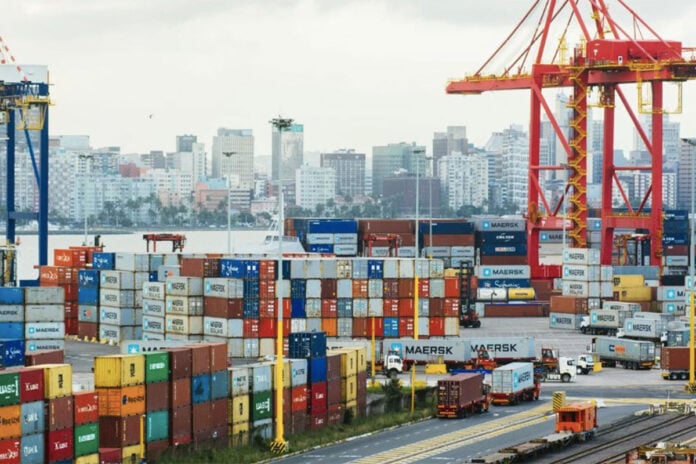
Transnet has announced urgent measures to ease congestion at the port’s Durban Gateway Terminal (DGT), formerly Pier 2, following reports of vessel delays of 14 to 20 days in mid-November. In a statement on 18 November, the company outlined plans to divert vessels, increase berthing capacity, and move more import containers by rail. It did not provide a timeline for clearing the backlog.
According to the Southern African Association of Freight Forwarders, DGT’s mid-August switch to the Navis N4 terminal operating system exacerbated congestion that was already building at the terminal. DGT suspended landside operations during the switch, and trucking companies had to register again to use the new system.
Freight forwarder Swift Worldwide Logistics said limited truck booking slots meant containers could remain in the yard even after they had been unloaded and cleared by customs. By late August, the terminal reported that the system was stable, but equipment constraints were still slowing efforts to clear the backlog.
“Durban is the main entry point for imported wheat and a major gateway for rice and fertiliser. It is also a key export port for maize and citrus,” Jolanda Andrag, chief operating officer of AgriSA, told Farmer’s Weekly.
According to figures supplied by Andrag, Durban received 1,92 million tons of wheat in the 2025/26 marketing season, or 87,6% of the 2,19 million tons landed at South African harbours. The figures include wheat destined for neighbouring countries.
“Reliable unloading helps keep wheat moving to millers and fertiliser to farmers,” Andrag said.
Durban accounted for an average of more than 75% of South Africa’s fertiliser imports from 2020 to 2024, according to a study Andrag cited. She also referred to figures from the South African Cereals and Oilseeds Trade Association showing that most of the 950 505t of rice South Africa imported between May 2024 and February 2025 came through Durban.
Citrus growers miss selling windows
“On the export side, delays can cost growers a selling window, as the CGA [Citrus Growers’ Association of Southern Africa] reported after the backlog at [DGT] in 2026,” Andrag said.
In a 13 November update, the CGA said the DGT backlog had disrupted shipping during the 2026 season.
“When fruit misses its window, costs remain while its value falls,” the association said.
Andrag said 2025 was the latest export season for which AgriSA could verify Durban’s share of citrus pallets cleared for export. Nearly 1,3 million citrus pallets were inspected and passed for export at Durban that season, accounting for 42,9% of the total across the five loading ports tracked by the CGA, including Maputo.
The port accounted for 83,4% of grapefruit pallets, 49% of orange pallets, and about one-third each of soft citrus and lemon pallets.
“Durban handled all seaborne whole-maize exports recorded by SAGIS [the Southern African Grain Information Service] in 2025/26,” Andrag said.
SAGIS figures show that Durban shipped 364 826t, equivalent to 17,8% of South Africa’s total maize exports by road and sea, which amounted to roughly 2,05 million tons. The port handled 28,3% of total yellow maize exports and 10% of total white maize exports.
The trade figures cover the Port of Durban as a whole. Transnet’s 18 November statement gave no figures for the volume of agricultural cargo caught in the container backlog.
Transnet moves to clear backlog
Transnet said Berth 102 at the port was available to vessels equipped with their own cranes. The company also said it was identifying vessels for diversion to the Port of Ngqura in the Eastern Cape, where Durban-bound containers could be transferred to smaller vessels for the onward trip.
Transnet Freight Rail has made trains available to move Gauteng-bound import containers, and a sixth ship-to-shore crane at Durban Container Terminal Pier 1 was scheduled to be handed over to operations on 21 November.
Transnet said it was prioritising essential cargo, citing pharmaceuticals and automotive parts as examples. Its statement gave no details on whether refrigerated food shipments qualified for priority handling.
Andrag also pointed to two longer-term projects at Durban’s Maydon Wharf. In March, the Transnet National Ports Authority (TNPA) named the BAL SA and Africa Global Logistics consortium as preferred bidder for a multipurpose terminal to handle agricultural dry bulk. The project has R810 million in committed capital expenditure.
The TNPA also named Khold as preferred bidder for a fresh produce and breakbulk terminal, with R250 million in planned investment.
“The port investment is therefore relevant to both food supply and export competitiveness,” Andrag said.