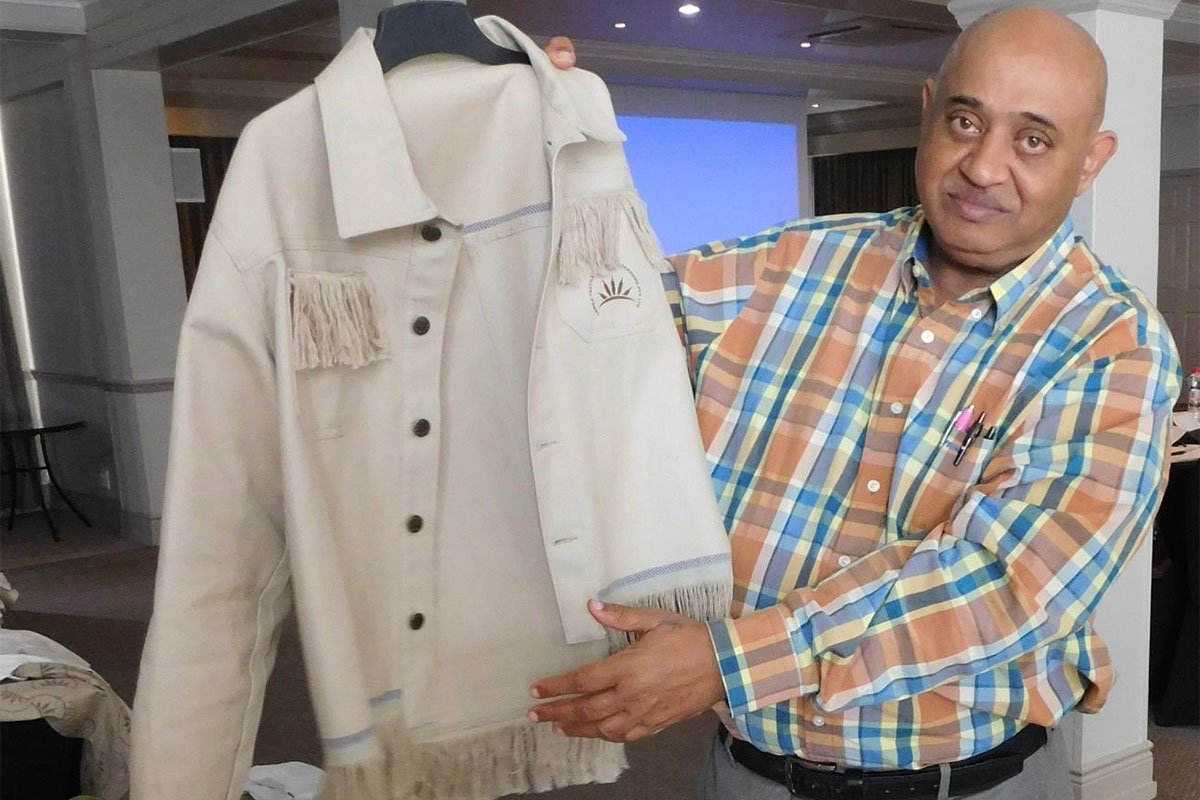
Garments made from hemp fibre processed and printed in South Africa were showcased to industry stakeholders, government representatives, and farmers, highlighting the potential for a locally integrated hemp textile industry.
The project involved Ledile Textile and Fibre Processing (Ledile) in Johannesburg, Koloni Hub Fashion Incubator (Koloni) in KuGompo, and Time Clothing in Nelson Mandela Bay.
This and similar projects are funded by Hempire-EC, an initiative of the Small Enterprise Development Finance Agency (SEDFA) and the Department of Small Business Development to support organisations working with industrial hemp and cannabis in the Eastern Cape, with the aim of increasing economic participation and inclusion of black industrialists.
Models from Koloni wore clothing made from the first run of locally processed hemp fabric, which stakeholders say represents progress towards building a South African hemp value chain.
Ledile founder Raj Jagesar told Farmer’s Weekly that the project shows hemp can be processed using equipment already available in the country.
He added that the development demonstrates South Africa’s capacity to support a full system, from cultivation through to processing, weaving, and garment manufacturing.
Ledile aims to produce organic hemp fabric for premium export markets in Europe.
Market opportunities for farmers
This growth in the hemp industry comes as interest in production is increasing across South Africa, particularly in the Eastern Cape, where government and industry stakeholders are positioning the crop as a potential driver of rural economic development and job creation.
Speaking at the event, Duma Maqubela, Buffalo City branch manager of the SEDFA, said the lack of a viable market has been one of the biggest obstacles facing local hemp farmers, despite the issuing of more than 2 000 hemp-growing permits nationally.
“Having a market for hemp has the potential to unlock thousands of rural jobs,” he said.
Stutterheim farmer Archie Madumane, a member of the Eastern Cape Hemp Producers Association, said farmers in the province have already demonstrated that hemp can be grown successfully under local conditions.
“The problem is, there’s nobody to buy what we’ve planted and harvested,” he said.
Madumane noted that the ability to process hemp locally could provide farmers with the market certainty needed to expand production.
Stakeholders said successful local processing of hemp fibre could reduce dependence on imported textile inputs while creating opportunities for small-scale farmers, manufacturers, and designers in the province.
Government support and expansion plans
Dr Sunshine Blouw, head of technology mainstreaming for field crops and animal fibre at the Eastern Cape Rural Development Agency, said the next phase of the project will focus on establishing clusters of small- to medium-scale hemp farmers supported by infrastructure, seed supply, and technical assistance.
He said hemp offers several production advantages compared with cannabis cultivated for medicinal or recreational markets.
“Hemp has a faster return for farmers than cannabis because it is harvested in around three months, before the flowers form,” he explained, adding that it can also be planted in both winter and summer, making it suitable for different production regions and seasons.
He noted that government support will be critical in the early stages of the industry’s development.
“For the first three years, government should fully support farmers. That is how other countries support new industries. If we do that, we will build confidence among farmers that they can make money from this crop.”
Blouw said the Eastern Cape government supports hemp production because of the crop’s versatility and economic potential.
“There are over 50 000 products that can be made from the hemp plant, and textiles represent one of the sector’s ‘low-hanging fruits’,” he said.