
On your way to Doornberg Guest Farm near Nieu-Bethesda, you’ll pass a shop mannequin loitering in a farm dam. With a hat, shades, bikini top and a nonchalant air, she is a bit of a showstopper as she stands in the water with the huge Karoo plains stretching behind her. Her name is Beverley.
Few can pass without taking a few photos. Some like to swim with her. And two people liked to travel with her.
She was installed by sculptor-entrepreneur Ryno Greeff, who also created the Stone Folk of Ongeluksloot not too far away.

There was a local uproar in November 2025, when two farmworkers from Steytlerville kidnapped the mannequin.
On a visit to Nieu-Bethesda, they decided to play a prank and move her to another dam, so they put her in the boot of their car and headed off. But they were late for Saturday afternoon TV rugby at the village tennis club, so Beverley remained in the boot. For a while, she was forgotten.
News of the shock disappearance of Beverley spread around the Karoo, South Africa and the world via social media, even as far afield as Canada.
People seemed amused, amazed and weirdly heartbroken. Sad emojis, amazed emojis, and guffawing emojis proliferated everywhere.
A Facebook page called Bring Our Beverley Back was launched.
A few days later, she reappeared in her dam, in new clothes, looking quite refreshed and well-rested. It turned out she had been taken on a lovely road trip through the Karoo. Once they realised what Beverley had meant to her ‘fans and followers’, the gleeful kidnappers took her on a special heartland tour, posing her for photos all over the place.
“I really wanted to make people aware of the beautiful towns in the Karoo,” said one of them.
A Delighted Farmer
“We got 400 000 social media hits from the ‘Beverley incident’,” marvels Peet van Heerden, owner of Doornberg Guest Farm, where the travelling dam doll resides.
The ebullient Van Heerden, who grew up here and loves to tell a story, also let Greeff and his artistry loose in a gully called Ongeluksloot, where he created a striking series of ‘stone folk’ statues in various poses on the rocky outcrops.
Dubbed the Stone Folk of Ongeluksloot, they have become a popular permanent outdoor installation, and one of the prime tourist attractions around Nieu-Bethesda. People seem to love visiting them, walking the 1km route to see the figures up on the hillsides and down at ground level.
Greeff had been inspired by the late Marcella de Boom’s The Dance installation of 10 dancing figures in the veld on a farm near Loxton in the Northern Cape – and, of course, the cement figures of the Owl House and Camel Yard in the village.
But that is not all
As we arrive at the Doornberg farmstead, we see Van Heerden in deep conversation with his gardener, Mervin ‘Jules’ Martins, in an open shed under a brace of huge donkey billboards.
Just like the doll in the dam and the stone fellows on their rocky perches, these donkeys also have their own story.
The photographs were made in 1996 by artist Jo Ractliffe as part of a project called End of Time, on display at the Ibis Art Centre in Nieu-Bethesda. They were inspired by Karoo donkeys and the part they used to play in carting the itinerant karretjiemense as they travelled the region in search of temporary work on the farms.
“I helped put up the installation,” says Van Heerden.
“And afterwards, I liked the donkeys so much I asked if I could have them. And they’ve been with us ever since.”
Fun in the toolshed
We walk along a track lined with all manner of old scrapped vehicles, from oxwagons to Studebakers to rusty Mazdas. There are also wind pump body parts lying everywhere.
“That’s not a scrapyard,” says Van Heerden. “That’s my spares department. Now let me show you my workshop.”
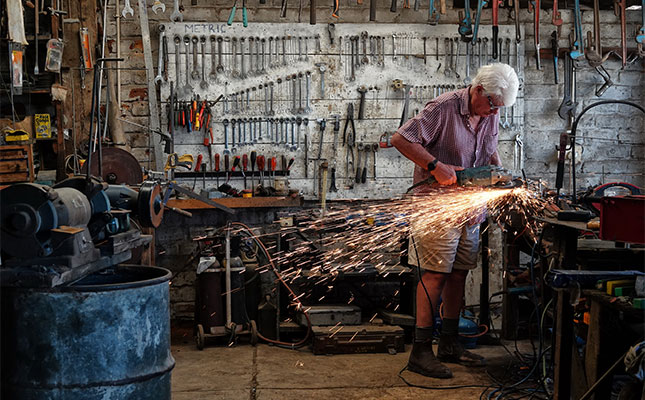
We follow him into a rather cavernous shed past a grease pit to a section dedicated to power tools, work tables, and a veritable wall of spanners. Like all the generations of Van Heerdens before him, he is a handy farmer who, albeit retired, can probably fashion most of the gear he needs right here in his toolshed.
He grabs a piece of metal and an angle grinder, and creates a rooster tail of sparks. Need a windpump fixed? An engine stripped, repaired and reassembled? It all happens here.
Near the house, Van Heerden shows us a small trailer where he has jerry-rigged an air conditioner into a cooling unit.
The Spy Radio Chill Room
“The really interesting part is the actual trailer,” adds Van Heerden.
“It was an office, parked on a nearby mountain, used by counter-intelligence agents to jam Radio Freedom transmissions during the apartheid era. Now it has become my cold beer room.”
Stories for Africa
Everywhere you look on the Doornberg property, there seems to be an interesting tale. The wall of an outbuilding sports a cement bas-relief image of a heart with an arrow piercing it. “That goes back to 1952, during my dad’s time on the farm,” he says. “We had a tame springbok in the yard that used to hang around with the milk cows. We called him Bambi.
“A family came to visit and the two young boys were given guns and permission to shoot Egyptian geese. Later on, they ran into the house, all excited because they’d managed to shoot a springbok instead. Alas, that was Bambi.
“A staff member plastered the broken heart into the wall in remembrance of the springbokkie.”
The Big Oak
Van Heerden is the sixth generation of Van Heerdens on Doornberg Farm. We ask him what it’s like to have such deep family roots on a piece of Karoo land.
“There’s a sense of belonging, but also of commitment and responsibility,” he says.
We’re sitting outside the family house, under a gigantic oak tree that sprawls over the roof and the lawn.
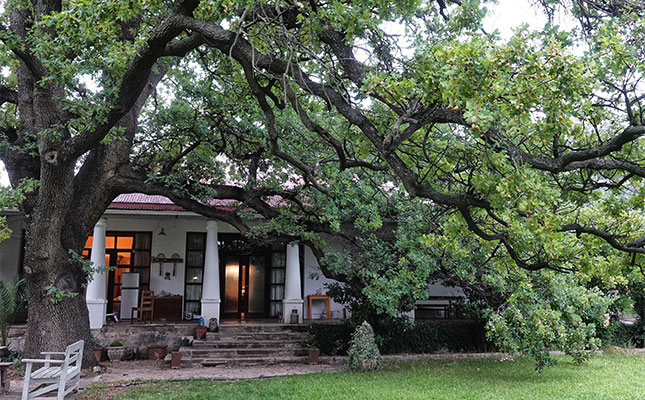
It was planted in 1900 and its enormous canopy extends over 400m².
For a few weeks in late summer, it starts shedding acorns.
When a strong breeze comes up, it sounds like machine-gun fire on the corrugated-iron roof over Van Heerden’s bedroom. The acorns are picked up and taken to the farm pigs – they love them.
In his dining room is the immense illustrated Van Heerden family Bible, printed in Dordrecht in the Netherlands in 1756. It’s really heavy and in High Dutch, written in Gothic script that must have been hell to read by candlelight in the old days.
Guest Farm Origins
Growing up on Doornberg, Van Heerden’s young days were filled with family and friends visiting the farm.
“It was a great place to spend the holidays,” he says. “We’d camp in the poplar grove and swim in the river. Even today, there are trees to climb, horses to groom and streams to swim in. It’s still a blissful Karoo farm experience for kids.”
What began as simple hospitality eventually became a business in the early 1970s, and since then thousands have experienced the outdoor magic of Doornberg Farm. When he inherited the farm, Van Heerden and his late wife Hanna switched to the guest farm industry and an informal ‘Doornberg Fan Club’, with members from near and far, was born.
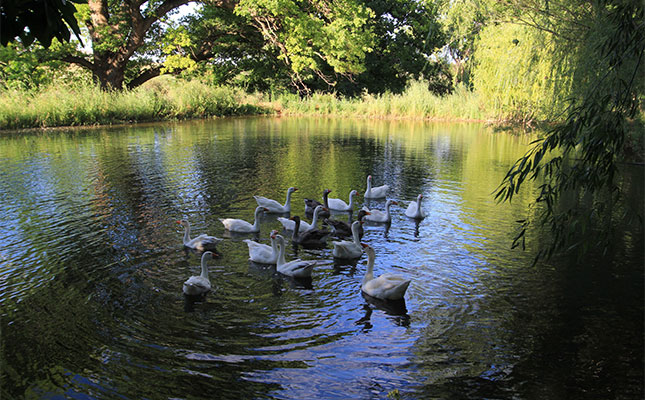
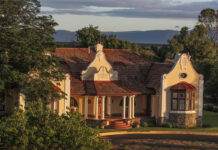
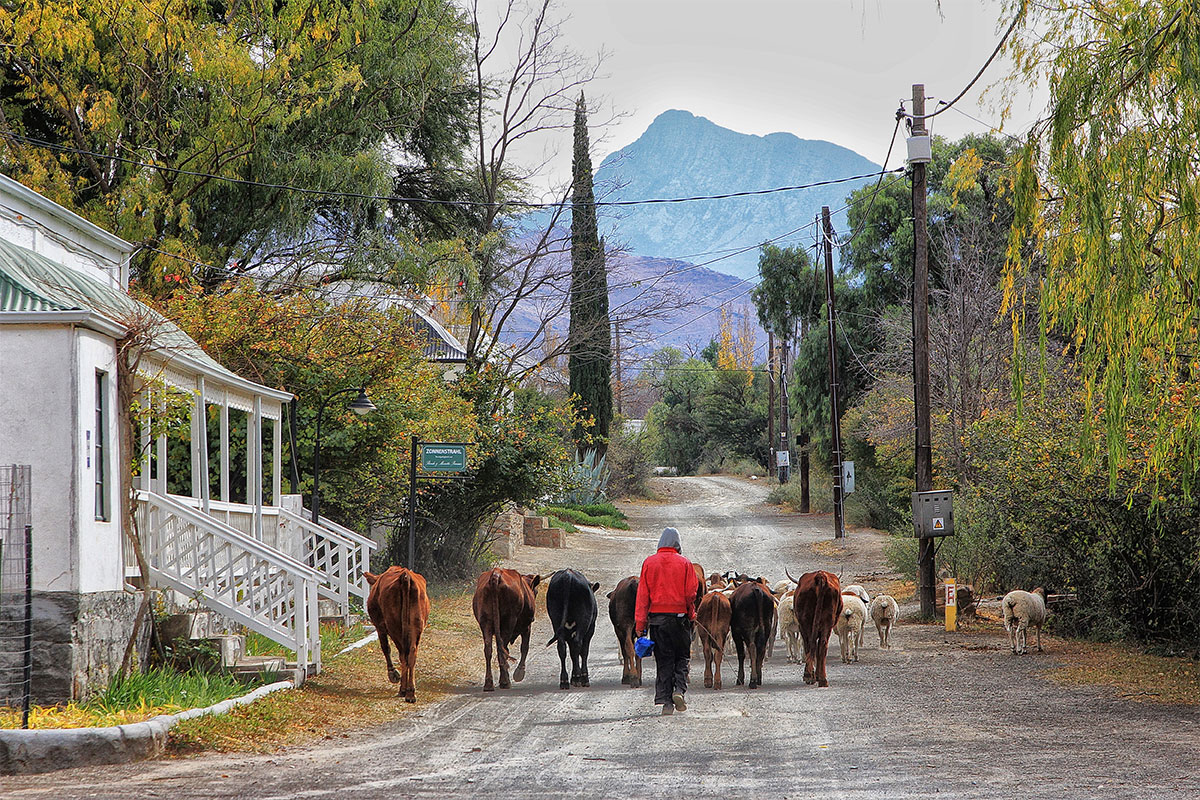
The Doornberg farmstead could be in England, with its whitewashed buildings, well-tended lawns, overgrown oaks and red roofs. It comes complete with geese, pigs, ducks and a dozen very bossy, very noisy roosters that were brought in from Nieu-Bethesda in two bakkie-loads. The villagers had simply grown tired of their constant crowing and strutting about.
And yet you lift your eyes up to the koppies and you see they are ridged with sunbaked ironstone, and the summit is lined with Karoo shrubs.
You are unmistakably in the Karoo, but this house has stood here for so long and its trees are so tall and long established that it has a micro-climate of its own.
Die boonste huis
We are staying in Die Boonste Huis (‘The Top House’) not far from Van Heerden’s homestead. Built in 1929, it was home to a number of farming Van Heerdens over the decades.
It’s a classic old Karoo farmhouse, with creaky wooden floors, high ceilings, many rooms, a large kitchen, and a dining area with great views. There’s a swimming pool, but Van Heerden’s daughters (Niki and Elbé) have just emptied it, because there’s a well-established pear tree nearby and it is peak fruiting season.
“The ripe pears kept bombing into the pool,” he says. “And the poor Kreepy Krauly couldn’t keep up.”
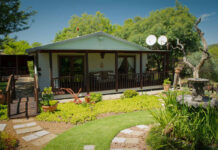
Die vleihuisie
In the late afternoon, Van Heerden takes us for a drive around the property, and we end up at a neat little exposed-brick cottage with a small wetland in front and the glorious Compassberg in the background.
Die Vleihuisie (‘The Little Marsh House’) was once an abandoned farm building, until a visiting Dutch couple looking for a summer hideaway came up with an interesting proposal: “We’ll pay you to fix it up if you let us live here for three months every year, for 20 years.”
Their time has now passed, but Die Vleihuisie remains as a modern cottage with a billionaire’s view of the Karoo at its best.
This 20-year, repair-and-stay concept could be taken up by hundreds of Karoo farmers who have spare buildings that have been neglected and are going to seed.
And what did the Dutch couple do for three months out here? “They sat in the sun all day long, buck naked,” recalls Van Heerden. “They used to go back to Holland looking like leguaans.”
A close community
Van Heerden has faced an extraordinary series of personal tragedies since 2020.
His son Petrus died in a motorbike accident. At the funeral he and his wife Hanna contracted COVID-19, and Hanna passed away.
The grief dealt a blow to his immune system, and he contracted tuberculosis (TB) of the bone.
The TB in his spine meant that several vertebrae had to be fused. After that, it was colon cancer. And then a quintuple heart bypass.
“But I don’t like to tell sad stories. No more trauma bombing.”
When he was in hospital for his first back operation, he posted something on the local WhatsApp group about how sore he was.
He said at the time that he could manage the pain, but the “black dog of depression” was following him. Within a few hours, he received 145 caring WhatsApp messages and was immediately buoyed by the gestures of compassion.
“That’s the gold thread that links the people of Bethesda.”
The clock watcher
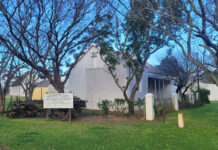
Van Heerden, now retired from farming but still running the hospitality on Doornberg with his daughters, was also the self-appointed clock-minder at the Nieu-Bethesda NG Kerk. And, as always, with Van Heerden, there’s a fireside tale. “In decades gone by there was no radio. No one was really quite sure of the time, which was mostly measured by the sun.
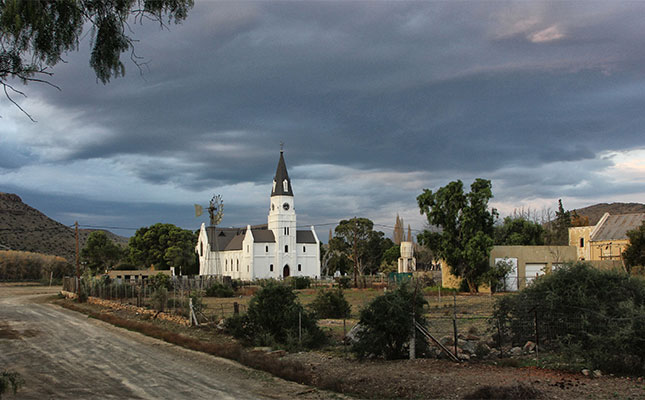
“But there were a few from Nieu- Bethesda’s congregation who took pride in getting the time right, by riding on horseback to Hanover. That’s where they’d find the coach from Cape Town. The driver always set his pocket watch to Cape Town’s Noon Gun just before he left. So that was considered die varsste tyd [‘the freshest time’],” recounts Van Heerden.
The first thing he looks for when he drives into any town is at the steeple clock of the mother church.
• Phone Lida on 082 954 8158, email [email protected], or visit nieubethesda.co.za.
• Wide Open Spaces offer guided guided slackpacking trails in and around Doornberg. Visit wospaces.co.za.