
South African farmers may enter the expected 2026/27 El Niño from a better climatic position than they did ahead of the devastating 2015/16 event, but weather is only one of several risks that could determine farm profitability in the coming season.
This was according to Dr Rudi Steinbach, senior economist in the Macroeconomic Modelling Unit of the South African Reserve Bank, who was speaking at the recent Agri Northern Cape Congress.
During his presentation, Steinbach placed El Niño within a much wider economic picture that also includes inflation, interest rates, diesel prices and weak economic growth.
One of the underlying problems facing farmers is that over time, costs have risen faster than agricultural income, placing increasing pressure on margins, he said.

Steinbach argued that lower and more stable inflation could ultimately benefit agriculture because a significant portion of farm expenditure, including wages, packaging, insurance and financing costs, is directly or indirectly affected by inflation. Lower inflation could also create room for lower interest rates and reduce financing pressure.
However, farmers questioned how much monetary policy can achieve when important costs are outside their control.
During the discussion following the presentation, Steinbach was asked whether interest rates should carry so much of the responsibility for controlling inflation when administered prices, including electricity tariffs, can continue increasing well above the general inflation rate.
He acknowledged the problem, noting that administered prices can carry a premium above inflation. He added that the challenge was that if some major prices continued increasing substantially faster than the inflation objective, other parts of the economy had to experience considerably lower inflation for the overall rate to remain contained.
Electricity and diesel concerns
For farmers, electricity and the cost of diesel are externally determined costs, which can significantly increase the cost of production.
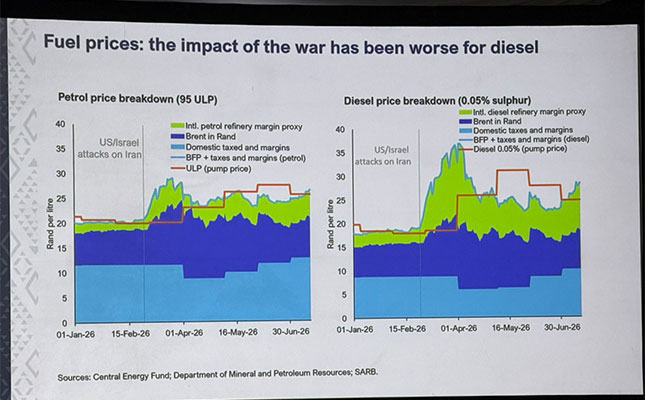
Steinbach showed that recent international instability has affected diesel more severely than petrol. As South Africa’s fuel prices are influenced by international refined-product markets, disruptions thousands of kilometres away can quickly find their way into the cost of production and transport.
Higher diesel prices also do not stop at the farm gate. Transport and production costs feed through the broader value chain and eventually contribute to wider inflationary pressure.
El Niño
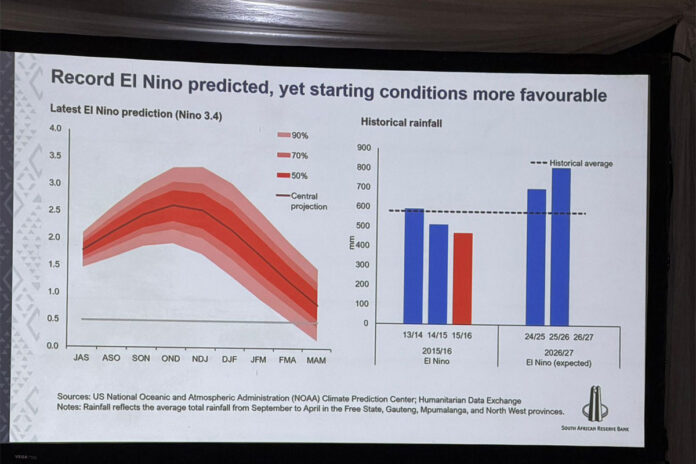
Against this already difficult cost environment comes the threat of El Niño. Steinbach said the latest outlook pointed to a potentially strong El Niño event. However, he stressed an important difference between the current position and the event in 2015/16.
South Africa entered the 2015/16 El Niño after already experiencing dry conditions. Recent seasons have provided substantially better rainfall in many of the important summer rainfall regions, creating a stronger starting position going into 2026/27. However, this does not entirely remove the risk.
Historically El Niño periods have been associated with sharp declines in agricultural production. Grain is particularly exposed, with lower production potentially pushing grain and food price inflation higher.
Livestock producers may experience the opposite price effect initially. As grazing deteriorates, farmers may be forced to reduce cattle numbers. More animals entering the market can temporarily place downward pressure on meat prices, leaving producers selling onto a weaker market at precisely the time drought is increasing pressure on their businesses.
Later, when conditions improve and herds are rebuilt, tighter supply can push meat prices higher again.
Optimise profitability over production
Dawie Maree, head of Agriculture Information and Marketing at FNB, brought the issue back to the individual farming business during his presentation.
Maree cautioned against using production alone as the measure of success: producing more does not automatically mean making more money. The objective, he argued, should be to optimise profitability within the conditions of the individual farm rather than simply pursuing maximum production.
The 2026/27 season may therefore demand less focus on chasing maximum output and considerably more attention to margins, cash flow, debt exposure and the ability of a farm to withstand another period of volatility.