
In a recent SA Grain analysis of the 2026/27 summer outlook, TerraClim climate specialists Dr Tara Southey, Mila Toth, and Caley Higgs, together with independent agricultural meteorologist Johan van den Berg, argue that seasonal forecasts are most useful when treated as risk-management tools rather than guarantees.
For summer grain producers, the analysis identifies soil-water reserves, soil characteristics, planting date, cultivar choice, input affordability, and financial resilience as variables that influence production risk.
The season starts below the surface
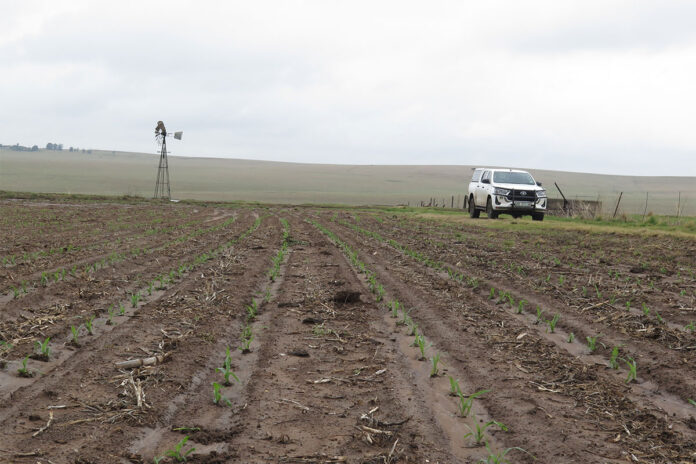
The amount of water already stored in the soil is one of the factors to consider before the coming season’s rainfall is added to the equation.
According to Southey and her co-authors, soil-water conditions are currently favourable in many parts of South Africa, although their analysis doesn’t identify specific production regions. They note that good soils can store 200mm of water or more, potentially providing a substantial portion of the water required during the production season.
That doesn’t mean rainfall becomes less important; it simply means the production season doesn’t begin at zero.
The practical implication is that stored soil water should be viewed as part of the production picture. Soils with deep profiles and good water-holding capacity enter the season from a different position than shallow or marginal soils, even before additional rainfall is received.
To put the 200mm figure into perspective, each millimetre of water across 1ha amounts 10 000ℓ.
Table 1: Putting 200mm of soil water into perspective
| Amount of water | Equivalent volume/ha |
| 50mm | 500 000ℓ |
| 100mm | one million litres |
| 150mm | 1,5 million litres |
| 200mm | two million litres |
Not every hectare carries the same risk
One of the key observations in the SA Grain analysis is that consecutive favourable seasons often change how farms expand production.
Marginal soils return to cultivation, higher yields become the expected norm, and increasingly expensive input programmes become embedded in the production system. These decisions aren’t necessarily wrong, but they become more exposed when seasonal conditions shift.
For producers, the question is therefore less about reducing hectares than about reassessing which fields justify the planned level of investment.
A high-potential field with deep soil and reliable water storage presents a different production proposition from a marginal field requiring similar expenditure to achieve a lower expected yield. The seasonal outlook simply makes that comparison more valuable.
There is also evidence that the relationship between climate and maize yield differs geographically. Southey and her co-authors said that a TerraClim and Grain SA pilot analysis examined 795 district-year observations from 128 districts across eight provinces. Maize yield responses were highly region-specific, while sustained heat exposure, particularly hours above 30°C, was negatively associated with yield.
The budget matters as much as the weather
The production plan is ultimately constrained by economics.
In an article on Grain SA’s summer 2026/27 grain production budgets, published in August, junior agricultural economist Cathrine Mathekga explained how closely profitability is linked to the relationship between yield, price, and production cost.
In the modelled eastern Free State and eastern Highveld budgets, variable maize production costs exceeded R20 000/ha, while fertiliser accounted for more than 40% of variable expenditure.
The actual fertiliser figures give further context. Grain SA’s modelled expenditure exceeded R8 600/ha in the eastern Free State and was more than R10 000/ha in the eastern Highveld. At R10 000/ha, fertiliser alone represents more than R1 million across 100ha.
The budgets are intended as planning tools rather than prescriptions. Grain SA emphasised that producers should replace the assumptions with their own yields, input prices, and management practices.
This distinction is important because weather affects more than production volume. When yields decline after much of the expenditure has already been committed, the production cost per ton harvested increases substantially.
A simplified R20 000/ha variable production cost and Grain SA’s modelled July 2027 maize price of R3 800/t illustrate the relationship (see Table 2).
Table 2: How a lower yield changes the production calculation
| Yield | Gross income/ha | Variable cost/ha | Variable cost/t | Margin above variable cost |
| 6t/ha | R22 800 | R20 000 | R3 333/t | R2 800 |
| 5,4t/ha | R20 520 | R20 000 | R3 704/t | R520 |
| 4,8t/ha | R18 240 | R20 000 | R4 167/t | -R1 760 |
| 4,2t/ha | R15 960 | R20 000 | R4 762/t | -R4 040 |
The financial discussion therefore shifts from how much to spend to whether a particular field still justifies the planned investment under its realistic yield potential.
Timing is the difficult variable
If seasonal rainfall totals were enough to predict crop performance, planting decisions would be considerably simpler.
Southey, Toth, Higgs, and Van den Berg argue that rainfall distribution remains a limitation of seasonal forecasting. A forecast may provide an indication of seasonal rainfall, but it cannot determine exactly when that rainfall will occur within the growing season.
For maize and other summer grains, this timing can materially affect production. The authors’ analysis notes that shifting the planting date by only one or two weeks can change a crop’s exposure to drought and heat during sensitive growth stages.
This places greater emphasis on soil-profile moisture, planting windows, and cultivar maturity than on the first significant rainfall event alone.
El Niño is one variable in a much larger system
The Bureau for Food and Agricultural Policy (BFAP) places the 2026/27 El Niño within a broader agricultural outlook that considers production alongside commodity markets and other economic factors.
BFAP’s Baseline 2026 Agricultural Outlook uses scenario analysis to consider how different drivers may shape the agriculture sector.
This perspective is useful at farm level.
A seasonal forecast may influence planting strategy, but its financial consequences are determined by how it interacts with yield potential, production costs, commodity prices, and the financial position of the farming business itself.
The practical value of the 2026/27 El Niño outlook therefore lies less in predicting the season than in identifying which assumptions within the existing production plan deserve another look before further capital is committed.
Sources:
- Bureau for Food and Agricultural Policy. August 2026. ‘BFAP Baseline 2026 Agricultural Outlook’. BFAP; Mathekga, C. 11 August 2026. ‘Planning for the season ahead: 2026/2027 summer grain production budgets’. SA Grain; and Southey, S, Toth, M, Higgs, C & Van den Berg, J. 2 September 2026. ‘Weather and climate outlooks for the 2026/2027 summer season’. SA Grain.