
This theme emerged during the Agribusiness Development Corporation Africa’s (ADC) Group Executive Business Briefing, held on 21 August near Strand in the Western Cape.
The ADC coordinates a network of more than 70 mainly South African agricultural technology and service providers. By pooling their expertise, the partners can offer integrated solutions, collaborate on projects, and pursue business opportunities across Africa that individual companies may struggle to unlock on their own.
Opening the meeting, ADC founder and CEO Hennie van der Merwe said collaboration within the network was aimed at improving market access and enabling partners to participate in larger, more complex agribusiness projects.
He highlighted the recent launch of the Bureau for Food and Agricultural Policy’s (BFAP) Baseline 2026 Agricultural Outlook and its emphasis on export-led growth. The report found that South African agriculture had expanded by an average of 3% a year since the launch of the National Development Plan in 2012, compared with the broader economy’s growth of less than 1% a year.
However, continued pressure on South African consumers’ spending power meant that local demand alone was unlikely to support the sector’s full growth potential. BFAP therefore expected exports to remain the primary driver of value creation for producers over the medium term.
Van der Merwe also highlighted efforts to quantify the contribution towards developing emerging farmers. He explained that linking these producers to functional value chains and markets was essential if the benefits of agricultural growth were to be shared more widely.
Building international connections
Against this background, Van der Merwe outlined the ADC’s planned participation in agricultural events in Angola, Ethiopia, and Italy, where its partners could identify projects, develop business relationships, and gain access to new markets.
He highlighted EIMA International in particular, a biennial agricultural and gardening machinery exhibition taking place in Bologna, Italy, in November.
The 2024 exhibition attracted 1 748 exhibitors and 346 800 visitors, including 63 100 international attendees from 150 countries, illustrating the scale of this networking and market-development opportunity.
Investigate incentives early
Representatives of the group’s partner businesses outlined their products, services, and areas of expertise at the briefing. The presentations were aimed at identifying complementary capabilities and opportunities for partners to work together on projects and gain access to new markets.
Theo Meintjes, managing director of project finance and grants consultancy Dectra, said businesses needed to understand the financial-support programmes available when planning new projects or expansions.
He identified 34 business-support programmes offered mainly through the Department of Trade, Industry and Competition (DTIC), the Industrial Development Corporation, and other state institutions.
“You need to know that they exist and that there is probably something there for you for your new project or for expanding or upgrading your existing project,” he said.
Importantly, Meintjes added that businesses needed to investigate these programmes before committing to a project.
“If you start your project and then find out about these programmes, it’s normally too late, because there are cut-off dates for most of them.”
Meintjes distinguished between traditional cash grants and newer blended-finance programmes.
Under a traditional cash grant, a business generally needs to finance and implement a project before claiming back a percentage of qualifying expenditure. This means the grant can reduce the eventual investment cost but will not solve the initial funding challenge.
Blended finance combines a commercial loan with a non-repayable grant and makes the package available before the project is implemented. Since the grant does not need to be repaid, it effectively contributes equity to the business and reduces the deposit or own contribution required from the applicant.
Meintjes said several programmes were open to agro-processing activities, including packhouses, because they added value to agricultural products and were classified as manufacturing.
Support may also be available for the infrastructure needed to unlock productive investment. He referred to a farming operation that received a grant covering 30% of the cost of a pipeline bringing water from a river about 7km away to land earmarked for vineyard development.
Reducing exporting risks
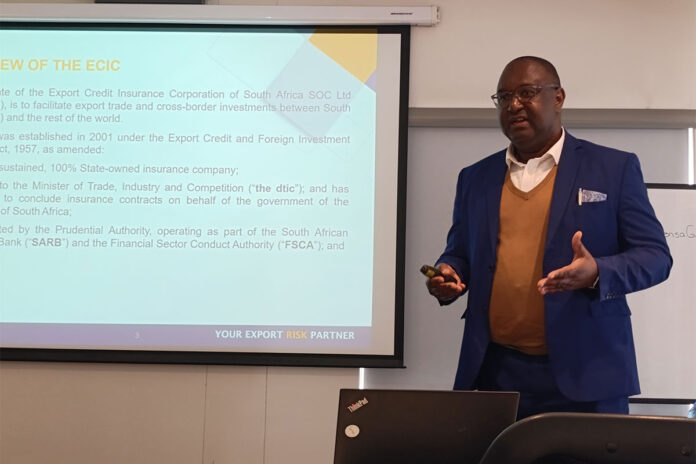
While grants and blended finance could help businesses establish or expand production capacity, Dr Baudouin Mbiya, senior deals originator at the Export Credit Insurance Corporation of South Africa (ECIC), explained how insurance could help them enter foreign markets.
He said economic growth in several other African countries was outpacing South Africa’s, creating opportunities for local companies that were able to supply these markets.
“When you are exporting, you catch the momentum of economies that are moving fast,” Mbiya said.
The ECIC is a state-owned insurer under the DTIC. Its mandate is to facilitate the export of South African goods and services and support investment by local businesses in other countries.
“For me to assist you, you must export or invest outside South Africa,” Mbiya said.
He explained that the corporation did not provide finance directly. Instead, it insured credit providers, primarily banks, against political and commercial risks associated with cross-border transactions.
Political risks included war and civil disturbance, expropriation, changes in legislation, currency-conversion or transfer restrictions, and the failure of a foreign government to honour its obligations. Commercial cover included insolvency or payment default by a foreign buyer.
By reducing the lender’s exposure, the insurance could make banks more willing to finance exporters or their foreign customers.
The ECIC could, for example, insure a working-capital facility when a South African business received a large foreign order but lacked the money to buy inputs and complete it. It could also underwrite much of the value of guarantees required for international tenders, freeing exporters from having to tie up substantial amounts of their own capital as security.
A buyer’s credit arrangement could, meanwhile, allow a foreign customer to finance goods and services sourced from South Africa rather than paying the full amount upfront.
For projects elsewhere in Africa, at least 50% of the ECIC-supported loan amount generally needed to be made up of South African content. A further 20% could come from the host country or another African country. Qualifying South African content included locally sourced materials, wages, transport, insurance, professional services, and the exporter’s profit, Mbiya explained.
Local manufacturing supports exports
Rovensa Next provided a practical example of how local production capacity could support expansion into international markets.
Stoffel Nel, the company’s commercial manager for sub-Saharan Africa, said its 2 300m² facility near Strand had previously manufactured mainly for South Africa and neighbouring countries but had started producing products for markets such as India, China, and Myanmar.
The company was also importing certain products in bulk from Mexico and Spain for packaging in South Africa. Nel explained that this could reduce transport and tariff costs and make products more affordable in African markets, where logistics remained a major cost.
Rovensa Next specialises in biological crop nutrition, biostimulants, biological crop protection, and adjuvants. Nel nevertheless cautioned that biological inputs should not be presented as a stand-alone answer to agricultural challenges.
“There is no way these products can stand by themselves; they must always be used in combination with other products.”
For Nel, sustainability ultimately means keeping farmers economically viable while preserving their farms’ productive capacity.
“For me, sustainability is keeping the farmer on the farm, so that we can continue farming on that specific farm, not only for this generation but for future generations as well,” he said.
Focus on plant nutrition
Dr Michael Southwood, agricultural and horticultural consultant at Southern Cross Trust, announced the SADC Plant Nutrition Symposium, which will be held in Stellenbosch on 19 and 20 November.
The event will focus on fertiliser research, plant nutrition technologies, soil health, precision farming, and regenerative production practices. Proceeds will go towards the Agri Vision Foundation’s food security and entrepreneurship projects in disadvantaged communities.