
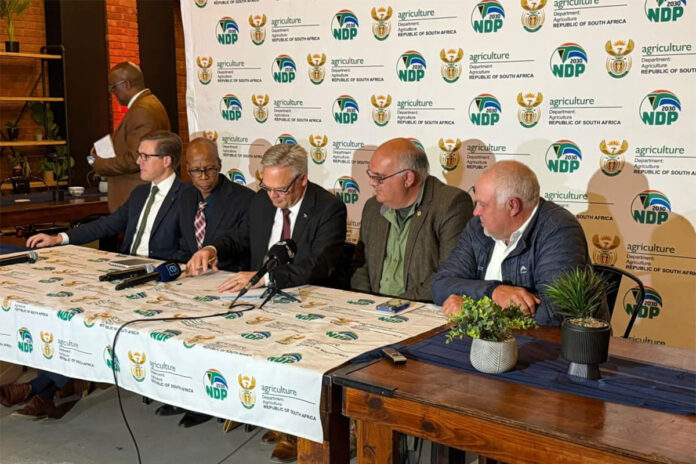
Under the agreement, owners of cloven-hoofed livestock may voluntarily vaccinate their animals, provided they comply with prescribed biosecurity, traceability, and reporting requirements.
The agreement, which will be made an order of court, follows legal action in which the organisations successfully argued that no legal prohibition prevented the private sector from importing and administering vaccines.
The negotiations also included representatives of the South African Health Products Regulatory Authority (SAHPRA), who facilitated the regulatory approvals required for vaccine imports.
Aucamp described the settlement as “a victory for all South African farmers”, saying it demonstrates government’s willingness to work alongside industry rather than attempting to solve the FMD crisis alone.
“The importance of the industry joining hands with government cannot be overstated. There is absolutely no way government could have solved this crisis on its own. If we work together with the private sector and organised agriculture, we will be able to win this fight. Today, I feel confident that we are on the right path and that, collectively, we will defeat this virus,” he said.
He added that the agreement also requires government to give up its exclusive control over FMD vaccine imports and distribution.
“We must now enable the private sector to import vaccines on a large scale. This means the Department [of Agriculture] and Onderstepoort Biological Products will expressly relinquish their exclusive control over the importation and distribution of FMD vaccines.”
Agreement takes effect immediately
Asked how quickly farmers could expect the changes to take effect, Aucamp left little room for doubt.
“This agreement takes effect immediately. Our objective is to implement it without delay. From government’s side, we will immediately do everything within our power to enable the private sector to begin importing vaccines at scale.”
He added that SAHPRA officials have already committed themselves to streamlining the approval process required for vaccine imports under Section 21 of the Medicines and Related Substances Act (No. 101 of 1965).
Faster access to vaccines
One of the livestock industry’s biggest frustrations has been the limited availability of vaccines during successive outbreaks.
Aucamp believes the settlement fundamentally changes that reality.
“By opening additional import channels and ending the exclusive arrangements that previously existed, we will be able to access vaccine supplies much faster than before.
“Government will continue importing vaccines, but private companies will now also be able to import them in parallel. The result should be a much larger supply of vaccines reaching farmers in a far shorter period.”
Aucamp rejected suggestions that government should regulate prices for privately imported vaccines.
“The state will not interfere in the commercial activities of the private sector or dictate pricing. We are creating an environment for healthy competition. The more authorised companies importing vaccines, the more competition there will be,” he explained.
He added that government vaccination programmes will continue, while farmers who choose to go the private route will pay commercial prices for vaccines.
‘The state must become an enabler’
The strongest endorsement of Aucamp’s intervention came from Dr Theo de Jager, executive director of Saai.
“I have not seen this kind of leadership displayed in organised agriculture before. [Minister Aucamp] came in this morning stating clearly how the way forward will look. He emphasised that the state must now become an enabler rather than a stumbling block,” he said.
De Jager described the agreement as a fundamental shift in government’s role.
“Today’s agreement breaks the state’s control over the importation and distribution of vaccines. Most importantly, we have spoken with one another, not past one another.”
He added that the next priority is removing unnecessary bureaucracy.
“Only authorised persons may currently apply to import vaccines. We have agreed that every livestock owner should be able to become an authorised person through a simple application process. Our aim is to make that process as streamlined and largely digital as possible.”
What farmers can expect
De Jager said the creation of a private import channel gives producers immediate options.
Current published prices indicate that the Aftodoll vaccine from Dollvet in Türkiye costs about R45 per dose, while the Bioaftogen vaccine from Biogénesis Bagó in Argentina costs between R45 and R55 per dose, depending on supplier and logistics. Farmers who choose not to purchase vaccines privately will continue to have access to government’s vaccination programme.
For farmers approaching breeding or calving seasons, De Jager said the new system could be particularly valuable.
“Instead of waiting for government allocations, they can obtain vaccines through the private sector once the necessary approvals have been granted.”
He added that several companies have already indicated their willingness to invest in importing vaccines and had suitable cold-chain infrastructure and logistics in place.
Turning the page
Francois Wilken, president of Free State Agriculture, described the agreement as the culmination of a long campaign.
“Farmers have long asked why they cannot obtain and administer their own vaccines. It has been a long road to get here, but today marks an important milestone that changes the way forward,” he said.
Western Cape Minister of Agriculture, Economic Development and Tourism Dr Ivan Meyer said the agreement reflects a spirit of political maturity and partnership, allowing government and industry to focus on supporting farmers rather than pursuing litigation.
“Farmers should not spend their time in court; they should be on their farms producing food.
“As Minister Aucamp said to me today, we are turning the page. This is a new beginning,” he added.
From reacting to preventing
Aucamp believes the most significant part of the agreement lies not in vaccine procurement itself but in the opportunity to fundamentally change South Africa’s disease-control strategy.
“This agreement gives us the opportunity to become proactive rather than reactive. If we succeed in bringing larger volumes of vaccine into South Africa, we will not only vaccinate areas where outbreaks have already occurred but we can also begin to protect high-risk areas before disease spreads. That is a significant change in our national approach,” he concluded.