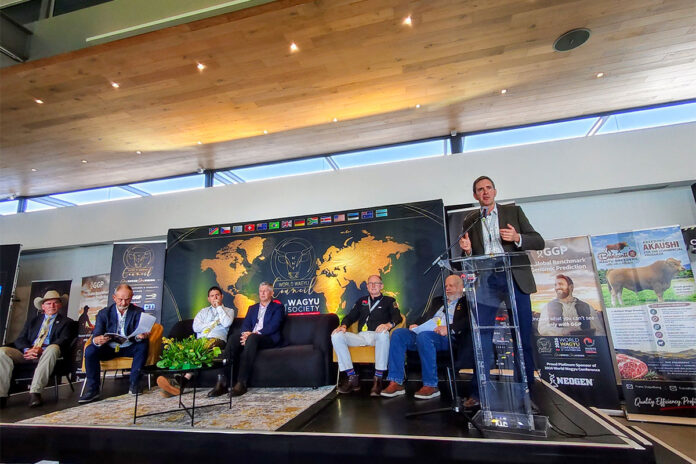
This was among the key messages from representatives of international Wagyu associations during the World Wagyu Conference in Somerset West, Western Cape, on 13 October.
Hosted by the Wagyu Society of South Africa (Wagyu South Africa) under the theme ‘One Breed. One Vision’, the conference highlighted the progress made in establishing Wagyu internationally, as well as the opportunities and challenges facing producers in different markets.
Speaking during the event, World Wagyu Council Chairperson Richard Saunders said the organisation had grown from five founding members in 2015 to the current 14, reflecting the willingness of international Wagyu associations to cooperate despite competing in global genetics and beef markets.
He described the Wagyu industry as a people-driven one, characterised by an openness among breeders to share knowledge and expertise.
“Such cooperation will become increasingly important as the industry seeks to improve genetics, protect the Wagyu brand, and expand its share of the global beef market,” Saunders added.
Protecting the Wagyu brand
A recurring theme was the importance of traceability and certification in protecting the premium associated with Wagyu beef.
Jerry Cassady, executive director of the American Wagyu Association, warned that the high prices commanded by Wagyu created opportunities for other producers to capitalise on the breed’s reputation without necessarily meeting its standards.
The US industry had consequently developed branded beef programmes incorporating stringent marbling requirements to help protect the authenticity and reputation of its Wagyu beef.
According to Saunders, who is also chairperson of the British Wagyu Association, Britain had taken a similar approach through its British Wagyu Assured scheme, which combined DNA sire verification, traceability, and independent audits.
He explained that all F1 cattle participating in the scheme were sire-verified, with independent auditors checking records from identification on the farm through to slaughter.
This provided retailers and consumers with confidence in the product and supported relationships with major supermarket chains, including Waitrose and Aldi.
South Africa has similarly prioritised product integrity through its Certified Wagyu Beef (CWB) programme, introduced in 2018.
Outgoing Wagyu South Africa Chairperson Bob Hobson said the programme was established to give consumers confidence in the authenticity and quality of the beef they purchased.
He added that Wagyu South Africa had 76 registered breeder members and another 36 members participating in the certified beef programme. Its records included more than 7 000 registered full-blood and purebred animals, along with about 28 500 animals registered under the CWB programme.
DNA testing and carcass scanning had also helped establish a valuable database to support future genetic improvement and production decisions.
Other countries are still developing their certification systems. Jasja Kotterman, secretary at Estancia El Álamo in Rocha, Uruguay, said that country already had a comprehensive livestock traceability system but was working towards Wagyu certification covering both breed authenticity and carcass quality.
He added that Uruguay produced about 2 000 full-blood and purebred Wagyu calves and 30 000 F1 calves annually.
Markus Dönz, president of the Swiss Wagyu Association, said Switzerland was also considering certification supported by objective carcass assessment to improve quality assurance and strengthen its market position.
Building commercially viable markets
While demand for high-quality beef was growing, speakers highlighted considerable differences in the ability of national industries to supply established markets.
Uwe Jerathe, co-founder and former chairperson of the German Wagyu Association, said Germany’s industry remained fragmented, with many small producers marketing their beef independently.
The association has 205 members, while the country’s Wagyu population is estimated at about 7 500 animals.
Jerathe said that although producers could supply high-quality beef, their relatively small volumes made it difficult to secure contracts with major retailers, while competition among producers placed pressure on prices.
He believes a centralised feedlot or marketing facility could help overcome these constraints by consolidating production and ensuring more consistent supply.
Switzerland faces similar market-access challenges. According to Dönz, the Swiss association has 42 members and a herd of about 1 500 animals, with farms averaging around 22ha.
He said that although domestic demand was growing, much of it was met through imports, while high export costs left local producers dependent on the domestic market.
Farmers are also largely responsible for marketing their own beef, although emerging partnerships with retailers and marketing businesses are beginning to improve their access to buyers.
Britain, by comparison, has developed a more integrated production and marketing system, largely based on pasture-raised F1 Wagyu cattle produced through crosses with dairy breeds such as Holstein and Jersey.
According to Saunders, the British association has about 40 full-blood and 850 commercial breeders, producing about 2 000 full-blood and purebred calves and 43 000 F1 calves annually.
He said partnerships with retailers, combined with financing and buy-back arrangements for producers, had helped build reliable supply chains while creating opportunities for smaller and younger farmers.
Australia demonstrated the advantages of achieving commercial scale.
Matt McDonagh, CEO of the Australian Wagyu Association, said the country produced about 70 000t of Wagyu beef annually, of which around 60 000t were exported, making it the world’s largest Wagyu beef exporter.
According to McDonagh, the association has about 750 Australian and 800 international breeder members across 40 countries. In Australia alone, annual production is estimated at 250 000 full-blood and purebred calves and 350 000 crossbred calves.
McDonagh said the industry’s success had been supported by commercially oriented production systems capable of consistently supplying the quality and volumes required by international buyers.
However, he added that achieving this scale remained a major obstacle for smaller Wagyu industries, particularly where buyers required hundreds or thousands of animals to maintain regular supply.
The differences are especially evident in emerging industries. The Czech Republic, for example, has just five full-blood breeders, producing about 61 full-blood and purebred calves and 655 F1 calves annually. Costa Rica only has two to three full-blood breeders and four to five commercial breeders.
Closer to home, Botswana’s Wagyu breeders, who fall under the South African association, only produce about 50 full-blood and purebred calves and 400 F1 calves annually. Livestock movement restrictions and high feed costs further constrain production, making it difficult to achieve the volumes needed to access larger markets.
The Namibian Wagyu Society has 34 registered breeders, including 19 producing both full-blood and F1 cattle, and an estimated national Wagyu herd of 7 800 animals. Despite considerable export potential, that country’s industry faces challenges from drought, climate variability, foot-and-mouth disease-related trade restrictions, and export tariffs.
Genetics and future growth
Genetic improvement was another area identified where international cooperation could help narrow the gap between established and emerging industries.
Jerathe said Germany had made progress in improving beef quality through carcass assessment and competitions, but it lacked a central genomic evaluation database.
This limited breeders’ access to information on economically important traits, prompting some to use genetic evaluation services in other countries, including Australia.
McDonagh said the Australian industry, by comparison, had invested heavily in genomic evaluation and carcass performance recording.
He said its database included more than 500 000 high-density genomic profiles, providing an extensive foundation for identifying and selecting desirable production and meat-quality traits.
McDonagh believes sharing this information could accelerate genetic progress around the world.
Cassady sees considerable potential for Wagyu crossbreeding in the US, where more than 70% of the beef cow herd is Angus-based, while Wagyu accounts for an estimated share of less than 1%.
“Growing demand for marbling and improved eating quality could create opportunities to expand the use of Wagyu genetics in commercial herds,” he explained.
However, McDonagh warned that the industry’s premium positioning also made it vulnerable to economic pressures.
He said that with about 85% of Australia’s Wagyu production exported, weaker consumer spending and rising living costs could quickly affect demand.
McDonagh added that consumers might continue buying Wagyu during difficult economic periods, but often purchased smaller quantities or shifted from the highest marbling grades to more affordable alternatives.
Saunders stressed the importance of creating value from the entire carcass rather than relying exclusively on premium steak cuts.
He said that in Britain, products such as Wagyu mince, burgers, and meatballs had helped broaden the consumer market while improving returns from less expensive cuts.
McDonagh believes there is still considerable scope to expand Wagyu’s share of the global beef market, provided the industry continues improving quality and meeting consumer expectations.