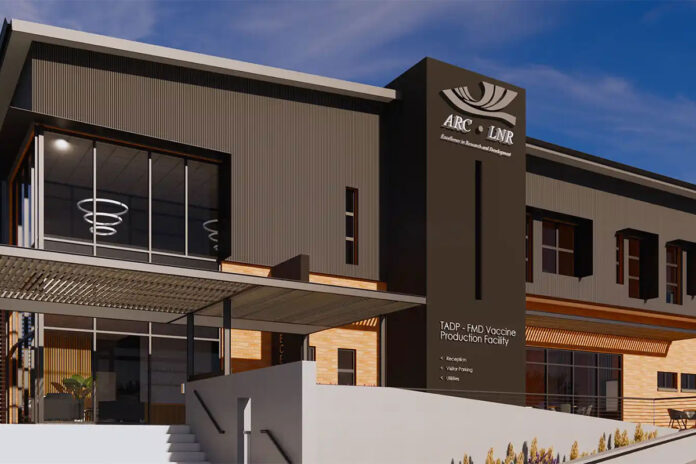
The ARC has confirmed that R453,8 million remains ring-fenced for its proposed FMD vaccine manufacturing facility, but says construction cannot begin until sufficient funding has been secured to complete the project.
This follows concerns raised by the Auditor-General of South Africa (AGSA) during a meeting of Parliament’s Portfolio Committee on Agriculture on 6 October, where members heard that the ARC had received approximately R535,5 million from National Treasury for the facility, yet construction had not started.
By 31 March 2026, R81,7 million had already been spent, while the estimated cost of the facility had increased to approximately R1,6 billion.
Responding to questions from Farmer’s Weekly earlier this week, the ARC said the expenditure had accumulated over more than 15 years and covered FMD vaccine development, technical planning, specialist services, and regulatory compliance.
The organisation attributed the construction delay primarily to insufficient and intermittent funding rather than the absence of preparatory work.
Where the funding has been spent
According to the ARC, the R81,7 million covered a broad range of activities beyond construction preparation. Expenditure included vaccine efficacy and safety testing, production process redesign, and training, including postgraduate qualifications.
Other expenditure involved professional services for electrical, civil, structural, mechanical, and process engineering; architecture; quantity surveying; wet services, and fire services. Geotechnical investigations, topographical and land surveys, assessments of bulk infrastructure, and associated legal and regulatory compliance costs were also included.
These activities formed part of the preparations required for the proposed facility and compliance with City of Tshwane requirements.
The ARC said the vaccine was registered as a stock remedy under the Fertilizers, Farm Feeds, Agricultural Remedies and Stock Remedies Act (No. 36 of 1947) in 2022.
However, the ARC did not provide an itemised financial breakdown showing how much was spent on each activity or service provider, neither did it quantify the value of individual deliverables resulting from the R81,7 million expenditure.
Construction depends on full funding
The ARC said the first funding allocation for the facility was received during the 2011/12 financial year, but the next major allocation only followed during the Medium-Term Expenditure Framework for 2019 to 2022.
According to the organisation, this funding gap delayed construction and contributed to escalating costs.
Other factors included revised design requirements; increased construction and equipment costs; the effects of exchange rate fluctuations on equipment imports; and changes to occupational health, safety, environmental, and construction requirements.
The ARC maintained that the facility could not be constructed in phases because it needed to function as an integrated, compliant vaccine manufacturing plant.
“The ARC can only commit service providers once funding is confirmed for the full project,” the organisation said.
It warned that further delays would increase costs beyond the current R1,6 billion estimate.
Based on the ARC’s current estimated project cost, the R453,8 million still ring-fenced for the project leaves a funding gap of approximately R1,15 billion.
The ARC did not specify where the remaining funds were held, nor did it provide details of a revised feasibility study or business plan supporting the increased project cost.
Asked when construction would begin, when the facility would be completed, and when farmers could expect locally manufactured FMD vaccines, the ARC said commencement depended on confirmation of adequate funding.
No construction or commissioning dates were provided.
Audit improvement does not resolve infrastructure delays
The AGSA’s findings also highlighted delays in strategic vaccine infrastructure at both the ARC and Onderstepoort Biological Products (OBP).
Desmond Phungula, senior manager at the AGSA, told the committee that the ARC had maintained an unqualified audit opinion for the second consecutive financial year. This represented an improvement in organisation’s financial reporting after earlier qualified opinions.
An unqualified audit opinion means an institution’s financial statements are fairly presented in all material respects. It does not necessarily mean that projects have been completed efficiently or that all expenditure has achieved its intended objectives.
However, issues relating to financial reporting and asset management remained, while the AGSA also identified continuing procurement and compliance weaknesses across the agricultural portfolio.
The AGSA identified the ARC and OBP as significant contributors to unresolved irregular expenditure within the portfolio.
The presentation also highlighted weaknesses in procurement processes, including uncompetitive procurement, contracts extended without the necessary approvals, and bids not evaluated according to prescribed criteria.
The ARC was also among the institutions identified as experiencing delays in paying creditors.
The AGSA acknowledged the ARC’s progress in financial reporting but emphasised the need for continued improvement in compliance and performance management.
OBP remains under scrutiny
While the ARC retained its unqualified audit opinion, OBP received another qualified opinion for the 2025/26 financial year.
The AGSA identified ongoing problems with financial reporting, inventory management, and property, plant, and equipment, as well as prior-period accounting errors. Weak record-keeping, inadequate financial controls, and instability in senior leadership contributed to recurring findings.
The AGSA also raised concerns about OBP’s incomplete good manufacturing practices (GMP) facility. OBP received approximately R492 million towards the project in 2013, but construction was halted in 2021.
Minister of Agriculture Willie Aucamp told the portfolio committee that completing the facility could now cost billions of rand.
Referring to an earlier oversight visit, Aucamp said: “We did oversight there when I was still a member of this committee, and there’s nothing to show for [the GMP facility] apart from a storeroom and a number of building supplies lying in it.”
He said the Special Investigating Unit had initiated an investigation and that he was awaiting its report.
Imported vaccine costs questioned
The AGSA also raised concerns about the cost of imported FMD vaccines procured through OBP.
During the portfolio committee meeting, the AGSA reported that it could not obtain sufficient evidence to determine whether the Department of Agriculture’s (DoA) expenditure of R311 million on 3,42 million vaccine doses represented an economical purchase or value for money.
The findings did not establish wrongdoing but raised questions about procurement costs and the efficiency of public expenditure.
According to the AGSA, import and handling costs charged through OBP increased the price of vaccines and reduced the number of doses that could be purchased with available funding.
Aucamp confirmed that OBP’s board was investigating the prices paid for imported vaccines and the amounts subsequently charged to the DoA and provincial governments.
“We should never be in a position where the farmers in this country are paying an exorbitant amount of money while an entity like OBP makes a profit from something it doesn’t even manufacture,” he told the committee.
Inge Mulder, OBP’s chief financial officer, said the organisation had sold approximately 17,5 million vaccine doses during the financial year, including 2,5 million imported FMD doses.
She said OBP manufactured its other vaccine products locally, although it remained dependent on international suppliers for certain raw materials.
Accountability and timelines remain unresolved
The AGSA recommended that the portfolio committee request quarterly progress reports on the implementation of corrective action plans and regular updates on the ARC and OBP projects, alongside stronger oversight of procurement, vaccine pricing, and appointments to critical management positions.
Aucamp acknowledged the seriousness of the recurring audit findings and said the DoA was committed to addressing weaknesses in governance and financial management.
“We don’t want to sit here again next year and give the same excuses for the same things that were done wrong,” he added.
In its response to Farmer’s Weekly, the ARC did not indicate whether an internal investigation or review into the delays and expenditure had been undertaken, or whether any corrective or disciplinary measures had resulted.