Spanish agritech company Polyfly, working with local pollination specialist Bee-Tech Group, has introduced two hoverfly products to South Africa: Queenfly® (Eristalis tenax) and Goldfly® (Eristalinus aeneus).
Speaking at a hoverfly pollination field day near Simondium in the Western Cape earlier this week, Christopher Duran, business development manager at Polyfly, stressed that the insects are not intended to replace honeybees.
“Our goal is to offer an alternative. On some crops, hoverflies may perform better; on others, they may be as effective as bees, while bees will remain the better option for certain crops.
“In many applications, however, combining the two has improved overall pollination activity, with some growers achieving better yields than when using either bees or hoverflies alone,” he explained.
Pressure on honeybees
Michiel Bruggeman, director of Bee-Tech Group, said South Africa’s beekeeping industry faces several challenges, including hive theft, declining forage resources, an ageing beekeeper population, and a shortage of suitable, safe sites for colonies.
Honeybees also experience considerable stress when kept under nets for extended periods, particularly in crops such as blueberries.
“Having a backstop and developing other ways to pollinate is healthy for both the bee industry and the fruit industry,” Bruggeman said.
Hoverflies offer several practical advantages. They do not sting or form colonies, and each adult forages independently. Unlike honeybees, they do not communicate the location of more attractive food sources to one another, which may make them less likely to leave the target crop for competing flowers nearby.
Duran added that hoverflies also remain active under cool, cloudy or windy conditions when honeybee activity declines.
Another potential benefit is biosecurity. Bruggeman said that because the flies are reared under controlled laboratory conditions and supplied as pathogen-free insects, they are less likely to introduce disease-causing organisms when moved into a production site.
As they are mass-reared specifically for pollination, their numbers can also be replenished through another release if adverse conditions or an unavoidable crop-protection treatment causes losses.
Queenfly Or Goldfly
Although both species perform the same basic pollination function, they are suited to different conditions.
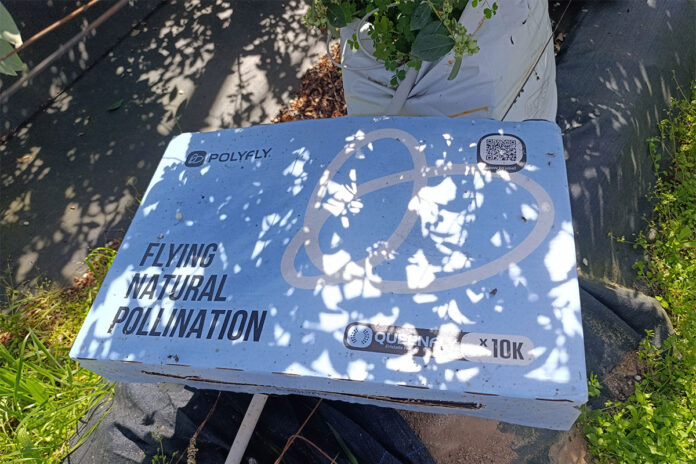
Queenfly is the larger of the two and is supplied in blue-labelled boxes. It becomes active at temperatures of about 8°C to 10°C and continues working at temperatures of up to about 30°C, making it better suited to cooler production periods like winter and early spring. Adults can live for three to six weeks under suitable conditions.
The smaller Goldfly, supplied in yellow-labelled boxes, is adapted to warmer conditions. It becomes active from about 15°C and can tolerate temperatures of roughly 35°C to 40°C, making it more suitable for late spring and summer.
The Goldfly’s lifespan is about half that of the Queenfly’s. However, its smaller body is advantageous in crops with small or narrow flowers that are difficult for larger pollinators to enter.
Adult hoverflies feed mainly on nectar for energy, while also consuming small quantities of pollen. Unlike honeybees, they do not have a hive or stored food reserves to rely on. They must therefore forage daily, moving between flowers and transferring pollen in the process.
Although the hoverflies are not sterile, they are unlikely to reproduce. Duran explained that they require a specific environment and a sufficiently diverse food supply to reach sexual maturity, and most would die before reaching that stage.

How are they used?
The hoverflies are imported from Polyfly’s production facility in Spain as pupae and are packed in ready-to-use cardboard release boxes.
The boxes are placed in the crop, preferably at the start of flowering. About half the adults typically emerge within 48 hours, while the remainder can take between seven to 10 days.
After emerging, the flies need between 12 and 24 hours for their bodies to strengthen and their wings to expand before they can begin visiting flowers.
They are only active during the day. Instead of returning to the release box at night, they settle elsewhere in the crop and resume foraging the following day.
According to Duran, application rates depend on the type of crop, planting density, production environment, flowering period, and whether honeybees are also being used. Repeat releases may be required to maintain sufficient numbers throughout flowering.
In open orchards, Duran recommends placing the boxes near the centre of the production block. Early South African observations have suggested that the flies remain close to the target crop, even under windy conditions, but this still needs to be confirmed through research.
Local trials under way
Polyfly began supplying hoverflies to South African seed-production companies in 2025. Their use and evaluation have since expanded to blueberries, avocados, cherries, strawberries, macadamias, peppers, and tomatoes.
Controlled trials are comparing honeybee pollination, hoverfly-only treatments, and combinations of the two, with researchers measuring the effects on fruit set, yield, and quality.
Bruggeman cautioned that it was too early to draw conclusions from the local work: “It takes time to build the data, because farming works from season to season.”
Importing the flies from Spain remains a complicated and expensive exercise, and a direct cost comparison with honeybee pollination is not yet available. Local production could become viable if sufficient demand developed, but Duran said the immediate priority was to prove the concept under South African conditions.
Commercial results will eventually determine whether hoverflies secure a lasting place in local pollination programmes.
“Ultimately, it could be a neat product, but if it doesn’t make you money, there’s no point in doing it,” Bruggeman said.