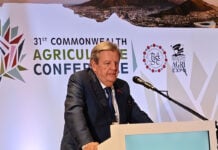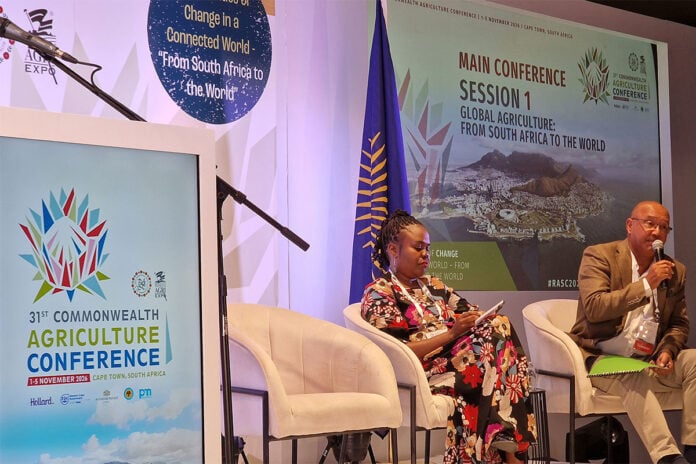
The opening day of the 31st Commonwealth Agriculture Conference, held in Cape Town from 1 to 5 November, examined not only the growing pressures facing farmers worldwide, but also practical ways to help emerging farmers build commercially viable agribusinesses.
Christo van Der Rheede, former CEO of AgriSA, argued that South Africa should move beyond the notion of separate commercial and emerging farming industries and instead focus on creating what he described as “one agricultural future”.
He said the success of established and emerging farmers was linked, as both depended on the same infrastructure, logistics systems, markets, and policy environment.
According to Van Der Rheede, meaningful transformation requires more than support programmes; it requires helping farmers to build independent, competitive businesses capable of succeeding in local and international markets.
“We must move deliberately and decisively from two agricultures to one agricultural future,” he said
Empowerment through commercialisation
Van Der Rheede added that the success of development programmes should ultimately be judged by whether participants progressed to running sustainable commercial enterprises.
“True empowerment should be measured by graduation. Our ambition must be that they manage their enterprises with such commercial discipline, agronomic precision, and financial acumen that one day that qualifying label [emerging farmer] disappears entirely. They should simply be called farmers,” he explained.
He also highlighted the growth of South African agricultural exports over the past two decades, noting that they reached a record US$15,1 billion (approximately R266,2 billion) in 2025, compared with less than US$2 billion (under R12,7 billion) in 2005, representing an increase of roughly US$13,1 billion or over 650% growth in USD terms.
Van Der Rheede said these figures highlighted the need to create opportunities for more emerging farmers to access competitive value chains and participate in these international markets.
Mohair project shows transformation in practice
Delegates later heard from Beauty Mokgwamme, manager of the Mohair Empowerment Trust (MET), who outlined how the MET is helping previously disadvantaged Angora goat farmers develop commercially sustainable farming businesses.
MET representatives said its programmes focus on helping farmers move beyond subsistence and small-scale production to more established commercial operations.
“Our main objective is to commercialise previously disadvantaged farmers,” Mokgwamme said.
She explained that, since its establishment in 2010, the MET has assisted about 20 farmers and is currently supporting nine projects. Beneficiaries receive livestock, training, mentorship, and technical assistance, while experienced commercial producers provide guidance on flock management, production practices, and business planning.
The MET’s approach is designed to reduce long-term dependence on support programmes by helping participants build profitable farming operations capable of standing on their own.
Together, Van Der Rheede and Mokgwamme’s presentations reinforced a recurring theme throughout the conference: successful agricultural transformation depends not only on finance, but also on mentorship, market access, partnerships, and the transfer of skills needed to build resilient farming businesses.
In closing his address, Van Der Rheede said South Africa’s greatest agricultural asset was its people.
“The most vital crop we cultivate in South Africa is not maize, not citrus, not wheat, or grapes. It’s human potential,” he said.