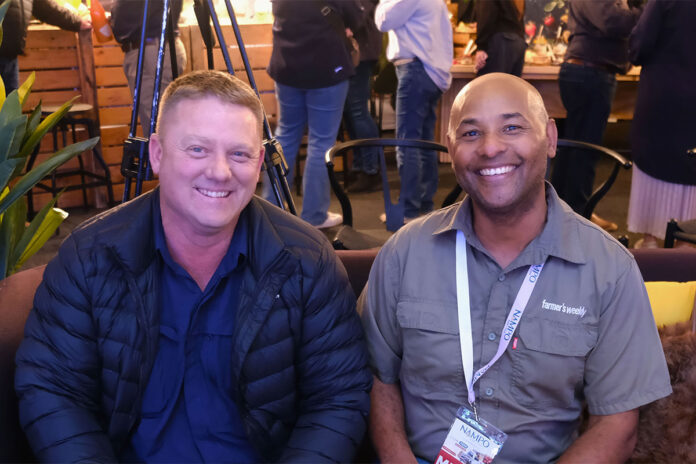
Irrigation farmers have been going through tough times over the past few years, said Fanie Botha, a cattle and irrigation grain farmer from Luckhoff, on the border between the Free State and the Northern Cape.
Noting that he was not necessarily speaking for himself, he told Farmer’s Weekly in an interview that smaller farmers are often not able to implement the practical steps that are generally advocated by advisers and financiers to improve resilience, such as “building up the soil” by adopting conservation agriculture practices and increasing soil organic matter.
“Your equipment does’t work for free, nor do your pivots or your staff. Everything that you use has become more expensive – electricity, fertiliser, diesel – but your income has not gone up.”
Botha said all farmers would like to improve their land and invest in their businesses, but it is not possible to invest capital one does not have.
“What [the experts] said is all good and well – building up the soil and restoring the soil with certain crops. But the reality is that as an irrigation farmer you are farming cash crops, and the steps you need to take to be able to farm with fewer inputs cost money. Farmers are offered all sorts of doepas, each one better than the previous one, but the farmer cannot buy every last product to improve the soil. You cannot have such high input costs that you end up not making a profit. So you cannot spend more money to improve your soil or yield and at the end of the season the input costs cause you to make a loss.
“We all understand that it is good to improve the soil, but how do you do that at a negative maize price, a negative wheat price and at the price of new equipment and fertiliser? Just take a walk around Nampo and see what these things cost. It all costs money, and the more money you spend, the less profit you make, and if you make less profit, you might end up not farming next year. And in the meantime your soil isn’t improving, it may in fact be getting worse, but you don’t have a choice but to continue, otherwise you definitely won’t survive.”
Stuck in reverse
Botha said the profits in maize and wheat farming have become so razor-thin that it has become unaffordable for smaller farmers to replace their equipment.
“The scale is simply too small. Twelve years ago a combine harvester cost R2 million; now it costs R5 million plus. Your farm did not get bigger but everything else got more expensive and your income stayed the same or went down. You cannot produce more on a limited number of hectares, and if you can’t replace your equipment, you simply fall behind. Land has become so expensive that a smaller farmer cannot afford to buy more land, so in the end smaller farmers just survive; they’re no longer going forward.
“We’re still better off planting in order to cover existing costs than not planting at all, but you know for a fact you’re going backwards.”
Profit becomes harder to achieve
He said while government talks about food security, it becomes impossible to invest in one’s business. No farmer is going to plant maize or wheat if the price is so low and they are unable to make any money.
“A month ago the farmer’s price for yellow maize was R2 900/t, but at the moment it is R3 800/t. Plenty of farmers had to sell at the low price. Then we heard that grain prices would go higher, but I must ask if the prices are expected to get so high, how will the consumer afford it? The prices of everything is getting out of hand.
“When we had to plant this season, the price of ureum shot up from R8 000/t to R16 000/t. Input costs on other fertilisers also increased by up to R6 000/t, and the diesel price rocketed while the grain prices went down.
“So the experts say you must market your commodities when the price is right, but many farmers have to sell in order to pay someone. You can’t hold back your crop when you have payment obligations.”
Botha said most farmers want to build up their soil and improve it, but not every farmer can afford to do so.
“On paper it is easy to become a millionaire, but in reality it is not that easy. Farming is a business and you must make money. Someone told me long ago that not everything you do has be for money; you must also love and enjoy it. But in reality you could lose everything you love to do if you don’t make any money. With these high input costs and low prices, farmers are slowly suffocating. And the reality is: no farmers, no food.”