
The mission, believed to be the first to send seeds from an indigenous South African plant species into space, will see the rooibos seeds flown to the United States in August before being launched aboard a SpaceX Falcon 9 rocket during a planned October mission to the ISS. The seeds will spend about six weeks in orbit before returning to Earth.
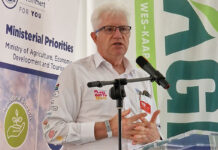
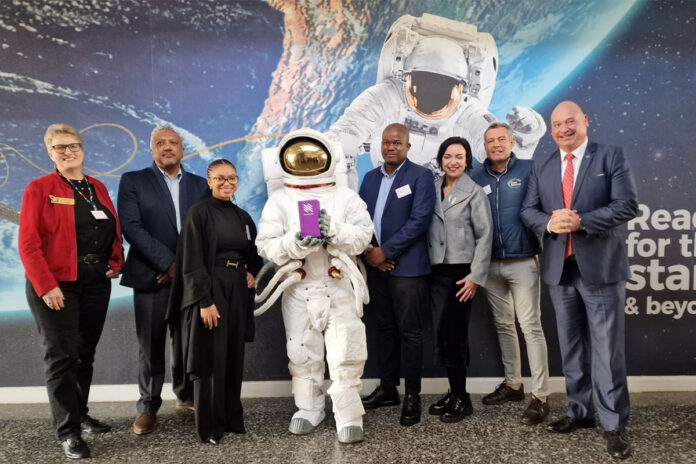
Dawie de Villiers, director of the South African Rooibos Council (SARC) told Farmer’s Weekly following the launch of the Rooibos in Space programme in Cape Town on Thursday 16 July 2026, how the project combines agriculture, space science and education.
He says it offers South African learners a rare opportunity to participate in a real-world space research programme.
“Rooibos has long been part of South Africa’s agricultural heritage. This project places it within a broader scientific context, where plant biology, space research and education intersect,” De Villiers says.
The programme, developed by SARC in partnership with MaxIQ Space and supported by the South African National Space Agency, will expose rooibos seeds to microgravity and space radiation before it is returned to South Africa for evaluation.
Judi Sandrock, founder and director of MaxIQ Space, who are responsible for getting the experiments onboard the space programme, adds that the exact launch date in October has not yet been confirmed as launch schedules remain subject to operational and logistical considerations.
“The seeds will spend about six weeks on the International Space Station before returning to Earth, where learners, researchers and growers will be able to evaluate the results alongside the control seeds,” Sandrock says.
De Villiers says unlike many scientific experiments, the mission is not designed to prove a specific theory.
“We do not have a hypothesis. It is purely exploratory. Maybe the seeds will perform in some different way, which would prompt us to move into more in-depth research.”
Seeds travelling inside a NanoLab
Sandrock showed Farmer’s Weekly a prototype of the NanoLab that will house the seeds during the mission.
“A total of 14 experiments are going on the International Space Station later this year, with two containers holding the rooibos seeds,” she explains.
The compact laboratory will carry a range of South African-led experiments developed by learners, researchers and technology innovators.
“Among them is a radiation sensor developed through a collaboration involving the University of Cape Town, which will monitor the radiation environment experienced by the seeds while in orbit,” says Sandrock.
Importantly, the project’s scientific and educational benefits are already being realised, long before the NanoLab reaches orbit.
Among the experiments travelling to the ISS is the SpringBot single-board computer, a South African-designed and manufactured platform programmed by Grade 6 learners at Parklands College.
“The learners have developed the code that’s going to go on the SpringBot computer, and what that code is going to do is read the sensors and save that data for analysis back on Earth,” Sandrock explains.
Back on Earth
Once back on Earth, the seeds will be distributed for planting and evaluation.
Learners from seven schools in the Cederberg, the birthplace of Rooibos, will work alongside local growers and researchers to compare the space-flown seeds with a control batch that remained on Earth, De Villiers says.
“The germination of the seeds will be measured. The performance of those will be measured against a controlled batch of seeds.
“There are various ways of measuring that: of what plants are growing, what shape the bushes are appearing in, are they growing sideways or erect? All of those are the measurements we will be conducting, and schools will be doing that as well,” explains De Villiers.
Researchers will compare germination rates, plant growth, vigour, bush shape and overall development between the space-exposed and control plants.
“Just the act of going to space, being in microgravity and being exposed to space radiation, will it have an effect on the seeds or not? That is what we want to determine,” says De Villiers.
Updates will be shared via the official website at www.sarooibos.co.za.