
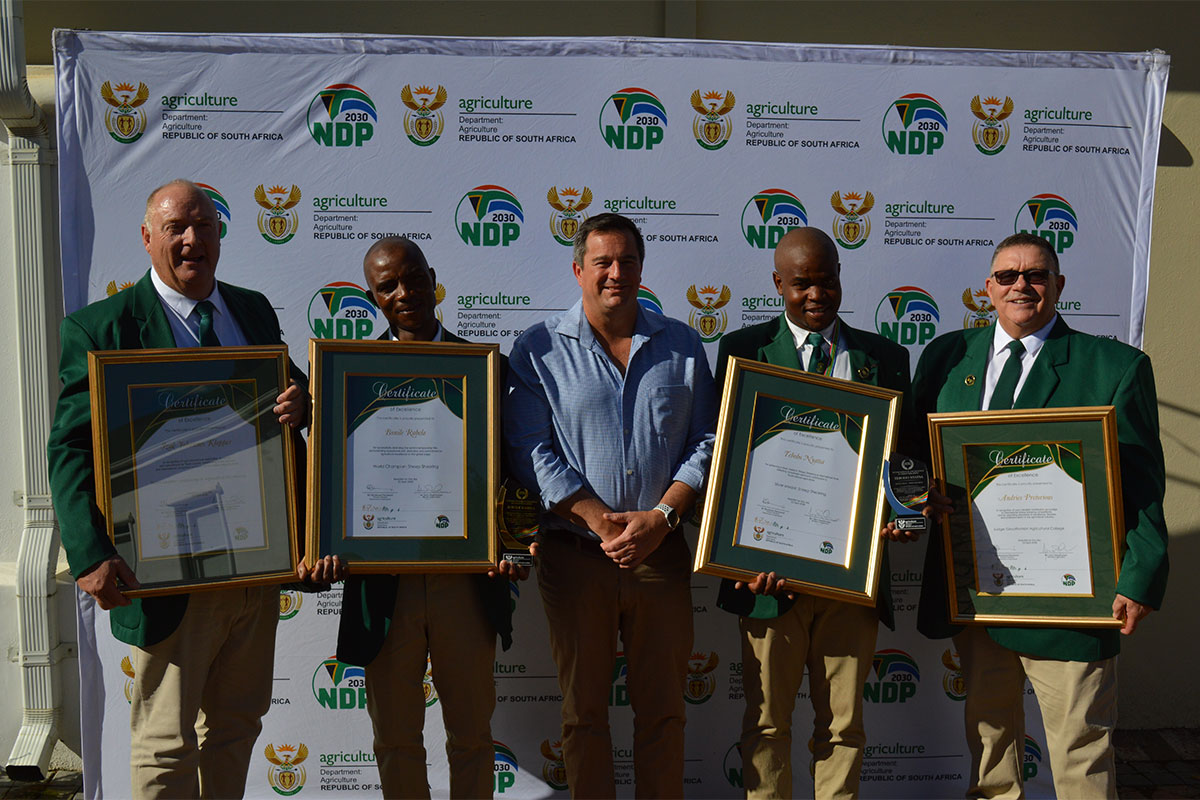
Rabela successfully defended his title as the World’s Best Hand Shearer, reaffirming his position at the top of the sport. In other events, he and Nyatsa secured silver in the team hand shearing division, while Nyatsa claimed gold and Rabela bronze in the All Nations category.
Participants from 26 countries competed in Masterton, where the first competitive shearing championships were held in the 1960s.
The recognition ceremony was held at Beyerskloof Wine Estate in Stellenbosch, Western Cape, on Thursday, 23 April 2026.
“We are not simply marking a win; we are marking a sustained standard of excellence that very few countries, in any field, are able to maintain. For the sixth consecutive time, South Africa has been crowned world champion in hand shearing at the Golden Shears Championships,” said Steenhuisen.
He praised the team’s consistency and diligence under team manager Izak Klopper, who has led them for 30 years. He also recognised Andries Pretorius of the South African Sheep Shearing Federation, an international wool handling judge at the championship and a lecturer at Grootfontein College of Agriculture.
Challenging sheep
Speaking to Farmer’s Weekly, Rabela, who hails from Sterkspruit in the Eastern Cape, said that while the team is used to handling docile breeds like Merino and Dorper, they had to contend with tougher New Zealand breeds, specifically Perendale-type sheep.
“Their sheep had longer wool and were harder to handle than our Merinos. I performed well with the help of Klopper and the team, despite injuring my hand during an intense training camp in New Zealand days before the competition,” he said.
Nyatsa, who lives in a village outside Burgersdorp in the Eastern Cape, said, “Everyone at the championships was impressed with our abilities. People even bought our locally made shears after we won gold and silver in the finals.”
Dan Kriek, general manager of the National Wool Growers’ Association, said, “It is an extremely important year for the wool industry. The tears of this winning team reflect the closeness of our industry, much like what Siya Kolisi and the Springboks brought to South Africa.
“As an industry, we invest heavily in training and supporting shearers. They are the basis for our exports because the quality of the wool depends on them.”
Danielle Heyns, a South African journalist based in New Zealand, covered the championships for her regional paper. She said it reminded her of the Springboks’ record 43–10 victory over the All Blacks in Wellington in 2025.
“It’s always special to see South Africa win, especially in New Zealand. Like with rugby, the New Zealand team is seen as the best in the world, and every competitive shearer wants to work here for a while,” she told Farmer’s Weekly.
“What makes competitive shearing fascinating is that most shearers also do it for a living. Seeing someone go from shearing on a South African farm to winning on the world stage makes it even more special, and you can’t help but feel proud of how far our shearers have come.”
Local support and industry warning
Mooketsa Ramasodi, Director-General of the Department of Agriculture, said at the recognition ceremony that sheep shearing requires great skill.
“Sheep shearing is a passion, and our men represented here elevated it to an art form. They define our farming communities. We also acknowledge how they support our wool industry, with this legacy passed on through generations. Farmworkers are fundamental to the industry.”
He also warned that amid the ongoing foot-and-mouth disease (FMD) outbreak, shearers must take care when handling animals.
“The virus can spread during shearing, which increases the risk. We urge all shearers to take care and to clean and shear healthy flocks first before moving on to others.”
Klopper concluded: “The championships will be held in Australia next year, and the chosen sheep are Merinos. For any South African, the next best thing to beating New Zealand is beating Australia.”