Europe’s drive to cut industrial carbon emissions is running into a stubborn bottleneck: the electricity grid. Manufacturers across the continent are being urged to electrify their processes and move away from fossil fuels.
Yet in many countries, they cannot access the additional grid capacity needed to power electric boilers, heat pumps, and other low-carbon technologies.
In the Netherlands, the situation has become particularly acute. Eurelectric’s Power Barometer 2025 shows that more than 14 000 Dutch businesses are currently waiting for new or upgraded electricity connections, with delays stretching from eight to 12 years for high-voltage infrastructure.
Against this backdrop, Royal Avebe, a co-op owned by Dutch farmers, has demonstrated that industrial electrification can move ahead, even within strict grid limits.
At its production site in Foxhol, Groningen, in the north of the Netherlands, Royal Avebe has worked with Schneider Electric and software specialist AVEVA to replace fossil fuel-based process heating with an industrial electric boiler. Crucially, the project was completed without increasing the site’s maximum grid connection.
The facility produces starch derivatives and plant-based ingredients from potatoes supplied by member farmers. These ingredients are sold to food manufacturers across Europe and are used in products ranging from baked goods to soups and sauces. Process heat is central to such operations, traditionally generated by burning natural gas.
The challenge Royal Avebe faces is common to many food processors: how to decarbonise energy-intensive production in a country where grid congestion has become a major obstacle to expansion and electrification.
According to Eurelectric’s report, more than 1 700GW of clean energy and electrification projects are currently waiting in grid connection queues across the continent. In December 2025, the European Commission acknowledged that at least 16 EU member states are grappling with grid connection backlogs, slowing both climate action and economic growth.
For manufacturers, the contradiction is stark. They are under pressure from regulators, customers, and investors to cut emissions, yet they face a decade-long wait for the electrical capacity needed to do so.
A practical workaround
Rather than joining the queue for additional grid capacity, Royal Avebe and its partners rethought how the Foxhol plant uses and manages energy within its existing limits.
The project involved installing a new industrial electric boiler and eliminating fossil-fuel heating in the targeted production area. But the key innovation lies in the digital energy management system built around the upgrade.
More than 1 000 data points across the site, including 542 smart medium-voltage relays, were integrated into a single real-time monitoring and control platform. This system provides a unified operational view of electricity consumption, process performance, and grid interaction.
In simple terms, the plant now ‘thinks’ about its electricity use.
When demand on the national grid rises and the risk of congestion increases, the system can automatically adjust and shift electrical loads to ensure the site remains within its contracted maximum capacity.
When renewable energy is abundant on the grid and demand is lower, the plant can increase consumption and absorb surplus power.
In this way, the facility has effectively become an active ‘prosumer’, both producing and consuming energy services. Instead of simply drawing electricity from the grid, it also helps to stabilise it.
Importantly, this approach required no reinforcement of the public grid connection. The electrification was achieved entirely within the site’s existing contracted limits.
Clear climate targets
The electrification roadmap directly supports Royal Avebe’s target of reducing emissions by 30% by 2030, alongside a continuous annual energy-efficiency improvement of 1,5%.
For a farmer-owned co-op, these gains extend beyond the factory gate. Lower-emission processing strengthens the sustainability credentials of its starch and plant-protein ingredients sold to food manufacturers who, in turn, face their own climate commitments.
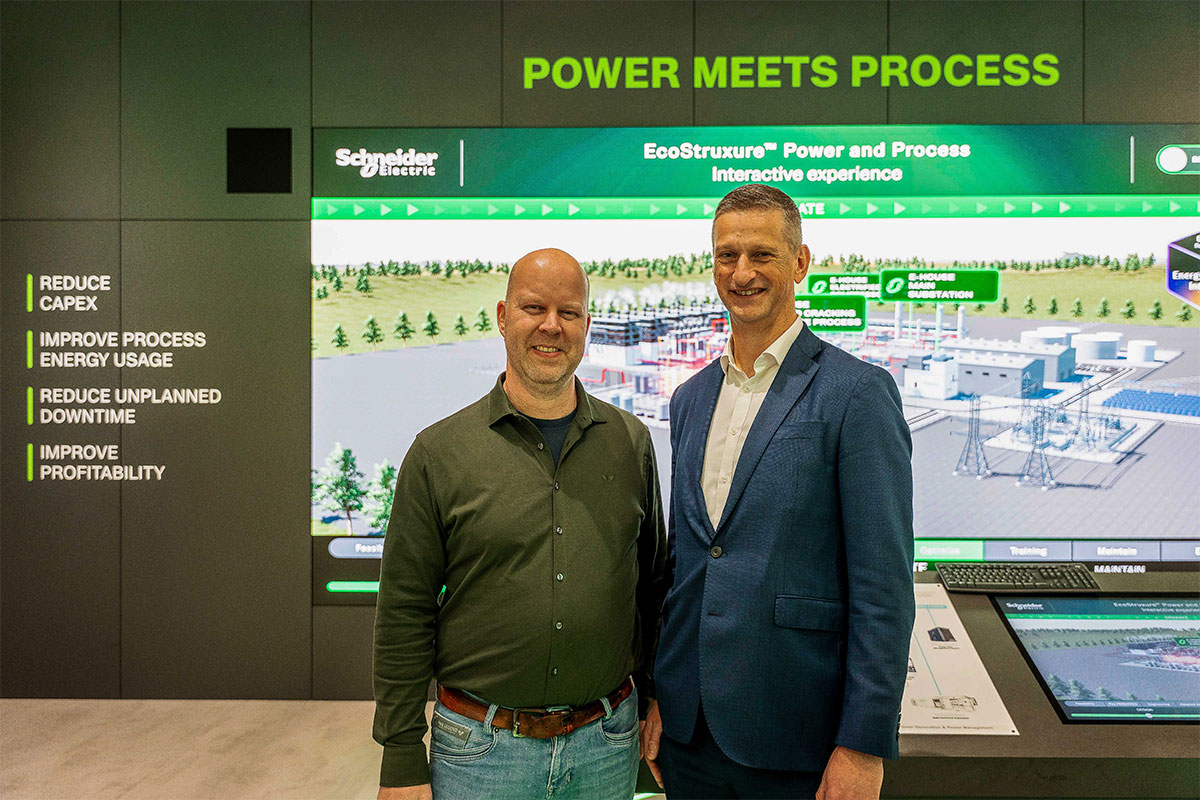
Speaking at the launch of the project at the 2026 Hannover Messe industrial fair in Germany in April, Joyce de Vries-Pieterman, director of communication and public affairs at Royal Avebe, said further electrifying production processes is a key step in making operations more sustainable.
She said that, together with its technology partners, the co-op is demonstrating that meaningful progress towards more energy-efficient and future-proof production is possible within the limits of an existing grid connection.
Neil Smith, president of consumer packaged goods at Schneider Electric in Switzerland, described the Foxhol project as a proof of concept for industrial Europe, adding that grid constraints do not have to mean delays in decarbonisation.
Technology backbone
The digital architecture underpinning the project integrates power automation, process control, and real-time operational insight.
Schneider Electric deployed its EcoStruxure Foxboro distributed control system for unified process control, alongside its Electrodynamic Controller for real-time load management. Operator visibility is provided through EcoStruxure Control Human-Machine Interface, while engineering and configuration are handled through EcoStruxure Power Automation System Engineering.
The system is integrated with the AVEVA PI data platform, which consolidates information from smart relays and legacy devices into a single operational view.
While the technical terminology is complex, the principle is straightforward: measure everything, understand what is happening in real time, and actively manage energy use rather than treating electricity as a fixed, passive input.
A model for replication?
Energy-intensive sectors such as food and beverages, chemicals, and paper account for a significant share of Europe’s remaining industrial emissions, and many are facing similar grid constraints.
Royal Avebe’s approach, combining electrification, digital monitoring, and dynamic load management, is designed to be replicable at other sites across Europe. By creating additional capacity within existing connections and supporting grid balancing, such projects may also help ease congestion pressures for other users.
For farmers and agro-processors keeping an eye on developments from outside Europe, the message is clear: grid limitations need not automatically stall decarbonisation plans. With careful planning, digital tools, and a willingness to rethink energy management, meaningful emissions reductions can begin today, even before new transmission lines are built.