

Artificial intelligence (AI) is rapidly moving from novelty to a practical business tool. Across South Africa, organisations that initially experimented with chatbots, content generation, and simple automation are beginning to ask a more scaling question, how should AI be incorporated into daily operations in a way that creates lasting value?
This is particularly important for the South African agricultural sector, where producers are facing an expanding burden of digitisation, record-keeping, and traceability. AI may offer valuable support, but the answer is not simply to use more of it. The technology must be applied deliberately, responsibly, and in response to clearly defined problems.
Businesses must first understand the problem they are trying to solve, determine where human judgement remains essential and then select the appropriate technology solution. When AI is allowed to define the problem and provide an unquestioned answer, the organisation gives up control of its own decision-making. A more responsible approach is to retain ownership of the problem while using AI to support the process of solving it.
Three ways to use AI
According to AI implementation expert Dr Francois du Plessis from Grey Matter, AI can broadly be applied in three ways.
Vending machine
The first is the ‘vending-machine’ approach. A user enters a question, receives an answer and accepts the result without examining the reasoning behind it. This is fast, but it is also risky. When the answer is incorrect, incomplete or misleading, the user may lack the knowledge required to recognise the problem. Over time, this form of use may also weaken the critical-thinking and problem-solving abilities of employees.
Augmentation
The second approach is augmentation. In this model, people remain responsible for thinking, evaluating and deciding, while AI assists with research, analysis, comparison, drafting, data processing and administrative work. This is generally the most appropriate model for knowledge-intensive businesses because it combines the efficiency of AI with human experience, judgement and accountability.
Embedding AI
The third approach involves embedding AI within a product or service so that the end user does not need to understand the underlying technology. This can be particularly useful in agriculture. A farmer does not necessarily need to know how a predictive model, computer-vision system or language model functions. The farmer needs a tool that is simple to operate, produces useful information, and supports a practical decision.
The choice between these approaches matters. In editorial work, management, consulting and other fields where judgement is central, augmentation should usually be the default. In products developed for farmers and other operational users, it may be preferable to keep the technological complexity behind a simple and accessible interface.
Agriculture’s data opportunity
One of AI’s greatest potential advantages in agriculture is its ability to process large volumes of data. Agriculture generates extensive information from weather records, soil analyses, production systems, markets and farm-management activities. Sifting through these datasets and extracting useful, timely information is beyond the capacity of most individual producers without technical assistance.
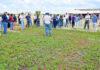
At a recent workshop hosted by Syngenta, Martin Clough, Syngenta Crop Protection’s R&D head of digital collaboration and sustainability, explained that the implementation of AI at the farm-production level has been relatively slow. However, the technology is already having a significant real-world effect on research and development in the crop-protection sector.
AI enables companies to research and develop increasingly effective crop-protection products more quickly, while also seeking to reduce their environmental impact. This demonstrates that the value of AI in agriculture is not limited to visible farm applications. It is also transforming the research, testing, and product-development systems that support primary production.
The real constraints are organisational
Discussions about South Africa’s readiness for AI often focus on electricity, infrastructure, skills, and data governance. All four are important, although not always in the way businesses expect.
Data governance is a genuine and immediate concern. Before an organisation uploads documents, client information, production records or proprietary data into an AI system, it must establish who owns that information, where it will be stored, who may access it and how it will be protected.
Du Plessis expands on this: “The skills challenge is also more complex than simply teaching employees how to write prompts. It is increasingly easy to ask an AI system to produce an article, analyse a spreadsheet or build a basic software tool. The scarce skill is the ability to design the task correctly, evaluate the output, document the process, and maintain the resulting system. The danger is not that a business cannot get AI to produce something. The danger is that it is left with a result that has no design documentation behind it, which cannot be understood, maintained, or repaired once the person who prompted it has moved on.”
A business that accepts an AI-generated product without understanding how it was created may therefore be left with something that cannot be corrected, adapted, or repaired. The real skills gap is not the ability to make AI to produce an answer – it is the ability to use AI in a controlled, transparent, and maintainable way.
The opportunity is not to chase the newest tool
According to Du Plessis, AI capabilities are developing faster than most employees, customers, and managers can follow. This creates a widening gap between what the technology can do and what organisations can understand, control, and use effectively.
Businesses that continually chase the newest AI application may implement systems that their own staff cannot explain and their customers do not trust. The greater opportunity lies in using mature, well-understood technologies to solve genuine problems.
Large language models can assist with analysing extensive documents, comparing information, and improving workflows. Computer vision can identify patterns in images, while deep-learning systems can support prediction and classification. Speech and pattern-recognition tools can make information more accessible, and fuzzy logic can help interpret complex situations where categories are not clearly defined.
The value lies in applying these established capabilities to problems that are expensive, repetitive, technically difficult, or impossible for people to solve efficiently on their own. It does not lie in automating every process simply because automation is possible.
Within agricultural businesses, opportunities include consolidating farm records, interpreting production trends, supporting disease identification, reviewing compliance documentation, and presenting technical recommendations in a more accessible form. The technology should strengthen the expert, adviser or producer rather than pretend to replace them.
Trust remains essential
AI-generated work can create reputational risks when readers, clients or employees believe that a business has concealed how information was produced. This is particularly important for publications, advisory services, and agricultural organisations whose value depends on trust.
Agriculture is traditionally cautious about new technology. Introducing AI carelessly could discourage adoption and cause avoidable harm. The tools should therefore be handled with care, kept simple at the point of use and judged according to whether they solve a real problem for the farmer.
As the South African agriculture industry moves from experimentation to execution, successful AI adoption will be less about acquiring another software subscription and more about establishing disciplined working methods. The businesses that benefit most will not necessarily be those that use the most AI. They will be those that remain in control of their problems, apply proven tools where they add genuine value and retain human responsibility for the decisions that matter.
Du Plessis suggests that, alongside deciding how AI should be used, a business should also determine how it will not be used and record that decision in writing. A short, agreed policy that clearly states where work will not be handed over to AI can protect employees’ ability to think and reason independently, safeguard business data, and ensure that the organisation remains in control.
The greatest threat is not necessarily that South African businesses will move too slowly and be overtaken by faster competitors. That fear often drives the race towards rapid adoption, but it may be the wrong concern. The more serious risk is that organisations act irresponsibly and defeat themselves by surrendering judgement, data, and understanding in exchange for speed they did not need.