
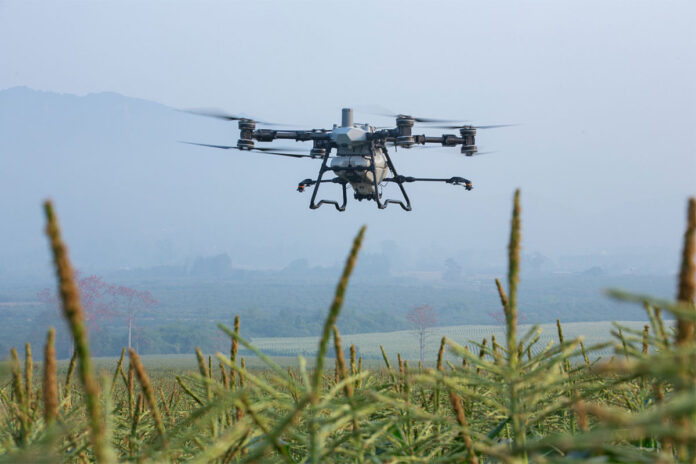
Agricultural drones have evolved rapidly from niche technology into practical farm equipment capable of spraying crop-protection products, spreading fertiliser and seed, and operating in areas that conventional machinery cannot easily reach. However, not every drone is suited to every farming operation.
According to Zane Barnard, expert regional manager at AgTech@NWK, farmers should begin by assessing their needs before comparing models.
“The best drone isn’t necessarily the biggest or the most expensive one. It’s the one that best matches the size of the farming operation, the workload, and the type of work it will be expected to perform,” he explains.
Match the drone to the size of your farm
One of the first specifications to consider is payload capacity, which determines how much product the drone can carry and how efficiently it can cover hectares.
Barnard explains that smaller drones generally suit first-time users or farmers managing smaller areas, while larger models are designed for high workloads and commercial contracting.
As a general guide, entry-level models with tanks of around 50ℓ are aimed at farms of roughly 10ha to 500ha, while mid-sized drones carrying about 70ℓ are better suited to farms larger than 500ha. The largest models, with 100ℓ tanks, are typically intended for farms exceeding 2 000ha or contractors servicing multiple clients.
“Farm size, rather than simply budget, should guide the buying decision,” says Barnard.
Spraying capacity is often measured in hectares per hour, making it one of the easiest specifications to compare. Mid-range models can typically spray between 20ha/h and 25ha/h, while larger models may achieve between 23ha/h and 28ha/h. Although the difference appears small on paper, those additional hectares add up over a busy spraying season.
“If a farmer only sprays a few hundred hectares, paying significantly more for marginal gains in capacity may not make economic sense. However, for contractors or large farming businesses, those gains can translate into considerably more work completed over time,” he explains.
Look beyond payload and capacity
Payload and spraying capacity are only part of the equation. Many modern agricultural drones can also perform more than one task. Barnard says farmers should look at whether a drone can be converted from spraying to spreading without complicated modifications.
Some models allow the spray tank to be replaced with a spreading system for fertiliser or seed, with the drone automatically recognising the new attachment and adjusting its operating parameters. This versatility enables one machine to perform multiple functions throughout the production season.
After considering performance specifications, farmers should also evaluate the support available once the drone is in operation. As with any farm equipment purchase, farmers should consider the availability of service centres and spare parts before buying a drone. Barnard explains that operators who are familiar with drones will likely be able to service the equipment themselves.
He advises first-time drone owners to take their machines to a service centre to ensure they’re serviced correctly.
Services are generally required every 50 hours of flying time completed, with a major service every 150 hours.
Accessories that improve efficacy
Tank size is only one part of spraying performance. The nozzle system also determines how effectively crop protection products are applied.
Standard nozzles allow droplet size to be adjusted over a wide range, but specialised mist nozzle systems produce much finer droplets that improve coverage in crops like orchards or when applying fungicides. These systems also increase flow rate and use additional nozzles to improve coverage.
Barnard notes that the application requirements should determine whether specialised nozzle systems are necessary.
Additional accessories can improve operational efficiency, particularly on larger farms. Relay modules help maintain communication between the controller and the drone where tall crops, hills, or other obstacles interfere with the signal.
Real-time kinematic (RTK) modules improve positional accuracy by enabling the drone to access additional satellite signals, making them particularly useful where highly accurate navigation is required.
Barnard says that while RTK technology enhances accuracy, it’s not essential for every farming operation.
“Accuracy of around 30cm can be achieved without RTK and up to 5cm with RTK. RTK is mostly recommended for high-value crops like orchards, which require far greater precision,” he explains.
Because drones rely on batteries, it’s advisable to have three batteries per drone: one to operate the drone, one that’s being recharged, and another that’s cooling off. This enables continuous operation with minimal downtime.
Barnard notes that for large drones geared towards farms of more than 2 000ha, a fourth battery is needed, as they consume battery power faster than smaller models.
While most batteries provide an indication of remaining flying time, he says this isn’t necessarily precise, because it depends on flying conditions.
He adds that environmental conditions have a greater influence on the drone’s efficiency than its make and model. Specifications on any drone should therefore always be viewed in light of the recommended flying conditions.
Don’t overlook training and licensing
Buying a drone is just the beginning. Barnard says operators must obtain a Remote Pilot Certificate (RPC) before flying agricultural drones commercially. While retailers generally provide training on operating the equipment itself, this differs from the formal licensing required to legally fly the drone.
He adds that RPC training is widely available through accredited providers across South Africa.
For more information, email Zane Barnard at [email protected].