
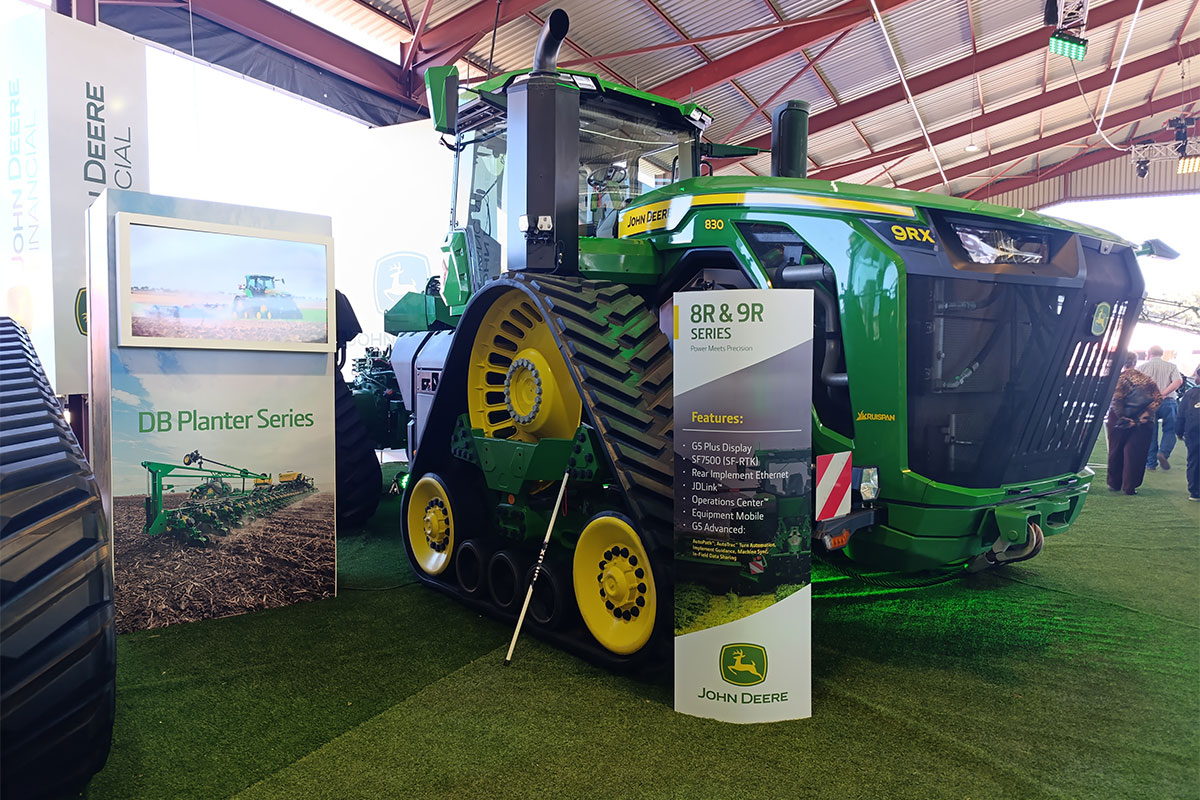
The line-up includes the 8R 440/8RX 440, 8R 490/8RX 490, and 8R 540/8RX 540. The main difference between the 8R and 8RX models is that the 8R runs on wheels, while the 8RX uses four tracks for improved flotation and traction.
All the tractors are powered by the 13,6ℓ JD14 engine and equipped with the eAutoPowr Electric Variable Transmission (EVT), the first electro-mechanical split-path transmission in agriculture, said Hein Snyman, regional production system specialist products and precision agriculture at John Deere, during a media session at Nampo 2026 in Bothaville.
However, John Deere did not simply add more horsepower. The machines were redesigned to ensure the additional power could be effectively transferred to the ground under real-world farming conditions.
“We have been working on these machines for the past six to seven years to develop a solution tailored to our customers’ needs,” said Snyman.
The flagship 540 models deliver 594hp (437kW), while Intelligent Power Management unlocks an additional 40hp (29kW) when required, boosting output to 634hp (466kW) to help maintain speed under heavy draft loads, on hills, or in difficult field conditions. This makes them one of the most powerful rigid frame tractors ever produced.
Hydraulic capacity has also been significantly increased, with the tractors offering up to 418ℓ/minute of hydraulic flow, enabling them to handle the growing demands of wider and increasingly sophisticated implements, including high-capacity planters, large air seeders, grain carts and slurry tankers.
Its eAutoPowr EVT transmission delivers up to 8% better power transfer than conventional hydro-mechanical CVTs.
Snyman explained that instead of relying primarily on hydrostatic power transfer, the EVT uses electric motors and generators within the transmission to reduce energy losses associated with heat generation and oil shear under heavy loads. The smoother power delivery results in fewer shock loads moving through the drivetrain, which translates into lower vibration and less noise.
The result is the smooth operation associated with a CVT, combined with efficiency levels closer to those of a powershift transmission, translating into lower fuel consumption, reduced heat build-up, improved pulling power and less driveline stress.
John Deere also strengthened the tractors’ ability to transfer power to the ground through a maximum ballast weight of 24t. This improves traction efficiency, reduces wheel slip and helps manage compaction under heavy loads.
Furthermore, the tractors feature John Deere’s patented wasp-waist frame design and larger steering cylinders. This allows for more precise headland turns without skipping rows, with John Deere claiming up to a 19% reduction in turning radius compared with similar opposition manufacturers.