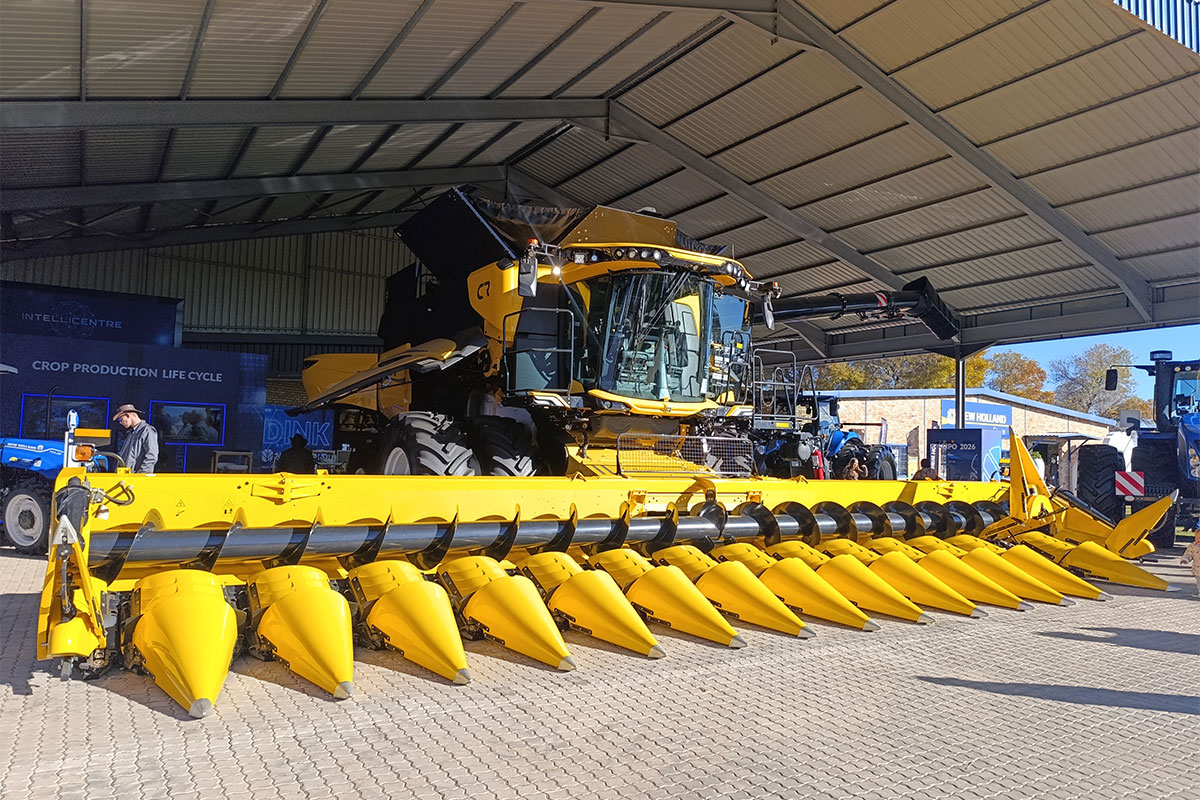
Speaking to Farmer’s Weekly at Nampo 2026, Derrick Coetzee, product marketing specialist at New Holland, said the CR10 was designed from the ground up, with a completely new driveline and layout aimed at reducing grain losses, protecting grain quality, lowering running costs and minimising soil compaction.
At the heart of the machine is the Twin Rotor technology that New Holland pioneered back in 1975.
On the CR10, the rotors have been enlarged from 558mm on the CR9 to 610mm, while the threshing compartment has been stretched from 2,64m to 3,6m.
According to Coetzee, the larger diameter and longer rotor length allow crop material to move through the machine more gently and efficiently, improving threshing capacity while helping to protect grain quality. The wider and longer threshing area also gives the combine more throughput capacity in demanding conditions.
The rotors feed into a 16 000-litre grain tank, with unloading speeds of up to 210ℓ/second to reduce waiting times during harvest. Coetzee added that a 20 000ℓ grain tank option will also soon be available locally, making the CR10 the only combine harvester in Africa to offer that capacity.
The larger tank will allow farmers to harvest for longer between unloads, reducing stoppages in the field and helping to improve fuel efficiency and overall harvesting productivity.
Another standout feature is the Twin Clean cleaning shoe, which uses two cleaning systems operating simultaneously. The setup includes two upper and two lower sieves, along with dual clean grain and pressure sensors that continuously monitor the cleaning shoe load.
Coetzee described the system as a major leap forward for the industry, because it automatically manages the crop flow across the sieves to maintain even distribution and maximise cleaning performance. The result, he said, is high throughput capacity with grain losses kept close to zero.
The award-winning IntelliSpread radar system further automates harvesting by adjusting residue spreading in real time. This ensures even residue distribution of up to 18m behind the combine, regardless of wind, crop type or moisture conditions, helping farmers prepare lands more effectively for the next planting season.
The CR10 is designed to handle more than 50 different crops, giving it the flexibility needed for diverse farming operations.
Coetzee added that the use of aluminium in key areas helped keep the machine’s empty weight to about 26t, compared with around 30t for some competing models.
This lighter footprint reduces soil compaction, which is increasingly important as farmers focus on preserving soil structure and moisture retention, while also lowering fuel consumption and easing transport demands.