

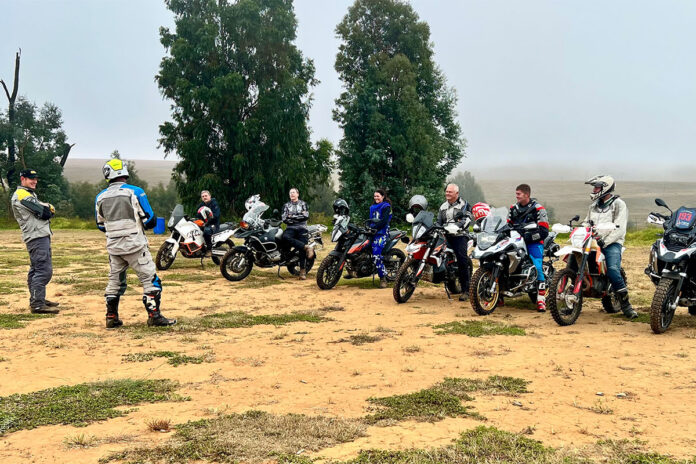
Our innate response to danger is either fight or flight. However, when you encounter a dangerous stretch of dirt road on an adventure motorcycle, there is nowhere to flee but forward.
When suddenly confronted by an obstacle that screams danger, a rider’s natural reaction, or ‘default mode’ is to clamp down on the handlebars, grip the tank tightly with their knees, and hit the brakes.
These are precisely the actions most likely to leave a rider in a heap of pain and humiliation, and the reason why riders need proper training and regular practice.
“The goal of our training here at Country Trax is to change riders’ default mode,” says Jan du Toit, owner of the Country Trax Off-Road Riding Academy in Amersfoort, Mpumalanga.
“Through our training, we want to change the rider’s natural response so that they can make safe decisions in the milliseconds available before either white-knuckling their way through trouble, or slamming into it.
“It becomes especially important when a rider is tired. That is when we want their default mode to be the safe mode.”
Training for safety
Du Toit’s training philosophy centres on keeping riders safe through training, enabling them to enjoy their motorcycles without constantly worrying about falling.
“During a three-day off-road course, we effectively fast-track the experience that a rider would otherwise accumulate over many years into those three days,” he says.
“It is easy to open the throttle and enjoy the experience and exhilaration of a speeding motorcycle. The danger is that most riders who do that have never learned how to perform an emergency stop. They do not know how to turn quickly or avoid an obstacle, particularly on a dirt road,” says Du Toit.
He refers to the Hurt Report, conducted by Prof Harry Hurt, an American safety science professor. Widely regarded as the definitive study on the causes of motorcycle accidents, it forms the foundation of modern motorcycle safety practices globally and locally.
The report found that the leading causes of crashes are human error, specifically motorists failing to see riders and riders lacking evasive manoeuvre training.
“It amazes me how few riders have the knowledge to make themselves more visible to other road users, considering how crucial that is to motorcycle safety,” remarks Du Toit.
From Farming to training
Du Toit established Country Trax in 2000 after deciding to discontinue his mixed farming operation near Amersfoort.
“After a hurricane destroyed everything on the farm, I realised I could not run the farm, my woodworking business and the motorbike training operation all at once. Fortunately, at the same time, a neighbour expressed interest in renting my land and taking over the sheep enterprise, allowing me to focus on the other two.”
Since then, Country Trax has set the benchmark for adventure and off-road rider training, growing into one of the largest certified training institutions in terms of active venues and instructor numbers.
Training is delivered in small groups of six to eight riders per instructor, ensuring hands-on coaching, individual feedback and a safe learning environment where every rider receives focused, personalised instruction.
While Country Trax is a BMW Motorrad certified training partner, its instructor training covers all major motorcycle brands. This ensures instructors are fully competent to provide high-quality off-road and adventure training to riders on any motorcycle brand.

BMW relationship
“We became South Africa’s first BMW Motorrad certified training academy in 2000. At that stage, there were only two others, one in the UK and one in Germany,” explains Du Toit.
The academy’s progressive course structure is designed to meet riders at their current skill level while developing real-world competence, confidence and control.
Training ranges from introductory off-road skills courses through to intermediate, advanced adventure and technical riding programmes.
The depth of experience within the instructor team – 25 certified trainers according to the company website – ensures consistent, world-class instruction across all 12 training venues.
When asked about the criteria he uses to select instructors, Du Toit laughs.
“That is my business secret, but what I can tell you is that the people I choose do not necessarily have exceptional riding skills; I can teach them that. Being an instructor is a natural talent that some people simply possess. I look for that trait, combined with good character, first and foremost. The last thing I need is an instructor who is so impressed with his own abilities that his ego gets involved. Those individuals are so focused on showing off that they usually tend to become the worst type of instructors,” he says.
Born for motorbikes
Du Toit’s fascination with motorcycles began at an early age. “Honestly, I think I was born with it,” he says.
It all started with a 50cc motorcycle on the farm. “The little 50 wasn’t much use in ploughed fields, so I soon blew the engine.”
The next machine was a Triumph Tiger 500 purchased from a neighbour who had bought four at a military auction. After doing some work on the motorcycle, Du Toit used it for many years.
“The Tiger worked rather well in that ploughed land,” he says with a laugh.
Du Toit learned most of his off-road riding techniques through practice, but he is also an avid reader and built his knowledge by consuming anything he could find on dirt riding and motorcycles in general since he was in primary school.
Once the business became a BMW Motorrad training partner, he also attended a course at the German academy.
“My objective was never to become the best crop or livestock farmer. I simply wanted to farm on a scale that would allow me to buy a new bike every now and then and still have enough time to ride,” he comments. And ride he did.
Pure adventure
“I was part of a group that became the first riders to cross the Death Acre, or Doodsakker, on adventure motorcycles,” he said.
This notorious and highly treacherous 50km to 60km-long stretch of coastline begins just north of the Namibian border at the mouth of the Kunene River and extends into south-western Angola. Because of its extreme risk, tackling the Doodsakker is considered the ultimate rite of passage for extreme 4×4 enthusiasts in Southern Africa. Attempting it on a motorcycle requires courage and skill well beyond that of the average rider.
“I was also part of a six- man group that completed a trip following the Zambezi River from its source in north-western Zambia to where it enters the ocean at the Zambezi Delta in central Mozambique.”
The Zambezi is Africa’s fourth-longest river, flowing approximately 2 574km.
“There are still many places in our country where I would like to ride my motorcycle,” he says.
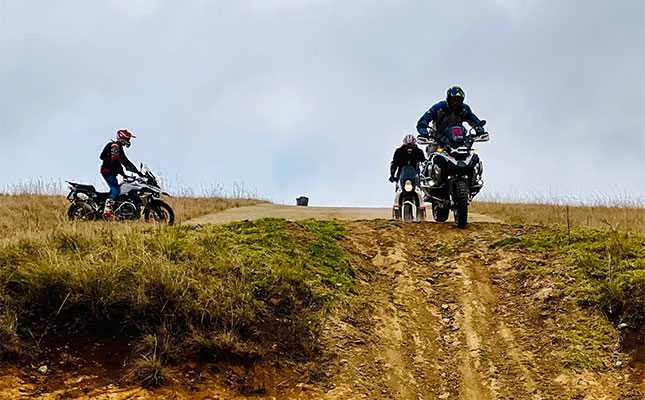
Looking ahead
Du Toit admits that he remains uncertain about the future direction of the motorcycle training business.
“The motorcycle market is declining, particularly in the adventure motorcycle segment, where bikes have become prohibitively expensive. This has affected the market to such an extent that I cannot see how this side of the business can grow much further. Perhaps the more affordable Chinese models entering the market will revitalise the sector,” he says.
Many prominent South Africans have completed motorcycle training at Country Trax over the years. Well-known South African crime author Deon Meyer was involved with Country Trax and founded the iconic GS Challenge event for dual-purpose motorcycle riders.
Among those who trained at Country Trax were singer Matthys Roets, Voetspore presenter Johan Badenhorst, investigative reporter the late Derek Watts, as well as a team from the lifestyle television programme Top Billing.
Du Toit turns every opportunity into an excuse for an adventure ride.
He operates a small sawmill on the farm and, in addition to building log cabins as accommodation for the motorcycle business, also manufactures wooden furniture for clients across the country.
“I do my own deliveries, and I usually take a motorcycle with me so that I can fit in a bit of adventure riding wherever I go.
Not long ago, I turned a delivery trip to Nieuwoudtville in Namaqualand into a great adventure ride,” Du Toit tells Farmer’s Weekly.
It seems he was entirely serious when he said he was born with a passion for motorcycles.
Philosophy
Du Toit emphasises that his training philosophy centres on keeping riders safe through appropriate training, enabling them to enjoy their riding.
“During a three-day off-road course, we effectively fast-track the experience that a rider would otherwise accumulate over many years into those three days,” he concludes.