
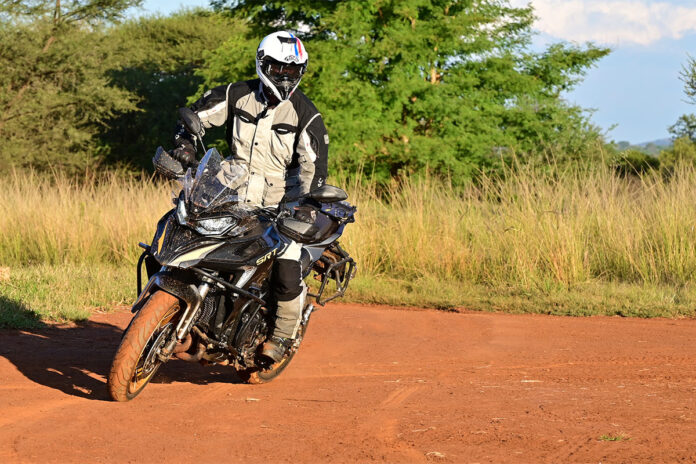
In a previous column, we discussed why standing on the pegs makes sense on dirt roads. This time, we go a step deeper – into the physics of what actually makes a motorcycle turn and how to keep control through those tight bends on a gravel farm road.
Here’s the truth: motorcycles don’t turn the way most people think they do.
You don’t turn by turning
At walking pace, you turn the handlebars in the direction you want to go. But once you’re moving faster than about 15km/h to 20km/h, that’s no longer what initiates a turn.
At speed, a motorcycle turns because it leans. And it leans because the rider uses a technique called counter-steering.
Before we unpack that, let’s first understand why your tyres are shaped the way they are.
Look closely at your adventure bike’s tyres and exactly how they are shaped. They are not flat like a car tyre.
Tyre profile: designed to lean
The tyres instead have a rounded, curved profile, almost like part of a sphere. That curve is critical.
When the bike is upright, the centre of the tyre makes contact with contacts the road. As you lean to the side, the shoulder of the tyre becomes the contact patch. This allows a gradual, predictable transition from straight-line travel into a turn.
In Dirt Busters: A guide to adventure motorbiking (Ridders van die Grondpad), Deon Meyer and Adriaan Oosthuizen illustrate this beautifully. Roll the cardboard cylinder from a toilet roll across a flat surface and it travels straight, like a car tyre with its flat contact patch.
Now roll an ice-cream cone or paper cup. It naturally curves toward the side with the smaller circumference. The same principle applies to a motorcycle tyre. When you lean the bike, you effectively ride on a smaller circumference of the tyre, and the bike turns.
In simple terms: the tyre’s shape allows the motorcycle to roll into a lean and carve through a corner.
On dirt, this becomes even more important. Knobbly tyres follow the same curved principle, but grip now depends on how those tread blocks bite into gravel or sand.
Lean angle, throttle input, and weight distribution determine whether they grip or slide.
Countersteering: turning the ‘wrong’ way to go right
Countersteering sounds complicated, but it’s surprisingly simple.
It literally means steering in the opposite direction when you enter a turn. Imagine entering a turn to the right, pushing the steering column gently to the left by using mainly your right arm.
It is almost like you’re nudging the right handlebar slightly down and forward, pointing it towards the turn.
The front wheel momentarily points left. The bike responds by leaning to the right, onto the smaller diameter of the tyre, and the turn begins.
Once the bike is leaning, the geometry of the motorcycle and the forces acting on it guide it naturally through the turn.
While it may feel totally counterintuitive, it is actually pure physics – and it works. It also takes practice and a bit of guts to get it right.

Countering the fear
Most beginners fear the rear wheel sliding out in a turn. Even intermediate riders can become tense when they misjudge speed or corner sharpness.
Let’s look at what’s really happening. When you enter a corner, three forces come into play:
- Gravity pulling you downward;
- Momentum wanting to carry you straight ahead;
- Centrifugal force pushing you outward.
To balance these forces, the bike must lean inward. The faster you go, the more lean angle is required for the same radius of turn. If you don’t lean enough, you run wide. If you lean too much for available traction, you lose grip.
Standing through a dirt road turn improves your ability to balance these forces. As you enter a right-hand turn, shift your hips slightly left and load your weight onto the left footpeg. You are now using gravity in your favour as the added weight on the rear wheel forces the tyre into a better grip on the road surface.
A good standing posture gives you more control and allows the motorcycle to move beneath you while your upper body remains balanced.
Grip, however, is finite, and on gravel, mud or sand, it’s limited.
There is no shame in reducing speed slightly before entering a turn. Do your braking while the bike is upright, before committing to leaning. Once leaned over, heavy braking reduces available traction, unless you are well-practised in controlled drifting.
Why the rear tyre slides
On loose gravel or corrugated farm roads, the rear tyre often steps out. This is not automatically a crash.
In fact, a controlled rear-wheel slide is a fundamental dirt-riding technique. A slight drift can help the bike pivot through the corner and the throttle becomes a steering tool.
The real danger is panic. When the rear steps out, inexperienced riders often:
- Chop the throttle abruptly;
- Grab the rear brake;
- Stiffen their arms.
All three reactive moves make matters worse. Smoothness is the goal, not reckless speed.
There are five important keys to bear in mind when flowing through a turn:
- Brake before the corner and slow down while upright;
- Look through the turn.
The bike follows your eyes.
- Look at your exit, not the obstacle;
- Apply smooth throttle. Once leaned, apply steady, progressive throttle to stabilise the chassis;
- Weight on the outside peg, especially when standing. It lowers the effective centre of gravity and increases grip;
- Relax your upper body.
Loose arms allow the front wheel to track naturally over uneven terrain.
The difference between a nervous rider and a fluid one is not bravery – it’s understanding.
Practice, not theory
Find an open gravel area. At moderate speed, practise gentle counter- steering inputs.
Feel how a light push initiates leaning. Then practise smooth throttle roll-on in mid-corner.
Try not to chase speed, rather chase smoothness.
Once you understand why a motorcycle turns, and how tyre profile, lean angle, body posture, and traction interact, you will stop reacting in fear and start riding with intention.
And that is exactly where dirt roads will stop being intimidating, and they start becoming addictive.