
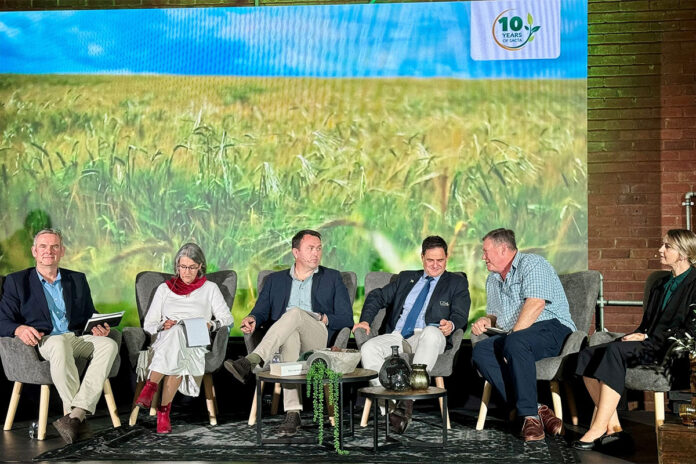
Guided by the theme: “Stronger pathways, Sustainable future”, SACTA brought together industry leaders, researchers and stakeholders to discuss the future of plant breeding, innovation and farmer resilience in South Africa during the ASEM in Pretoria.
SACTA was created as the legitimate agency to administer breeding levies for all self-pollinated grain and oilseed crops including wheat, barley, soybeans, lupins and some canola cultivars.
Agriculture is operating under increasingly tighter margins and higher levels of risk. Climate variability, rising input costs, and continued consolidation in the global seed industry all elevate the importance of reliable, locally adapted genetics. In this environment, seed improvement remains one of the few interventions that consistently delivers long-term value. The SACTA levy plays a critical role in ensuring that this improvement process stays steady, well-resourced, and commercially viable.
According to SACTA Chairman Ryk Pretorius, the levies allow South African farmers continued access to global innovative technologies of strategic importance. “It supports plant breeding, cultivar development and research, skills and enterprise development with the end goal of long-term sustainability.”
How SACTA levies benefit farmers
He pointed out that since its establishment in 2016, SACTA has over the past decade collected and distributed statutory breeding levies that enabled the release of over 70 new wheat cultivars, boosted local soya bean production, and funded critical agricultural transformation and research initiatives.
When producing these open-pollinated crops, many producers save seed from one season to the next. While this practice makes sense at farm level, it also means that the commercial return on seed development is limited. For seed companies, the incentive to invest in long-term breeding programmes for these crops moves lower on the priority list as they receive very little return on their investments.
The value of SACTA lies in collecting and distributing funds to maintain seed research, breeding, skills, and infrastructure that allow seed improvement to continue year after year.
According to Andrew Bennett, Chief Executive Officer at SACTA, continued industry support remains crucial. “Plant breeding is not seasonal. When a seed company’s income declines, investments also come under threat. Consequently funding becomes erratic, breeding stalls, trial sites are lost, and skilled breeders move elsewhere. Once that capacity disappears, rebuilding can be costly and slow.”
He explained that the SACTA levy provides stability in research for open-pollinated crops such as soybeans, wheat, barley, oats, and lupins. “It ensures that seed improvement does not only depend on good seasons or shifting commercial priorities, but on steady reinvestment by the industry itself. The levy strengthens the foundation on which commercial breeding is built, reducing risk and improving relevance for South African conditions.”
Global seed companies invest heavily in breeding, and South African producers benefit from access to world-class genetics. However, imported material is only as valuable as its local evaluation, without rigorous testing under South African conditions, even the best global genetics cannot reliably meet farmers’ needs.
South Africa’s production environments are demanding and diverse. Without strong local trial capacity, producers would be forced to rely on limited data or overseas performance claims that may not translate under local conditions.
The SACTA levy supports:
- Plant breeding.
- Pre-commercial research across different production regions.
- Confined field trials and regulatory processes.
- Retention of breeders, technicians, and trial managers in the industry.
- Maintaining South Africa’s credibility as a destination for seed research and development.
- Create investors’ confidence.
The SACTA levy maintains trial networks that ensure the following:
- New varieties are properly tested before wide release.
- Performance claims are grounded in local data.
- Poorly adapted genetics are filtered out early.
Bennett pointed out that since the inception of SACTA, a total of 231 new varieties were put in the market. Of these 146 were new soybean varieties, 66 were wheat, 11 barley, six oats and two lupins. A total of R986 million was made available to seed companies for research and breeding. He also noted that for every R1 invested in research and development, industry gained a R2,20 return on investment.
At the event, Nandipa Gaqa, Lead: Partnership Development and Ecosystem Coordination at Land Bank, shared valuable insights on the role of partnerships in driving sustainable growth and creating new opportunities across the agriculture sector.
“Our partnership with SACTA reflects a broad approach where Land Bank works with various institutions across the agri value chain to support farmers. Through strategic partnerships and collaboration, we continue to contribute towards a more resilient and sustainable agricultural sector.”
Challenges facing the wheat industry
During the meeting, managing director of the Bureau for Food and Agricultural Policy, Dr Ferdi Meyer, facilitated a panel discussion on challenges facing the wheat industry such as quality, research, plant breeders’ rights and genome editing. On the panel were Prof Marena Manley, lecturer and researcher at the Department of Food Science, Stellenbosch University; Kobus van Huyssteen, technical manager at the South African National Seed Organization; Corné Louw, applied economics and member services lead at Grain SA; Rossouw Swart, farmer from the Western Cape; and Dr Melissa van der Merwe, senior lecturer in agricultural economics at Stellenbosch University.
Wheat producers operate under tight margins and increasing climatic pressure. Diseases such as rusts remain a constant threat, while quality traits remain one of the topics under discussion. Levy-supported breeding and testing have contributed to the following:
- Improved rust resistance packages
- Yield stability across diverse production areas
- Maintenance of high baking and milling quality, with increased yield potential
During the discussion, Van Huyssteen emphasised the importance of protecting breeding technologies, recognising the significant investment required to develop new varieties, and continuing collective action against illegal seed sales (brown bagging).
Louw noted that the SACTA system and breeding are the only tools that help the wheat industry to get back on its feet and remain resilient.
Some of the suggestions at the end of the discussion included:
- Improve communication between the various stakeholders in the entire value chain especially with regard to the benefits of the levy system.
- Involve universities and students so that students can be exposed from an earlier stage in the process for better understanding of the intricacies in the agriculture value chain.
- Ensure that the system is protected.
- Build on the successes of the past.
- Specifically with regard to wheat, look at an incentive system for production of high quality wheat.
Farmer survey
A recent survey among soybean producers showed a broadly positive sentiment toward the SACTA levy system. According to Anelda Craffert, operations executive at SACTA, the responses indicate that farmers are not only experiencing value but can point to specific areas where the levy is making a difference, particularly in relation to growth, support, and advancement within the sector.
“Producers recognise that the levy delivers measurable benefits, strengthening both seed improvement and the future of South Africa’s soybean sector,” she noted.
More than a quarter of soybean producers highlight future growth and investment as the key advantage of the SACTA levy. On the question, “What are your thoughts and take outs on the SACTA levy,” 26,33% of the respondents indicated that they see the investment and future growth as one of the major advantages of the levy system. Other leading responses indicated that 19,88% of the respondents are positive about the levy and a further 15,96% indicated that they strongly support the system.
Asked if they feel that they have gained value from the levy, an overwhelming 97% of the farmers indicated that they gained value. “This indicates that farmers have a strong perceived benefit of the advantages and the effectiveness of the system,” Craffert said.
When ranking the reasons why the felt that they gained value, the following results were recorded:
- Yield and productivity gains – 28%
- Seed quality and genetic improvement – 18%
- Industry and system value – 16%
- Technology and efficiency gains – 13%
- Financial returns and upside gains – 9%
- Knowledge insight and data access – 8%
- Improvement across all areas – 2%
Regarding yield performance, 69% of the farmers reported that they gained improvements. An additional 9% indicated that they experienced both positive and negative changes, suggesting some variability in outcomes.
Across all responses, farmers described yield changes as layered and experience-based outcomes where improvements were rarely attributed to one factor, and that yield gains rather reflect a combination of increased production and improved crop quality. “Agriculture is influenced by many factors, and yield performance cannot be attributed to only one factor.”
Some 45% of farmers indicated that the current technology levy system should remain unchanged with an additional 10% indicating that it should remain with slight changes.
Farmer development
The SACTA levy also supports developing farmers through interest-free loan facilities. Sandile Mahlangu, transformation manager at SACTA, stressed that these were not grants or hand-outs. “They are structured financial instruments designed to lower the cost of entry and enable participation where access to affordable finance is limited.”
“Interest-free loans ease early pressure without weakening discipline, they build productive capacity and strengthen the entire seed system. Loans are repaid, systems are maintained, and productive capacity is built, therefore strengthening the broader seed and production system rather than distorting it,” Mahlangu added.
Unlike fertiliser or chemicals, the returns from seed improvement do not appear on an invoice. They accumulate gradually, season by season, in the form of greater stability and incremental gains. Mahlangu noted that these returns include:
- Improved yield potential over time, reflecting steady genetic progress.
- Better disease resistance, reducing yield losses and lowering reliance on crop protection inputs.
- Greater tolerance to heat and moisture stress, supporting more consistent performance under variable conditions.
“Often the greatest benefit is not higher top-end yield, but reduced risk. This protects producers and maintains confidence in the seed system.”
For more information, contact Andrew Bennett at [email protected].