Water is becoming one of the biggest challenges facing South African agriculture. Many parts of the country continue to experience recurring droughts, rising temperatures, and increasing pressure on available water resources. At the same time, farmers are expected to produce more food while keeping production costs under control.
As producers look for ways to farm more efficiently, aquaponics is attracting growing interest. The system combines fish farming with vegetable production in a single recirculating system, allowing farmers to produce two food sources while using far less water than conventional farming methods.
Mchunu says aquaponics has the potential to play an important role in improving food production, especially in water-scarce areas.
“It is a sustainable system that allows farmers to produce fish and vegetables at the same time while recycling water,” he says.
Rather than viewing fish waste as something to dispose of, aquaponics uses it as a valuable source of nutrients for crops. The result is a system that reduces water use, eliminates the need for synthetic fertilisers, and produces two marketable products from one production system.
While aquaponics is still relatively new in South Africa, Mchunu says interest is growing as more farmers look for practical ways to adapt to climate change and rising input costs.
What is aquaponics?
For many farmers, aquaponics is still an unfamiliar concept and is often confused with hydroponics or aquaculture.
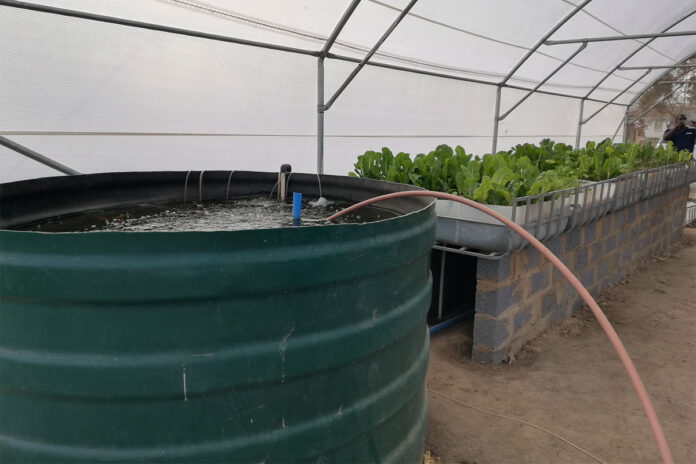
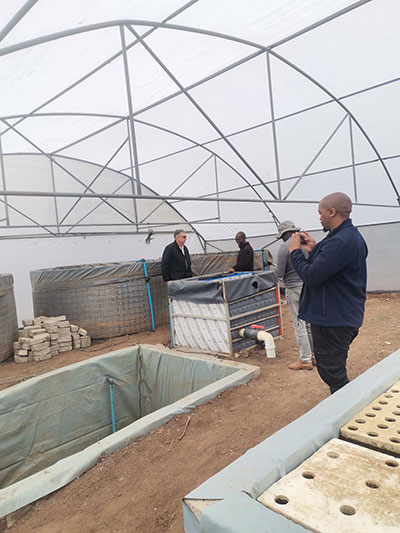
Mchunu explains that aquaponics combines fish farming and hydroponic crop production in one closed system. Fish are kept in tanks where they produce waste that must be filtered. Instead of being discarded, this nutrient-rich water is pumped through mechanical and biological filters before flowing to plants grown without soil.
“The fish waste water becomes a source of nutrients for the plants, and once the plants have absorbed those nutrients, the cleaned water flows back to the fish tank,” he says.
This creates a continuous cycle where fish and plants support one another. Unlike hydroponics, which relies on commercially produced fertiliser solutions, aquaponics uses nutrients produced naturally by the fish. Unlike conventional farming, it requires no soil and uses significantly less water.

How does an aquaponics system work?
The success of an aquaponics system depends on maintaining a balanced relationship between the fish, plants, and the water circulating through the system. Each component plays an important role in ensuring the system functions efficiently.
Mchunu says fish are reared in tanks where they naturally produce waste. Water containing this waste is then pumped from the fish tank through mechanical and biological filters before reaching the hydroponic growing area.
“The system works by water circulation. Fish waste from the fish tank is pumped into the hydroponic culture of plants, where it serves as a nutrient source to support the crop’s life cycle,” he says.
The mechanical filter removes solid waste from the water, while the biological filter prepares the water before it reaches the plants. As the crops absorb the nutrients they need for growth, the cleaned water is returned.
Because the same water is continuously recirculated, very little is wasted. Instead of regularly replacing large volumes of water, farmers only need to replace water lost through evaporation and plant uptake. This closed-loop system is what makes aquaponics one of the most water-efficient food production systems available.
Mchunu says building the infrastructure is only one part of establishing a successful aquaponics system. Farmers also need access to reliable inputs and the knowledge to manage them effectively.
“Key inputs include technical knowledge, a sustainable supply of fish fingerlings, a sustainable supply of seedlings, and a reliable energy source, preferably solar,” he says.
Electricity is particularly important because submersible pumps are responsible for keeping water circulating throughout the system. Without continuous water movement, both the fish and plants can be affected, making a dependable energy supply essential for day-to-day operations.
Why aquaponics is gaining attention
With water becoming an increasingly limited resource across many parts of South Africa, farmers are under pressure to find production systems that make better use of every available litre.
Mchunu says one of aquaponics’s biggest advantages is its ability to significantly reduce water use. “Aquaponics saves 90% of the water used in conventional farming because the water is recirculated for reuse,” he says.
Unlike conventional crop production, where irrigation water is often lost through evaporation, run-off, and deep drainage, aquaponics continually recycles the same water through the system. This not only reduces overall water consumption but also allows farmers to continue producing food in areas where water availability may be limited.
The technology is particularly relevant as South Africa continues to experience more frequent droughts and increasing climate variability. For farmers operating in water-scarce regions, improving water-use efficiency is becoming just as important as improving yields.
Producing more than one food source
Another advantage of aquaponics is that it produces two food products from a single production system.
Rather than growing vegetables or producing fish separately, the two enterprises work together. Fish provide the nutrients needed for crop growth, while the plants help improve water quality before it returns to the fish tanks.
“The dual production of fish and vegetables allows food diversity for food and nutrition security,” says Mchunu.
This integrated approach gives farmers an opportunity to diversify production while making efficient use of available space and water. It also allows households to produce both fresh vegetables and a source of animal protein from one system.
For urban and peri-urban producers, where land is often limited, this can be particularly valuable.
Mchunu says crops also have relatively short production cycles under aquaponics conditions. “Lettuce literally takes three weeks to grow in an aquaponics system,” he says.
The quick turnaround means farmers can harvest regularly, helping to maintain a consistent supply of fresh produce throughout the year.
Affordable at different scales
One of the biggest misconceptions about aquaponics is that it is only suitable for large commercial businesses with significant financial resources.
Mchunu disagrees. “People think aquaponics is expensive, but it is not,” he says.
He says the size and cost of a system can be adapted to suit different production goals and available budgets. Mchunu says he has built hobby-scale systems for as little as R7 500. A subsistence-scale system can cost around R25 000, while a starter commercial operation may require an investment of approximately R150 000, depending on the design and the resources available.
These different entry points allow prospective producers to gain experience on a smaller scale before investing in larger commercial systems.
Mchunu says researchers and the government have an important role to play in making the technology more accessible.
“Researchers and government need to work together to make these innovations available to our people. People must be allowed to interact with the technology and apply their indigenous knowledge, talents, and gifts,” he says.
Developing the right skills
While aquaponics can reduce water use and fertiliser costs, Mchunu says it is not a system that can simply be installed and left to operate on its own. Like any farming enterprise, it requires daily management and a good understanding of how the different components work together.
“Aquaponics is more than just a concept. It is a living laboratory,” he says.
He says farmers interested in aquaponics need to develop technical skills in three key areas: water quality management, fish production, and plant production.
Maintaining good water quality is one of the most important aspects of managing the system. Water conditions directly affect both fish health and plant growth, meaning producers need to monitor the system regularly.
Mchunu says farmers should pay close attention to electrical conductivity, dissolved oxygen levels, and water temperature.
“If the water quality is not managed properly, it can affect the entire system,” he says.
Fish health is another important management consideration. Producers need to monitor their stock for signs of disease and respond quickly if problems arise. Healthy fish are essential because they provide the nutrients that drive plant production.
Plant management also remains an important part of the production cycle. Although aquaponics removes the need for conventional fertilisers, growers still need to monitor crops for diseases, maintain healthy plant growth, and plan production carefully to ensure a continuous supply of vegetables.
Starting small and learning the system
Mchunu says one of the biggest mistakes people make when entering aquaponics is allowing their enthusiasm to outweigh their experience.
“People become fascinated by the concept and rush to start big without sufficient experience,” he says.
He encourages prospective producers to begin with smaller systems where they can develop practical skills before expanding their operations.
“Starting on a smaller scale gives farmers the opportunity to understand how fish, plants, water quality, and the filtration system interact on a daily basis. It also allows them to identify and solve management challenges without risking a large financial investment,” he says.
As producers become more confident and gain experience, they can gradually increase the size of their systems to meet household needs or commercial production goals.
Strengthening food and nutrition security
Beyond commercial farming, Mchunu says aquaponics has an important role to play in improving food and nutrition security, particularly in urban, and peri-urban communities.
With increasing urbanisation, many households have limited access to land for conventional food production. Aquaponics offers a way to produce fresh food in relatively small spaces while making efficient use of water.
“The dual production of fish and vegetables at the same time allows food diversity needed for food and nutrition security,” he says.
The relatively quick production cycle of leafy vegetables means households can harvest fresh produce regularly, while fish provide an additional source of protein.
Mchunu says this combination has the potential to improve household diets while reducing the environmental footprint associated with transporting food over long distances.
Barriers to wider adoption
Although aquaponics offers many benefits, Mchunu says several challenges continue to limit its wider adoption in South Africa.
The biggest obstacle is access to capital. “Capital input is the major challenge generally in South Africa for any enterprise development,” he says.
He adds that aquaponics is still regarded as an emerging technology in the country, which means there are currently no funding programmes or policies specifically aimed at supporting its development.
“There are no specific funding mechanisms or policies for aquaponics,” he says.
To encourage wider adoption, Mchunu believes the government should consider introducing policies that promote the technology at the household and community levels.
As part of his doctoral research completed in 2018, he proposed the development of a ‘one home, one aquaponics system’ or ‘one school, one aquaponics system’ policy.
He says such initiatives could help expose more people to the technology while strengthening household food production and creating opportunities for skills development.
Looking to the future
Mchunu says the future of aquaponics in South Africa is promising as the country continues to search for farming systems that can adapt to climate change and increasing pressure on natural resources.
“There are great prospects for aquaponics globally, particularly in South Africa,” he says.
He is currently involved in collaborative research with the University of Pretoria, where he is supervising two PhD students and two master’s students investigating different aspects of aquaponics production.
The research aims to generate scientific evidence that can support future policy development and encourage wider adoption of the technology.
Mchunu says climate change will continue to influence how food is produced in the years ahead.
“Global warming is a serious threat,” he says.
He says more food production systems will increasingly make use of aquaponics together with shade-net structures to protect crops from excessive light intensity and high temperatures that can affect plant growth, development, and reproduction.
For more information, email Ntobeko Mchunu at [email protected].