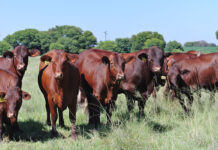

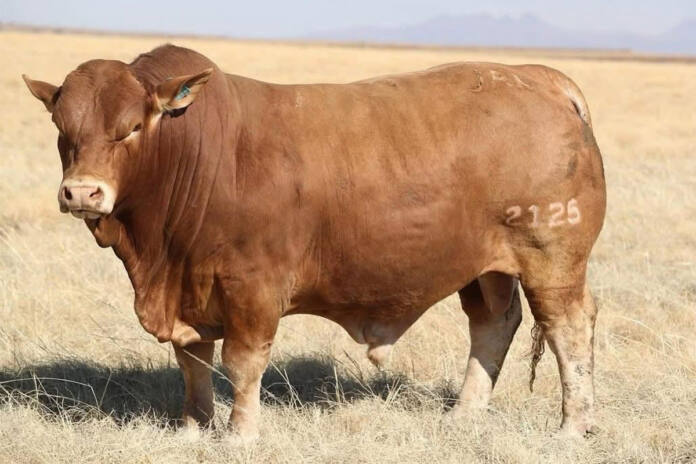
NGB Beefmasters is situated north-west of Thabazimbi along the Crocodile River. The Potgieters first incorporated Beefmaster bulls into a crossbreeding programme with Simbra cattle in 2017 and, as Potgieter puts it: “We quickly recognised the value these bulls added to our herd.”
The NGB stud was consequently registered in 2020.

“I established the stud with my two sons, Philip and Willie. The decision was based on simple mathematics. An adult animal typically consumes approximately 3% of its body mass per day in feed intake. Medium-framed animals require less energy for maintenance, which can contribute to improved reproductive efficiency and quicker re-conception. When a medium-framed cow consumes less, consistently weans a calf at 50% or more of her own body weight, and maintains an annual calving interval, the result is a highly efficient and profitable production system,” he explains.
The initial NGB Beefmaster genetics were sourced primarily from BOS Blanco, WO Beefmasters, Majesto Beefmasters, and Janmarck Beefmasters. The NGB herd now consists of more than 400 registered animals, and on 14 August 2026 the stud will host its third production auction.
Both embryo flushing and artificial insemination programmes are used as part of the stud’s quest to accelerate genetic progress.
Why Beefmaster?
For the Potgieter father-and-sons team, some of the breed’s most important attributes includes low birthweights, which contribute to easy calving, combined with excellent growth and high weaning weights, as well as the breed’s hardiness, fertility, adaptability and efficiency.
“The Beefmaster has proven itself across diverse production environments and climatic regions. The breed’s adaptability has also been demonstrated in neighbouring countries and Zambia,” says Potgieter.
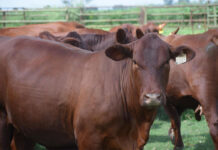
According to him, the ideal Beefmaster is a medium-framed animal that combines functionality, efficiency, and structural correctness. Females should exhibit strong feminine characteristics, including femininity, fertility, and good maternal qualities, while maintaining adequate capacity and sound conformation.

Calving ease and the short duration of labour are among the most important reproductive traits of the Beefmaster breed as it contributes to reduced calving stress and improved survival rates.
Beefmaster females possess strong maternal ability, milk production, and overall efficiency. This is reflected in the breed’s ability to consistently produce and raise a heavy, healthy calf.
Well-developed and functional bulls
The NGB bulls display strong masculine characteristics, with well-developed muscling, a strong head, ample capacity, and a balanced combination of bone and beef. Both males and females should be structurally sound and well-balanced.
“We strive to achieve the ideal balance between phenotypic characteristics, proven bloodlines and breeding values. Our goal is to breed functional, productive cattle that consistently wean a quality calf every year, adaptable to a wide range of environments and climatic conditions,” says Potgieter.
“The NGB bulls have strong bone structures, excellent growth, good muscular development, a clean sheath, a strong topline, and a masculine head. The bulls are functional and capable of covering a substantial number of females coupled with outstanding walking abilities.
“The females display strong feminine characteristics, excellent maternal instincts, and sufficient milk production to wean a calf weighing at least 50% of their own body weight. In our environment, we consider the ideal mature cow weight to be between 500kg and 550kg, ensuring a balance between productivity, fertility, adaptability, and efficiency,” says Potgieter.
NGB maintains an average birthweight of 36kg and aims for a weaning weight of at least 50% of cow weight, with an intercalving period of less than 390 days. In many cases, NGB calves wean at 60% or more of their dam’s body weight. Weaning weights in excess of 275kg are common.
However, cows that wean a 250kg calf while weighing approximately 450kg themselves are considered exceptional and are retained as breeding females in the programme.
‘Reproduction is not a sprint’
While early calving in heifers is often promoted, it is important to recognise the potential drawbacks, including calving difficulties, increased losses and, most importantly, delays in re-conception. This ‘sprint approach’ often results in extended intercalving periods between the first and second calves.
The Potgieters believe the management of a female’s productive lifespan is a marathon rather than a sprint.
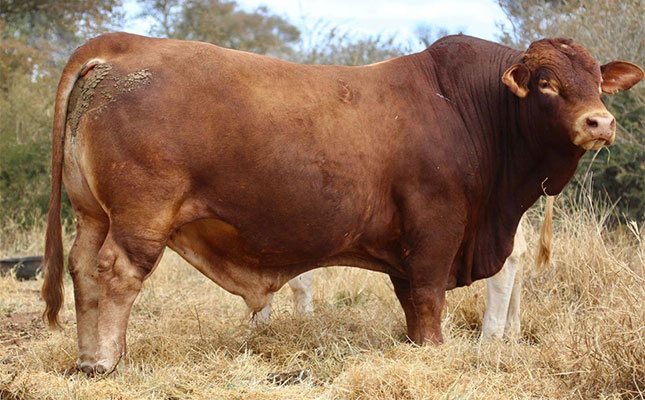
“We only put heifers to bulls once they reach a minimum weight of 360kg to 380kg, and they are never mated before 16 months of age, calving for the first time at typically 26 to 30 months of age. That is how we ensure that the heifer has reached an adequate level of physical and reproductive maturity at first calving.
As a result, most females conceive within three months post-partum, leading to a consistently short intercalving period between the first and second calf, typically maintained throughout their productive lives.
“The value of each calf is too significant to justify using a small-framed or substandard bull solely for the purpose of ‘opening’ heifers. Instead, we select our best herd sires for use on heifers, while giving preference to bulls that have proven genetically capable of producing lighter birthweights without compromising quality,” says Potgieter.
Adaptability of the Beefmaster
This approach allows the Potgieters to maintain calving ease while still ensuring strong genetic merit, growth potential, and overall performance in the resulting calves. In this way, they balance calving ease with genetic progress, ensuring that no compromise is made on long-term herd quality.
Although Thabazimbi is a sweetveld area, the Potgieters have found that animals sold to breeders in sourveld areas adapted exceptionally well. The adaptability of the Beefmaster breed has been demonstrated repeatedly, with many cattle successfully performing in a wide range of grazing environments throughout Southern Africa and even as far north as Zambia.
This has confirmed the breed’s ability to adapt to varying veld types, climatic conditions, and production systems without compromising performance, fertility, or efficiency.
The NGB stud forms part of diversified farming enterprise that includes a game breeding component focused primarily on sable antelope, as well as a crop irrigation division.
For more information email Wynand Potgieter at [email protected].