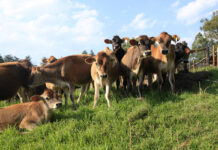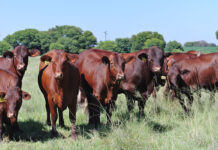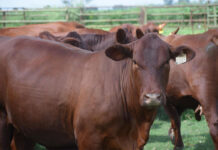

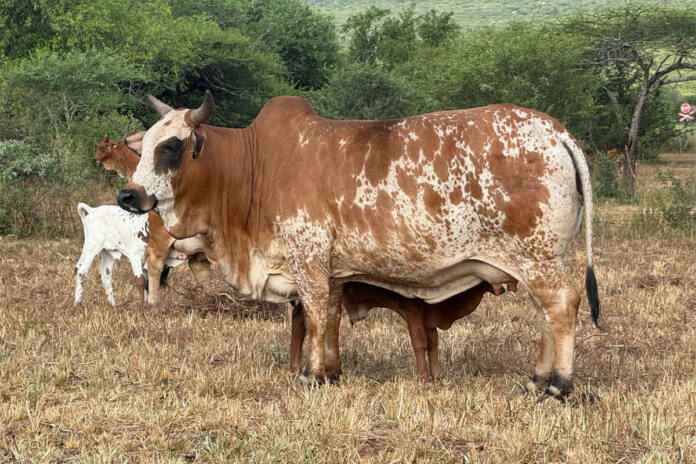
The 3 514ha game reserve is located between the towns Nsoko and Lavumisa in southern Eswatini. Liz and Ted Reilly run approximately 700 stud Boran cattle alongside a wide variety of wildlife, including predators such as hyenas, leopards and jackals.
The farm’s livestock consists entirely of purebred, indigenous African lineages, specifically Boran cattle and a diverse array of Nguni breeds, including cattle, goats, pigs, and fowl.
The Reillys also operate international, regional and domestic tourism enterprises on several other parks, with the core aim of supporting the long-term protection of these areas, their wildlife and the natural environment.
From Ngunis to Borans
The Reillys involvement with the Boran breed began in 2013 while searching for additional grazing for their growing Nguni herd. They acquired Impofu Ranching (Pty) Ltd, which held a lease over about 3 000ha of bushveld near Big Bend, together with almost 1 000 Black Angus crossbred cattle.
While inspecting the herd, they noticed a number of calves sired through artificial insemination using Boran bulls.
“They were head and shoulders better than other calves and we immediately sold off the Angus bulls and then purchased our first batch of Boran bulls from Elandspruit near Amsterdam and the rest is history!” says Reilly.
Perhaps one could add that we were particularly fortunate in being able to purchase the entire kernel of the Elanspruit Boran Stud when this was dispersed, including a nucleus of excellent foundation cows by the great bull CI08-34 KOOKWATER, who “clicked” extremely well with MKHULU.
Breeding for adaptation
According to Reilly, the stud was established to produce pure, low-maintenance and functionally efficient Boran cattle adapted to harsh bushveld conditions under extensive management.
The objective is to produce seed stock for Eswatini and beyond while maintaining cattle that perform under minimal-input conditions.
“We are only interested in pure cattle indigenous to Africa as we believe they outperform all other breeds when reared off the veld. This is also a meaningful conservation exercise,” she says.
Adapted to extensive conditions
Having worked with several breeds over the years, including Brahman and Simmentaler cattle, Reilly says the Boran has consistently impressed under bushveld conditions.
“We have worked with other breeds of cattle over many decades, including Brahman, Simmentaler and others, and over the first 12 years with us, the Boran has shown itself to make far better use of available vegetation than other breeds. Not only do they remain far more productive, but they also carry far better condition through difficult times.”
Reilly also values the breed’s temperament.

“The Boran also has a quiet temperament, unlike some other Bos indicus breeds, which makes them an absolute pleasure to work with.”
She adds that while Boran and Nguni cattle display similar hardiness qualities, the Boran tends to be more fleshy, which enhances sale prospects.
Disease pressure and rising costs
“FMD has caused zero income to be earned from cattle sales for almost a year, since this scourge entered Eswatini from South Africa. Considerable extra unexpected expenditure to strengthen fencing to protect our stock has added to a serious financial dilemma which has threatened our survival and will take some time to overcome,” says Reilly.
Climate pressure has presented less of a challenge, she says, because the operation relies on breeds indigenous to Africa that are adapted to heat and drought conditions.
Selection priorities
When selecting breeding animals, the Reillys focus on temperament, conformation and adaptation.
“Any animal that tends to be ‘wild’ is selected out of the herd at the first opportunity.”
Particular attention is paid to structural correctness, with cows expected to display feminine characteristics and bulls masculine characteristics.
Reilly also favours cattle with minimal sheath and navel skin to help limit tick damage under bushveld conditions.
Fertility remains central
The stud does not utilise performance testing or estimated breeding values (EBVs). Instead, selection decisions are based on visual assessment, temperament, fertility records and observations of tick resistance.
Under favourable conditions, the target is an inter-calving period (ICP) of no more than 400 days.
“We agree that fertility is the most important statistic, not only showing productivity but also being well adapted to the environment where they live – they could not continue to produce well if not in tune with their environment,” she says.
Value in commercial systems
Reilly says Boran genetics offer significant advantages in crossbreeding programmes, particularly with Bos taurus breeds.
“Exceptionally good hybrid vigour when crossed with other breeds, particularly Bos taurus. The Boran’s values of adaptability, fertility, growth and profitability are clearly visible in crossbred calves judging by the limited experience we have had with this.”
Although the operation does not run feedlots, it sells cattle to organisations that do.
“We do not run feedlots ourselves, but do sell to large organisations that purchase stock for their feedlots. We understand that our Borans do well compared to other animals and they are always in hot demand.”
Reilly adds that the cattle are sold directly off the veld and are not specially fed in preparation for sale.
A foundation sire
Among the herd’s bloodlines, one bull stands out.
CFH 13-246 Mkhulu was purchased as a weaner from Elandspruit Borane in 2014 after the Reillys bought 30 pure Boran heifers.
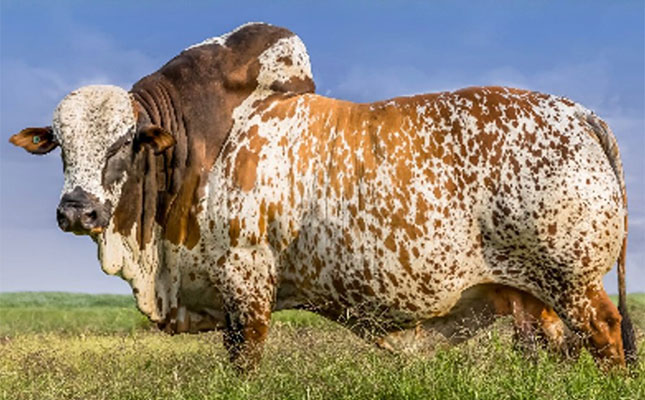
“We were particularly fortunate in being able to purchase the entire kernel of the Elandspruit Borane Stud when this was dispersed, including a nucleus of excellent foundation cows by the great bull CI08-34 Kookwater, who ‘clicked’ extremely well with Mkhulu,” says Reilly.
The bull has become the cornerstone of the stud’s breeding programme.
“We have bred many different kinds and breeds of wild and domestic animals over the decades and never have we known a sire to produce such consistently brilliant progeny as does Mkhulu,” she says.
The couple intend to continue carefully linebreeding to the bull to fix what they describe as his superior qualities of substance, correct conformation and kind temperament within the herd.
Looking ahead
Reilly believes the Boran has an important role to play in the future of beef production in Africa, particularly in more marginal areas.
“The most cost-effective option for bovine protein production in Africa, especially in more marginal areas which are more challenging to livestock and where other breeds struggle. From our experience the Boran excels, more so than any other breed, on extensive range under a minimal management regime.”
According to Reilly, these qualities position the Boran as a strong option for beef production under extensive African conditions.
For more information, contact +268 7602 1275.