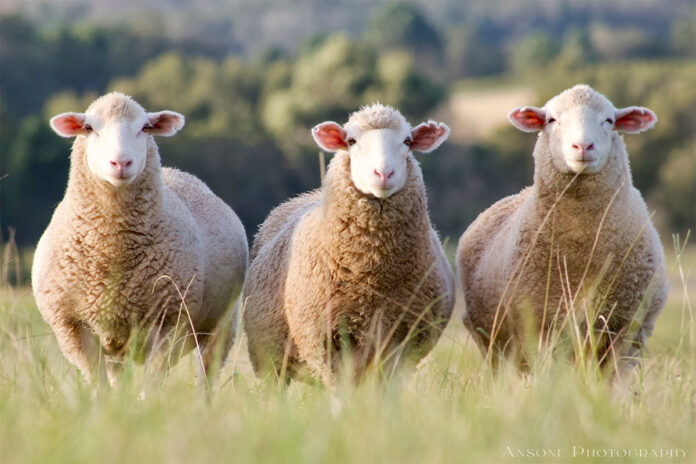
Although the breed has evolved over the decades, its core purpose remains unchanged: to deliver an efficient, fertile, and adaptable meat sheep that adds value under South African production conditions. Marius Eksteen who owns the Hatari Dormer Stud near Bloemfontein and heads the Dormer Breeders’ Society’s marketing portfolio, spoke to Magda du Toit about how the breed’s origins continue to shape its role with a view to the future.
The Dormer breed emerged from a purposeful cross between Dorset Horn and German Merino genetics, with the aim of producing a meat sheep suited to local conditions and capable of producing quality slaughter lambs. Developed through nearly two decades of rigorous slaughter‑lamb experiments that started in 1927 at the Elsenburg Research Station, today the breed stands as one of the country’s agricultural successes.
By the time the breed was officially recognised in 1946, it had already proven itself as a robust, adaptable terminal sire suited to both local production systems and global market expectations.
According to Eksteen, the Dormer stands testament to purposeful breeding – a sheep shaped not by chance but by decades of data, experimentation, and the practical needs of South African farmers.
“The Dormer was developed with a very practical production objective and clear goal: create a hardy, early‑maturing mutton breed capable of thriving in the cold, wet winter‑rainfall regions of the Western Cape while still producing high‑quality carcasses that could compete on global and international markets. Today, the Dormer consistently delivered rapid growth, excellent carcass quality, strong fertility, and resilience against local disease pressures.”
In many ways, he says, the breeding philosophy has remained simple and the same over time. “The figures on paper must ultimately translate into performance in the veld, the lambing pen and the slaughter lamb.”
Breeding values
He adds that the Dormer breed is not maintained simply because of its history or appearance but because it remains a functional, economically relevant breed for both the stud breeder and the commercial sheep producer.
Looking at specific traits, Eksteen says the modern Dormer should combine fertility, growth, sound functional conformation, maternal ability, adaptability, and carcass quality.
He further points out that the lambing percentage of the breed should be between 120% and 150%, depending on specific conditions and management practices. In addition, the Dormer boasts early maturity, exceptionally high average daily gains, and a high slaughter percentage.
“These qualities also make the breed particularly well suited to the feedlot situations.”
When focusing on breeding, Eksteen argues that both breed integrity and genetic progress are essential.
“Maintaining the integrity and recognisable characteristics of the Dormer is important, but breed purity alone cannot be the final objective. A livestock breed must continue adding economic value to the farmer. In today’s environment, no farmer, commercial or stud breeder, has the luxury of keeping a flock for pleasure alone. At the end of the day it must make economic sense.”
For that reason, he points out, the society encourages selection for economically important traits such as fertility, reproductive efficiency, growth, maternal ability, functional conformation, and meat production.
“At the same time, attention must be paid to genetic diversity and responsible management of inbreeding. As a breeding society, our responsibility is not only to preserve the Dormer we inherited, but also to leave the next generation of breeders with a Dormer that is genetically stronger, more accurately recorded, and even more commercially relevant.”
He highlights some of the key traits that breeders should focus on:
- Growth rate and early maturity;
- Carcass quality – conformation, fat distribution, dressing percentage;
- Adaptability to winter‑rainfall regions;
- Fertility and mothering;
- Hardiness and disease resilience.
Eksteen points out that although the fundamental objective of producing a functional meat sheep has remained, the tools available to breeders have changed dramatically.
“Historically, selection relied heavily on visual appraisal, breeder experience, and pedigree information. Although these will always remain important, particularly functional conformation, modern breeding increasingly combines these with more objective performance information. Today, breeders have access to performance recording, reproduction records, growth information, estimated breeding values, and increasingly genomic information.”
He notes that the society holds the responsibility to help breeders combine phenotype, pedigree, performance, and genomic information in a practical way. “The goal is not to replace the experienced breeder’s eye with numbers, but to improve breeding decisions by using both objective information and sound functional selection.”
Genomic tools are enabling more accurate parentage verification, strengthening pedigree integrity, improving the management of genetic relationships and inbreeding, and ultimately supporting more precise selection as the reference population expands.
“Over the years, performance recording and genetic evaluation have become central to breed improvement, with close cooperation between breeders, SA Stud Book, and other industry partners providing increasingly robust data for informed selection decisions.”
He rates the balance between progress and preservation of the breed as one of the ongoing challenges. “Genetic improvement must take place without losing the functional characteristics and breed identity that made the Dormer successful in the first place.”
He points out that the continued growth and acceptance of the Dormer within both the stud and commercial sectors is testimony of the breed’s value and is in itself an important achievement.
“Our long-term goal is to ensure that the Dormer remains one of South Africa’s leading meat sheep breeds and continues to be relevant under changing agricultural and economic conditions.”
He emphasises that future progress will increasingly depend on reliable data. “We would like to see continued improvement in recording participation, data quality, reproductive information, and genomic testing across the breed. Genomics, in particular, presents an exciting opportunity. As more animals are tested and the genomic reference population expands, the value of genomic information to breeders can increase substantially.”
He cautions, however, that genetic diversity must be managed responsibly.
“Popular genetics can rapidly influence a relatively small population, making the monitoring of genetic relationships and inbreeding increasingly important.”
Genomic testing can strengthen parentage verification and pedigree accuracy and provide breeders with additional information to manage genetic relationships.
The society is also placing increasing emphasis on the quality and accuracy of performance information. Reliable genetic evaluation is only as good as the information submitted by breeders. For this reason, he says, accurate birth information, weaning information, reproductive records, weights, and other performance measurements are becoming increasingly important.
“The society’s technical structures continue to evaluate ways in which performance recording, genetic evaluation, and genomics can be used more effectively to accelerate sustainable genetic progress within the breed. The long-term vision is to aim for a Dormer population that is productive, fertile, genetically diverse, objectively measured, and commercially relevant.
Promoting the breed
The breed is promoted through a combination of breeder communication, technical information, agricultural media, social media, shows, championships, sales, and national breed events.
The National Dormer Auction remains an important showcase of genetics from breeders across the country, while agricultural shows and breed championships provide opportunities to exhibit the functional and phenotypic quality of the breed.
These events are important not simply from a competitive perspective. They create opportunities for breeders to exchange knowledge, evaluate genetics, and engage with commercial producers.
Digital communication and social media have also become increasingly important in communicating technical information and showcasing the breed to a new generation of producers, Eksteen says.

Society initiatives
Animal improvement plays a central role in building a productive and competitive livestock sector while farmers rely on structured breeding systems to improve breed traits.
“As a breeders’ society, we set breed standards, set guidelines for selection, testing, and registration, record performance data, and guide genetic progress within the Dormer breed. We must support our members to understand not only how these systems work but to help them to use them optimally so that they are able to make better breeding decisions and achieve consistent results.”
Eksteen points out that the society’s objectives have remained the same since 1940.
“Our objective is to expand and improve the Dormer breed within South Africa. To do this, we are running several initiatives, including ongoing genetic improvement programmes, breeder training workshops, youth involvement projects, and partnerships with research institutions to explore new technologies for sheep production as well as to promote the breed.”
According to him, information sharing, training, and technical support assist farmers in adopting best practices in breeding and management.
“As a society, we provide educational resources and workshops to improve our members’ knowledge. We believe continuous support leads to innovation and ensures that farmers remain aligned with breeding standards as well as industry developments. It also encourages younger farmers to enter the sector with a solid understanding of modern breeding techniques.
“Another important role of our society is to ensure that our members have access to information that enables them to make better breeding decisions. Equally important is educating commercial buyers. A commercial producer purchasing a ram should increasingly be able to look beyond appearance alone and understand the available information regarding growth, reproduction, genetic merit, pedigree, and relatedness.”
He adds that the better informed the buyer becomes, the greater the incentive is for breeders to produce animals backed by credible performance information.
One of the highlights on the annual Dormer calendar is the Dormer National Championships where top genetics are showcased. During the annual sales of top rams and ewes, breeders’ are recognised for outstanding performance records, as well as collaborations with agricultural shows to promote the breed.
Eksteen states that collaboration between farmers, breeders’ societies and other industry bodies strengthen the livestock sector.
“No breed operates in isolation. Genetic improvement, animal health, research, performance recording, marketing, and meat production all involve different parts of the livestock value chain. Collaboration between breeders, commercial farmers, breeders’ societies, SA Stud Book, researchers, veterinarians, universities, and other industry organisations allows information and technology to move more rapidly from research into practical farming systems.”
In addition, South Africa has a wealth of exceptional livestock genetics in the toolbox and combined with highly skilled breeders, this sets the scene for a healthy and prosperous livestock industry. “Greater co – operation and responsible sharing of information can strengthen not only individual breeds but the national livestock industry as a whole.”
Challenges and opportunities
Not everything in the Dormer’s development has been straightforward. One of the society’s ongoing challenges is ensuring that genetic progress remains balanced and commercially meaningful. As Eksteen cautions, livestock breeding can easily drift toward single‑trait selection at the expense of whole‑flock performance. Growth, for example, is undeniably valuable, but growth without fertility, structural correctness, maternal ability, or feed efficiency does not necessarily produce a more profitable sheep.
“The Dormer’s long‑term success depends on maintaining equilibrium across these traits, safeguarding the breed’s reputation for both performance and practicality.”
He adds that genetic diversity should also require increasing attention.
“Modern reproductive technologies and the rapid use of successful sires can accelerate genetic improvement, but they can also increase relationships within a population.”
In the modern agriculture environment, data is playing an increasingly important role because it can add tremendous value in decision-making. But the quality of data is one that raises red flags.
“Data quality is a challenge. The livestock industry is entering an era where increasingly sophisticated genetic tools are available, but those tools depend on the accuracy of the information as well as the ability to interpret the data.”
“The future of the Dormer will not be determined by the amount of data we collect, but by how effectively we use that information to breed sheep that make farmers more profitable,” he adds.
“Climate variability and rising input costs will challenge producers but they also increase demand for animals that perform efficiently under real‑world conditions. For the Dormer, this is both a challenge and an opportunity to produce more kilograms of quality lamb efficiently.”
Commercial producers increasingly require rams that can contribute to fertility, growth, survival, adaptability, and carcass value. This creates an opportunity for Dormer breeders who can demonstrate these characteristics through reliable records and practical performance.
“There is also significant opportunity for the Dormer to continue contributing to terminal-cross and commercial meat production systems where producers require rapid-growing, well-muscled lambs with strong carcass characteristics,” he states.
Eksteen concludes with the following statement: “The Dormer was created to solve a practical production need. Nearly a century later, we believe that practical relevance remains the breed’s greatest strength. Our responsibility as a society is to respect the history of the Dormer while continually improving the breed for the farmer of tomorrow.”
For more information email Marius Eksteen at [email protected], or Liezel Grobler at [email protected], visit dormersa.com.