
I’m fortunate to live in a conservancy on the outskirts of suburbia that features a wetland, untamed bush, plots and a river on its border.
Birdlife is abundant here, from the woodland kingfisher to the African grey hornbill and tiny cardinal woodpecker I hear long before I spot him high in the Acacia.
A favourite afternoon activity of mine is watching ‘bird TV’ from the couch on my patio, as various species quarrel at the feeders and frolic in the birdbath.
Easy-to-make feeders
My bird feeders are all DIY projects, made cost-effectively from discarded items or hardware store materials.
One of the easiest to DIY is a repurposed plant saucer. Drill or pierce holes in the rim, thread PVC or nylon cord through, knot and hang.
For an eco-friendly alternative, use hemp rope and a coconut shell, cutting it through the middle two-thirds of the way down. The one-third portion serves as your feeder, as it’ll be shallower.
Whether you choose a plastic saucer or a coconut shell, remember to clean them regularly and discard seeds wet from the rain to prevent mould.
To attract the fruit-eaters, my friend John who is skilled in carpentry, gifted me a feeder comprised of a wooden plank on iron rods welded to a mounting plate with three prongs (apologies to carpentry/hardware experts for my terminology!).
Nails hammered along its length are for spiking fruit.
This feeder is a snacking hotspot for glossy starlings, Karoo thrushes and barbets, who jostle and bump each other off, while a crested barbet bullies other birds away by his mere arrival on a nearby branch.
Easily recreate this feeder using metal table legs or even fancy hairpin table legs (available from hardware stores) for a unique garden feature.
Creative feeders
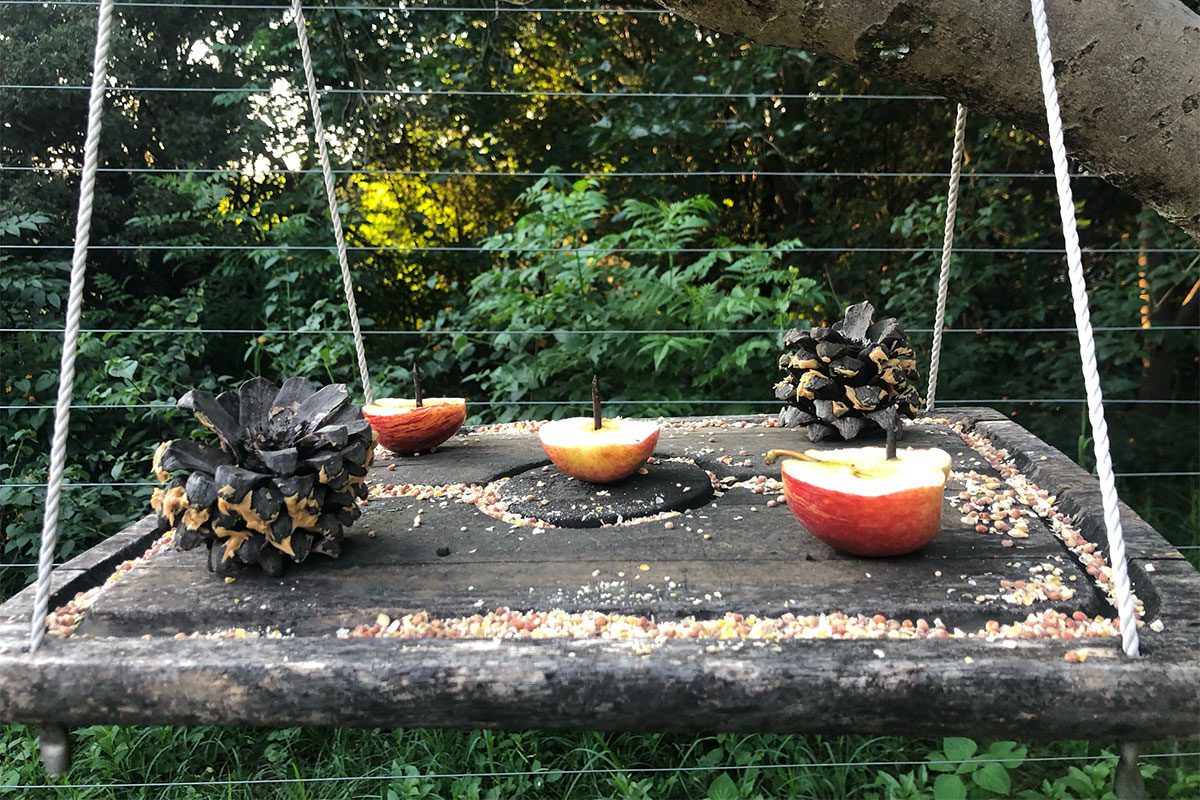
The most popular feeder in my garden is the result of finding a discarded wooden slab in the veld. Its original purpose remains a mystery, but the grooves creating a pattern on the slab are ideal for holding bird seed. At first, I simply laid it onto a tree stump that was oozing resin, naturally glueing it in place and creating a tabletop of sorts.
Its makeover involved a lot more creative flourish, courtesy of John.
He drilled four holes, used pieces of nylon rope to hang the slab from a branch, and added several nails as spikes. While he used metal crimps to secure the ropes at the bottom, you could simply make a large, tight knot.
The grey loeries and red-billed wood-hoopoes approve, but this smorgasbord also attracts the LBJs (little brown jobs), doves and weavers.
Another friend, Anneke, shared her husband’s creation with me. All you need is a disc/slice of wood, wooden pegs glued on for perches and a wooden pole or broom handle glued to the middle.
Hammer small nails into the disc in a circular pattern, radiating out from the pole to wedge the fruit between the circles, instead of spiking it.
Leave the outside of the disc empty so that birds can land and stand. Drill a hole through the top of the pole and thread wire or twine through to hang the feeder from a branch.