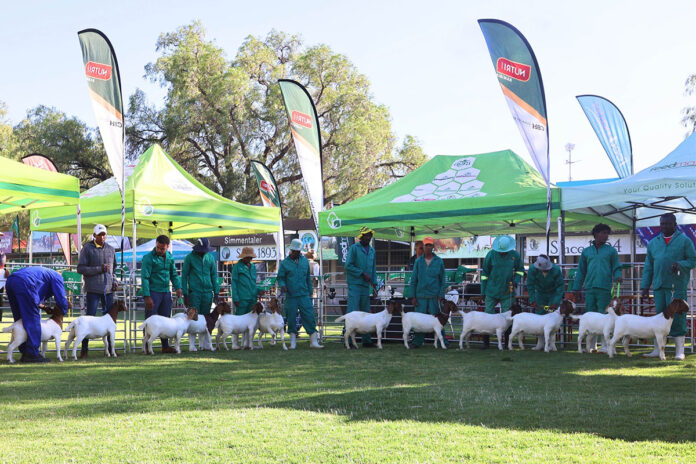
According to Martenique Scott, owner of Real Time Agri and a member of the Windhoek Show Livestock Committee, the Windhoek Agricultural & Livestock Show (Windhoek Show), taking place this year from 29 September to 3 October at the Windhoek Showgrounds, has grown from a small agricultural gathering into one of Namibia’s important platforms for agribusiness, trade, networking, and economic activity.
“[The event] is not simply a traditional show but a living indicator of how Namibia’s agriculture sector has matured, and why it continues to matter for farmers, breeders, local businesses, and the wider Southern African economy,” says Scott.
The show spans roughly 7 000m² of indoor exhibition halls and 35 000m² of outdoor spaces, sorting exhibitors into 14 major categories outside of livestock, including agriculture, food security, finance, information and communication technology, tourism, fashion, and health. Restaurants and food stalls also offer a wide variety of cuisines on offer.
From humble beginnings to a modern agribusiness platform
The first Windhoek Show took place on 2 and 3 June 1899 in what was then German South-West Africa.
“It was a modest agricultural exhibition with just 22 exhibitors, and it focused on fresh produce, wine, and a small number of breeding animals,” says Scott.
According to her, the show was then held intermittently in subsequent years.
She says the current showgrounds were laid out in 1934, with the first event on the site believed to have taken place in the early 1950s.
From 1966, the show became an annual fixture and, over the following decades, industrial and commercial exhibitors were gradually incorporated alongside livestock and crop displays.
“Today, it is formally known as the Windhoek Agricultural & Livestock Show. Agriculture and livestock remain the heart of the event, but the programme now spans agribusiness, manufacturing, value addition, finance, technology, tourism, retail, and services,” adds Scott.
She explains that the show’s transformation is also reflected in its format, as the traditional nine-day event has been shortened to five days.
What visitors can expect
Scott says livestock remain the anchor of the event, adding, “Farmers should anticipate a strong livestock programme.”
Producers can expect displays of approximately 500 cattle and around 800 small-stock animals, with entries reflecting, “a solid, high-quality entry across the major adapted breeds”.
“The cattle classes will include Simbra, Brahman, Simmentaler, Angus, Braunvieh, Dexter, Boran, Afrikaner, Charolais, Tuli, Sussex, and Santa Gertrudis, among others. Small-stock classes will include Boer goats, Kalahari Reds, Savanna goats, Dorpers, White Dorpers, Van Rooy sheep, Persian sheep, and Meatmasters.”
Internationally acclaimed Australian cattle producer, breeder, and agricultural advocate Erica Halliday has been appointed as the show’s official cattle evaluator.
She is a fourth-generation producer from New South Wales and, with her husband Stuart, runs Ben Nevis Angus, a family seedstock operation established in 1947. She has also held senior positions in Angus Australia, including its presidency.
For the Small Stock Expo, breed pioneer Christie Labuschagne will take the ring as the official judge for the Damara sheep division, while international master adjudicator Jaco van Rensburg has been selected to judge the Dorper, Van Rooy, and Boer goat categories.
More than a livestock show
According to Scott, the livestock section provides more than competition. It’s a place for breeders to market genetics, compare breeding programmes, and make commercial contacts.
Summerdown-based cattle breeder Bonnie Nieuwoudt, who co-owns and operates Bonbennic Simbra with his wife Nicky, says events like the Windhoek Show play an important role in the farmers’ market.
“While breeders enjoy the opportunity to travel to various smaller expos across the country, we strongly hope that major anchors like the Windhoek Show will continue to live on for many years to support the farming community.”
The commercial value of exposure at the show was demonstrated when the Simbra bull Rumba Kelloggs sold for a Namibian record of NAD$650 000.
Nieuwoudt, who bought the bull after seeing it at last year’s show, where it was named Interbreed Champion Bull, says he was relieved that the animal would remain in Namibia and be available to the local stud industry.
Breeder Danie van Vuuren, who has participated in the show for the past 25 years and holds several leadership roles in Namibian agriculture, says breeders return each year to promote their animals.
Last year, his commitment to the industry was rewarded when a young Damara ram from his Weerlig stud was named Small-stock Champion of Champions.
Van Vuuren described the victory as both emotional and unexpected, adding, “Every year, we strive to bring more animals to compete among the best.”
A diverse line-up
Also on show will be machinery, agricultural inputs, animal-health products, feed, fencing, solar and water technologies, and related services.
Importantly, the entire 2026 event will be live-streamed courtesy of Meerkat Online Auctions.
“This will allow farmers, buyers, and industry stakeholders across Namibia, South Africa, and the wider region to follow the livestock judging, competitions, exhibitions, and related activities in real time, even if they can’t attend in person,” explains Scott.
Exhibition categories include agriculture and food security, finance, ICT, tourism, manufacturing, and retail.
Economic impact on Windhoek and local businesses
The show’s impact extends well beyond the showgrounds.
“The show injects significant activity into Windhoek,” says Scott.
Accommodation providers, restaurants, transport operators, informal traders, and small and medium-sized enterprises benefit from the influx of farmers, breeders, exhibitors, and families from across Namibia and neighbouring countries.
“For many local manufacturers and service providers, it’s one of the most efficient platforms of the year to reach rural and commercial clients in a concentrated period,” she says.
The show also provides a platform for Namibian-made products and value addition.
“Livestock genetics developed under local conditions, processed agricultural goods, and manufacturing outputs are showcased alongside inputs,” adds Scott.
The show’s broader commercial role can be seen in the range of organisations using it to reach their markets.
In a statement to Farmer’s Weekly, the Namibian Agronomic Board described the exhibition as an effective platform for communication, education, and promotion of local agronomic products.
“We use the show as a vital annual platform to engage with the public, support local producers, and address regulatory issues facing the crop industry,” it said.
Regional interest and South African participation
The show is also an increasingly important meeting point for Southern African businesses.
“Interest from the wider Southern African region remains strong,” says Scott, adding that exhibitors and visitors from Botswana, Angola, Zambia, Zimbabwe, and South Africa have long participated in it.
“South African companies active in the Namibian market, particularly in agricultural machinery, animal health, feed, genetics, and related services, regularly use the Windhoek Show as a key contact point.”
Zimbabwe’s participation provides a recent example of this regional trade role.
In 2025, ZimTrade coordinated 13 Zimbabwean companies at the show, representing industries such as leather and footwear, agro-processing, horticultural inputs, poultry, beverages, and lifestyle products.
The companies used the event to meet Namibian retailers, identify distribution contacts, and develop market leads.
Why the show still matters to the local farming community
Namibia’s agricultural conditions lend particular importance to the show’s livestock section.
“In an arid country where livestock remains a cornerstone of both commercial and communal livelihoods, the Windhoek Show provides one of the few national stages where breeders can compare genetics under the same roof,” explains Scott.
The show also gives young farmers an opportunity to see leading animals and engage with established studs, while commercial producers can meet much of the agricultural value chain in one place.
Combined with the continued emphasis on livestock excellence, technology, inputs, and networking, as well as full live streaming, Scott says the 2026 event will reinforce its role beyond that of a traditional agricultural exhibition.
“It functions as a practical marketplace and meeting point that supports Namibia’s agricultural economy and strengthens links across the Southern African region,” she adds.
For more information, email Martenique Scott at [email protected].
@farmersweeklysa Erica Halliday is the official cattle evaluator for the Windhoek Show Livestock Expo from 29 September – 3 October 2026, Windhoek Showgrounds, Namibia. Watch the show live on: https://auctions.meerkatonline.co.za/auctions/1662 #windhoekshow2026 #windhoeknamibia🇳🇦 #cattleshow ♬ original sound – Farmer’s Weekly SA