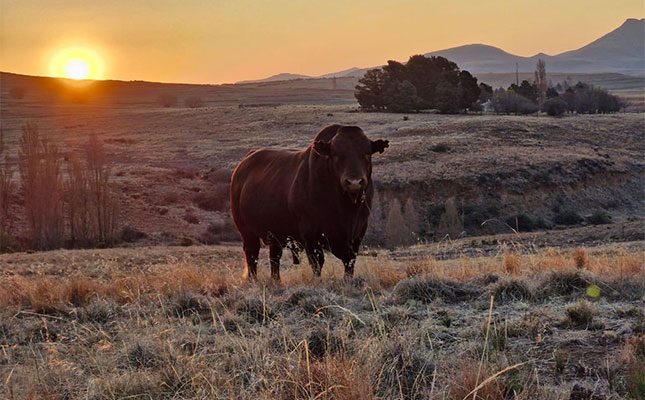
Photo: Supplied
The foundation of BLUP relies on accurate pedigree records for each breed and physical measurements of animals for various traits. The data are submitted to SA Stud Book via platforms such as Logix or BenguFarm.
The data that breeders record are monitored for discrepancies before being run through a computing model that produces BLUP EBVs. Prior to testing, breeders must outline which EBVs they wish to prioritise. Cock says more than 20 EBV traits are now available.
“The most important EBV that I test for is fertility. Your cows need to calve every year, so it’s vital that you have a good estimation of your breeding rate,” he explains.
Additionally, farmers might test for calving ease, weaner growth, cow production value, growth rate, and carcass value. Growth efficiency traits such as feed conversion ratios and average daily gains are also tested.
Ultimately, BLUP is one of several tools used to make decisions related to complementary mating and achieve the desired offspring characteristics. It also helps determine cattle’s productive lifespan, when they should be replaced, and where to invest in new genetics to maintain herd productivity.
Given its significance in herd management, knowing how to correctly use the BLUP model is imperative.
Cock says BLUP is not only important for breeders but for buyers, too. Studs, in particular, need to consider their clients and their clients’ goals. Buyers use EBV data to decide whether the livestock on offer is suitable for their particular operation.
Using BLUP effectively
Although BLUP is widely adopted and considered crucial for breeding selection, Cock says there are some common misconceptions about choosing EBVs and the effect they have on herd management.
He explains that some commercial breeders select breeding values without considering their farm environments and genetic goals.
For example, a farm with high feed availability can support breeding stock with higher growth rates without affecting fertility. In contrast, cows on poor-quality grass may struggle to reach condition for conception, as their maintenance requirements are higher. This is often misunderstood by breeders, who commonly aim to produce offspring with maximum growth potential.
Another important consideration is that almost all EBVs involve ‘trade-offs’, and that the data accuracy improves as the animal’s productive life progresses. When breeders aim for positive EBVs in every trait, one trait often suffers at the expense of another.
Cock says breeders must focus on complementary traits that align with their breeding goals and environments.
“There is no breeding value for adaptability or cattle sense. Always remember that nature does not tolerate extremes,” he adds.
EBV accuracy also determines how offspring are managed and evaluated as more genetic information becomes available. Therefore, Cock says not to set expectations that BLUP will guarantee a certain outcome.
Additional tools to ensure accuracy
Physical evaluations and genomic typing are additional tools that enhance BLUP accuracy. By noting the physical characteristics of certain genetic types, breeders can begin gene patterns in an animal’s physical presentation.
Genomic typing to gather single nucleotide polymorphism (SNP) profiles can be done to determine the genetic relationships of progeny to dams and sires. This improves genetic estimation, especially for low-heritability genes, and helps the breeder make better selection decisions. Cock says early indications are that SNP data can improve EBV accuracy by as much as 10%.
To simplify the process of selecting the right breeding values for a desired genetic outcome, EBVs have been grouped into sets that specifically target the most important traits in a given area.
These sets, called ‘selection values’ or ‘super values’, cover traits such as cow value, birth weight, weaner growth, and fertility, providing a reliable guide for breeders using BLUP in their breeding programmes.
Super values are more commonly used by commercial breeders, while stud breeders tend to be more specific. The latter aim for a marketable balance across traits to produce animals acceptable to both stud and commercial clients.
BLUP is an extremely useful tool that helps breeders produce the desired offspring that meet industry and international standards. Its use is crucial to stud breeders in particular, as they must use advanced data and precision farming techniques to remain competitive in a rapidly changing livestock market.