
But long before department stores adopted him, before Coca-Cola coloured him, and before Christmas became a global holiday industry, there existed a very different set of winter traditions; ones rooted in Arctic forests, shamanic rituals, and a striking mushroom that looks suspiciously familiar: the Amanita muscaria, commonly known as the fly agaric.
At first glance, this bright-red, white-spotted mushroom looks like something out of a fairy tale, and indeed, it may have helped shape some of the fairy-tale imagery we associate with Christmas. 
With its vivid scarlet cap sprinkled with white spots, the fly agaric appears almost designed for Christmas décor. Yet some ethnographers, historians, and folklorists argue it may have influenced much more than ornaments. Could the early celebrations surrounding the winter solstice (and even the story of Father Christmas and his reindeer) have been shaped by this remarkable fungus?
The answer lies somewhere between fact, myth, and the fertile imagination of human culture.
Handle with care
The fruit body of the fly agaric was traditionally used as a natural fly trap, hence its common name. In Afrikaans, the fly agaric is called Vlieëgifswam.
Known as one of the ‘magic mushrooms’, it intoxicates the system and induces hallucinations. Consumption is one of the most common causes of mushroom poisoning, usually accidentally by children or intentionally by people seeking a hallucinogenic experience.
The fungus contains muscarine, muscimol, and other toxic alkaloids, and its consumption is quickly followed by nausea, vomiting, diarrhoea, excessive salivation, perspiration, watering of the eyes, slowed and difficult breathing, dilated pupils, confusion, and excitability.
Illness usually begins within a few hours after eating the mushroom, and recovery normally occurs within 12 hours. Death is rare, but the symptoms would certainly dampen the festive spirit.
A mushroom at the centre of winter rituals
Fly agaric grows naturally in the boreal forests of Siberia, Scandinavia, northern Europe, and North America, precisely where many ancient winter traditions originated. For thousands of years, the indigenous peoples of Siberia, such as the Evenki and Koryak, as well as the Sámi people, indigenous to northern Scandinavia and the Kola Peninsula of Russia, used the mushroom in midwinter shamanic ceremonies.
Shamans gathered the mushrooms beneath pine and birch trees, where they often grow, which was possibly a precursor of the modern Christmas tree tradition. They dried the mushrooms above the fire or strung them like garlands (a visual parallel to today’s red-and-white ornaments). Consumed in small, controlled doses, the mushroom’s psychoactive compound, muscimol, created visions, euphoria, and a sense of ‘flight’ or transformation.
These rituals took place around the winter solstice, the darkest point of the year, when people sought renewal, protection, and contact with the spirit world. It is in this mystical landscape that the seeds of the Father Christmas story may have been planted.
Take a moment to imagine a winter forest at twilight: snow-dusted pines, evergreen trees, and beneath them, scattered red-and-white mushrooms peeking through the snow. For those ancient peoples, such a sight may have held wonder, mystery, and perhaps even sacred meaning.
It’s no coincidence that the traditional colours of Christmas — red and white — mirror this mushroom so strongly. It might be worth entertaining the idea that this small and mighty mushroom has had more historical influence over the Christian celebration than we might think.
The shaman who became santa?
Several symbolic parallels have led scholars to suggest that Father Christmas may be partially descended from Siberian shamanic traditions linked to the fly agaric.
His red-and-white suit probably found its origin in the garments worn by Siberian shamans. They often wore red garments trimmed with white fur, mirroring the colour pattern of the fly agaric. The similarity to Father Christmas’s outfit is hard to ignore.
Why would Father Christmas enter homes through their chimneys? Well, in Arctic cultures, heavy snow frequently blocked the doors of winter dwellings (yurts or reindeer-skin tents). Therefore, shamans traditionally entered through the smoke hole in the roof; the proto-chimney.
And the gifts? As part of the winter rituals, dried fly agaric were delivered to families as sacred gifts, carried in sacks. Later Christian adaptations emphasised generosity and gifts without the mushroom, but the delivery motif remained.
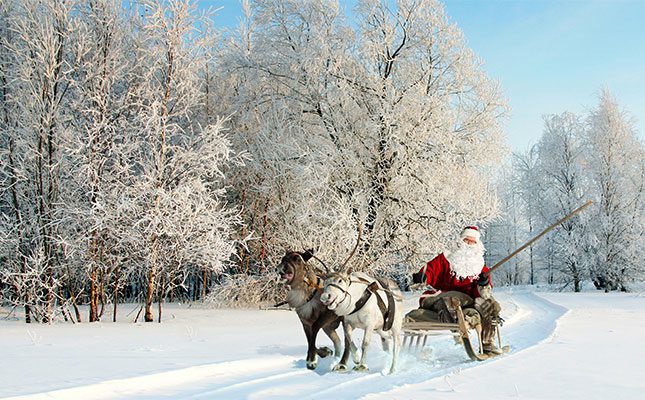
Father Christmas has to get around somehow. He has to travel right around the globe to do his thing, and what creature would be more appropriate than a reindeer? They are central to northern nomadic life and are known to seek out and eat fly agarics.
Observers noted their erratic, ‘dancing’ behaviour afterwards, appearing almost to ‘fly’. Shamans, after consuming the mushroom, often spoke of journeys through the sky, accompanied by animal spirits, which were frequently reindeer.
These symbolic links do not prove that Father Christmas derives directly from mushroom rituals, but the overlap is striking enough that many folklorists consider fly agaric one of the mythic ingredients in his story’s long evolution.
Christianity meets older traditions
Although for Christians, the core meaning of Christmas is deeply embedded in the birth of Jesus Christ, when Christianity moved into northern Europe, it encountered a deeply rooted winter holiday season based on solstice symbolism: light returning, the death and rebirth of the sun, and the mystical relationship between humans and the natural world.
During the Christmas festival, Christians celebrate God becoming human to bring love, hope, and salvation, though secular traditions like gift-giving and trees symbolise aspects like God’s gift and spiritual rebirth.
Rather than erase the pagan traditions, Christianity incorporated and reinterpreted many of them:
- Evergreen trees, once symbols of forest spirits, became Christmas trees.
- Midwinter feasts became Nativity celebrations.
- Folk figures connected to protection, generosity and magic gradually transformed into Saint Nicholas — and later, Santa Claus, or Father Christmas, as we know him.
Whether fly agaric played an explicit role in this transformation is debated, but its visual signature appears on 19th-century Christmas cards, in early European holiday decorations, and in Germanic and Scandinavian folklore.
In many Alpine and German Christmas villages today, wooden or ceramic red mushrooms are still placed beneath Christmas trees as symbols of good luck.
Did it ‘start’ Christmas? Probably not, but it shaped the imagery connected to Christmas celebrations. There is no single ‘origin’ of Christmas: it is a fusion of Christian theology, Roman festival culture (Saturnalia), Germanic Yule traditions, and northern European winter rituals.
While fly agaric did not create Christmas, it very likely influenced:
- Holiday imagery
- Early gift-giving rituals
- Symbolic associations with magic, transformation, and winter spirits
- Some folkloric details that fed into the Santa Claus mythos
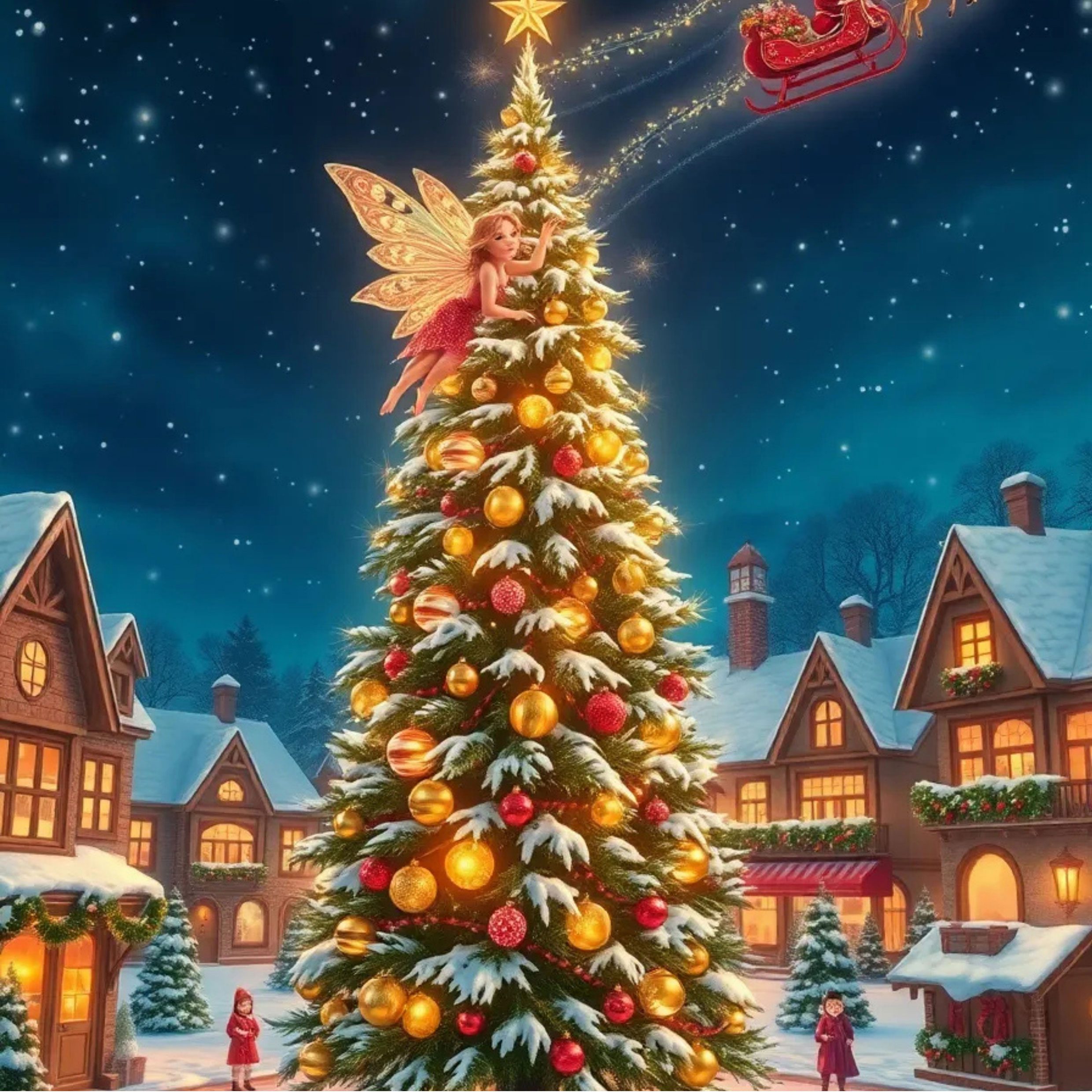
In short: the mushroom helped colour the imaginative world from which our modern Christmas emerged, especially through northern shamanic traditions. For thousands of years, humans have turned to the natural world – mushrooms, evergreens, reindeer, winter skies – to mark the turning of seasons and the renewal of life.
The fly agaric is more than a whimsical toadstool; it is a reminder that our celebrations are shaped by complex cultural layers: Christian, pagan, shamanic, agricultural, ecological. And perhaps that is part of the magic of Christmas; a holiday rooted not only in faith but also in forests, fungi, and the deep human desire for wonder in the darkest days of winter.
A mushroom of striking appearance and complex biology
Fly agaric is far from an ordinary mushroom. It belongs to the large genus Amanita, a group containing some of the most famous (and infamous) fungi of our forests.
The characteristic red cap flecked with white – the image that leaps to mind when one says ‘toadstool’ – comes from the red surface beneath a universal veil. When the mushroom first emerges from the soil, it appears like a white ‘egg’. Inside that egg, the entire young mushroom is enclosed by a membrane. As it grows, the veil breaks and leaves behind the little white patches on the red cap.
Depending on age and weather, the cap can range from 5cm to as much as 30 cm across. As the mushroom matures, the cap flattens out, sometimes fading in colour or losing some of the white warts. Under the cap are gills; the stalk is white (or pale yellowish), with a ring and base encased in a volva (another remnant of the universal veil).
Ecologically, A. muscaria is ectomycorrhizal, meaning it forms a symbiotic relationship with the roots of certain trees (most commonly pine, spruce, fir, oak, birch, and cedar). Through this partnership, the fungus helps its host tree absorb water and nutrients (especially nitrogen), while the tree provides it with sugars produced via photosynthesis. 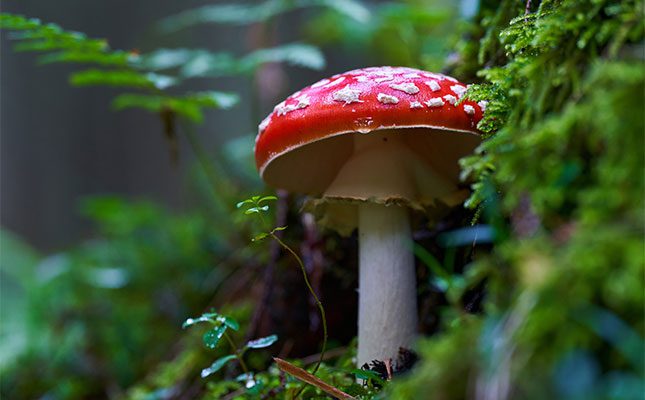
In fact, recent molecular studies suggest A. muscaria carries a high-affinity ammonium importer gene, meaning it can significantly enhance nitrogen uptake for its partner plants; an important ecological function, especially in poor soils.
Like many fungi, the mushroom you see above ground – the cap and stalk, or ‘fruiting body’ – represents only a small part of the organism. Underground lies an extensive network of mycelium that links trees and soil, cycling nutrients and contributing to forest health.
Originally, fly agaric was native to temperate and boreal woodlands of the Northern Hemisphere – Eurasia, North America, and parts of North Africa. However, thanks to the global movement of seedlings and planting of exotic trees, A. muscaria has been introduced to many parts of the Southern Hemisphere, including Australia, New Zealand, South America, and, indeed, South Africa.
Locally, there have been confirmed reports of the fly agaric fruiting in areas where pine plantations or exotic trees have been established. It has been observed in the Garden Route of the Western Cape, and occurs in combination with certain plants in gardens and even plantations.